
The Little Red Book (Quotations from Chairman Mao Zedong)
Short, portable compilation of Mao Zedong's quotations widely distributed in China during the 1960s–70s; influential as a political and cultural symbol during the Cultural Revolution.
The Little Red Book is the popular name for the collection officially titled Quotations from Chairman Mao Zedong, known in Chinese as 毛主席语录 and in pinyin as Máo zhǔxí yǔlù. Compiled from speeches, essays and recorded remarks, it presents selected statements attributed to Mao Zedong. A preface often associated with the volume was written by Lin Biao, a senior military leader who promoted the work in the 1960s.
Image gallery
5 Images
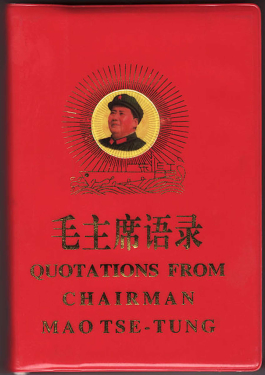


Physical form and contents
The book was issued in a small, red-covered paperback designed for easy handling and everyday use; editions were deliberately compact and portable, which led to the informal name and the visual association with its red binding (pocket format). Contents vary between editions but typically group quotations by theme—politics, war, class struggle, and mass mobilization—and often include brief editorial notes or an index.
Publication history
The work began to appear in the mid-1960s and was widely printed and distributed by state and party organs, including publications tied to the armed forces such as the military newspaper often cited in accounts of the period (People's Liberation Army Daily). Its circulation expanded rapidly during the Cultural Revolution (1966–1976) as part of mass political education campaigns.
Uses and influence
During its peak, the book was used in study sessions, public gatherings, and as a symbol of political loyalty. It functioned as both a practical handbook for party activists and a talismanic object carried by civilians and soldiers. Internationally, translations and reprints appeared in a number of languages, contributing to its global recognition as a symbol of Maoist thought.
Legacy and notable facts
After the end of the Cultural Revolution and Mao's death, the book's prominence declined as political priorities shifted. Historians and commentators emphasize its role in fostering a leader-centered political culture and its function as an instrument of mass mobilization, while noting that multiple versions and editorial practices mean that exact contents and emphases differed between printings.
Further reading
- For primary text references, consult editions and translations of Quotations from Chairman Mao Zedong.
- Contemporary accounts and military publications provide context for its distribution (see People's Liberation Army Daily and related sources).
- Biographical and historical studies explore the role of figures such as Lin Biao and the wider impact of Mao Zedong's thought.
Related articles
Author
AlegsaOnline.com The Little Red Book (Quotations from Chairman Mao Zedong) Leandro Alegsa
URL: https://en.alegsaonline.com/art/98364