
The Hunchback of Notre Dame (1939 film)
1939 RKO adaptation of Victor Hugo's novel directed by William Dieterle, starring Charles Laughton and Maureen O'Sullivan; noted for its central performance, studio-era spectacle, and condensation of Hugo's themes.
The Hunchback of Notre Dame (1939) is a Hollywood screen adaptation of Victor Hugo's 19th-century novel produced by RKO and directed by William Dieterle. Set around the great cathedral of Notre Dame in Paris, the film centers on the deformed bell-ringer Quasimodo and the tragic entanglements that drive its dramatic arc. It translates Hugo's sprawling narrative into a focused studio feature that emphasizes character and atmosphere.
The picture is led by Charles Laughton as Quasimodo and Maureen O'Sullivan as Esmeralda. Laughton received wide attention for the depth and sympathy he brought to the role, while O'Sullivan portrayed the young Romani woman whose fate motivates much of the plot. Director Dieterle and the production team used expansive sets, costumes and makeup to create a convincing period milieu within the constraints of studio filmmaking.
As an adaptation of Victor Hugo's novel, the film condenses many subplots and political commentaries present in the book. Screenwriters streamlined relationships and events to fit a single feature-length format, retaining the emotional core—Quasimodo's isolation, devotion, and the cathedral as a central symbol—while simplifying some of Hugo's broader social critique.
Technically, the production relied on large interior sets and makeup effects to evoke medieval Paris and the cathedral's interior spaces. Lighting, framing and set decoration were used deliberately to create a gothic mood: contrasts between sunlit public squares and shadowed church interiors reinforce themes of visible vice and hidden compassion. The film is often discussed alongside earlier and later adaptations for its studio-era approach to literary material.
Image gallery
2 Images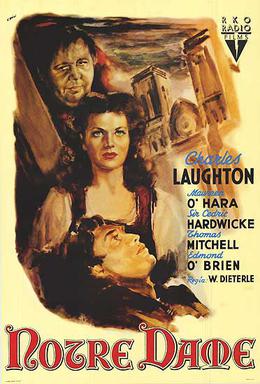

Reception and notable aspects
Contemporary critics highlighted Laughton's performance and the film's visual ambition; some viewers and scholars have noted that the narrative compression changes the novel's emphasis. Over time the 1939 version has been viewed both as a product of the classical studio system and as a distinct interpretive reading of Hugo's story.
- Performance: Laughton's sympathetic Quasimodo is the film's central strength.
- Design: Sets and makeup create the film's gothic atmosphere.
- Adaptation: The novel's political and social layers are reduced to focus on personal drama.
- Legacy: The movie remains one among several major screen adaptations and is compared frequently with silent and later versions.
Today the 1939 film is studied both for its place in adaptation history and for how studio-era cinema reshaped classic literature for mass audiences. For further information and archival materials consult studio histories, film criticism, and editions of Hugo's work that explore how the novel has been interpreted across media.
Related articles
Author
AlegsaOnline.com The Hunchback of Notre Dame (1939 film) Leandro Alegsa
URL: https://en.alegsaonline.com/art/98177