
Binary number (base‑2) — definition, structure, history, and uses
The binary numeral system (base‑2) uses two digits, 0 and 1. This article explains its positional structure, historical development, conversion examples, and its central role in computing and digital systems.
Overview
The binary numeral system is a positional notation that represents numbers using only two symbols: 0 and 1. Because each digit can take two possible values, binary is called base‑2. The system is the foundation of modern digital electronics and computer architecture, where binary digits correspond to two physical states commonly understood as "off" and "on". For a general introduction to the topic see binary numbers.
Image gallery
5 Images

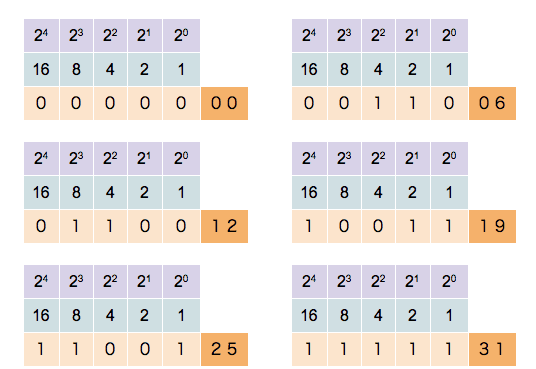


Structure and place values
Binary numbers are written with digits called bits. In a positional base‑2 system, the rightmost bit has place value 2^0 = 1, the next bit to the left has value 2^1 = 2, then 2^2 = 4, and so on. To find the integer value of a finite binary string, multiply each bit by its place value and add the results. For example, the binary string 10110011 expands as follows:
- 1 × 2^7 = 128
- 0 × 2^6 = 0
- 1 × 2^5 = 32
- 1 × 2^4 = 16
- 0 × 2^3 = 0
- 0 × 2^2 = 0
- 1 × 2^1 = 2
- 1 × 2^0 = 1
Summing those values yields 128 + 32 + 16 + 2 + 1 = 179 in decimal. For readability, bits are often grouped into nibbles (4 bits) and bytes (8 bits). The example 10110011 can be shown as 1011 0011; each nibble maps directly to a hexadecimal digit, so that grouping becomes 0xB3. For background on place‑value ideas see place value, and for how binary represents data in hardware see computers.
History and development
The idea of representing information with two states has ancient analogues, and a positional base‑2 system was formalized in Western mathematics in the early modern period. Gottfried Wilhelm Leibniz is widely credited with developing and promoting the modern binary notation in the 17th century, linking it to symbolic logic. Later formal connections between binary arithmetic and Boolean algebra helped make binary the natural language of electronic switching and computing devices.
Uses, examples and importance
Binary is used in many layers of computing: at the physical level (transistors, magnetic domains, optical pulses), in data storage (bits and bytes), in instruction encoding for processors, and in communication protocols. Common operations carried out in binary include addition, subtraction (often via two's complement for signed values), bitwise logical operations (AND, OR, XOR, NOT), and shifts. Because of its simplicity, binary enables reliable hardware design and efficient error‑detection and correction techniques.
Common units and representations
- Bit: single binary digit, 0 or 1.
- Nibble: group of 4 bits, often written for clarity when converting to hexadecimal.
- Byte: group of 8 bits; a basic addressable unit in many computer systems — see byte.
- Word: architecture‑dependent group of bits (e.g., 16, 32, 64 bits).
Notable facts and distinctions
Binary differs from decimal (base‑10) in its radix and the number of symbols used. While humans commonly use decimal, binary is better suited to devices that implement two stable physical states. Hexadecimal and octal notations are compact, human‑friendly ways to represent binary data by grouping bits (4 and 3 bits per digit, respectively). When studying binary it is also useful to learn common conversions, signed number encodings (such as two's complement), and basic bitwise operations, because these concepts recur in programming, networking, and hardware design. For deeper reading on practical implementations and standards in computing hardware consult authoritative technical sources and specifications available through educational and industry channels such as computer science references.
Related articles
Author
AlegsaOnline.com Binary number (base‑2) — definition, structure, history, and uses Leandro Alegsa
URL: https://en.alegsaonline.com/art/11583