
The Genetical Theory of Natural Selection
R. A. Fisher's 1930 book that integrated Mendelian genetics with Darwinian natural selection, advancing population genetics and shaping the modern evolutionary synthesis.
Overview
The Genetical Theory of Natural Selection is a landmark scientific book by Ronald A. Fisher, first published in 1930 by Oxford University Press. Fisher set out to reconcile Mendelian inheritance with Charles Darwin's ideas about evolution through natural selection by developing a quantitative framework for how genes affect population change.
Image gallery
4 Images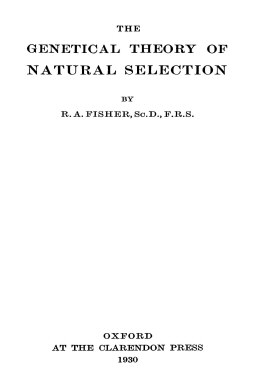


Key concepts and contributions
Fisher introduced mathematical treatments of selection, variation, and inheritance that helped turn qualitative evolutionary ideas into a theory amenable to statistical and genetic analysis. One of his best known contributions is a formal claim, often called the fundamental theorem of natural selection, which links changes in mean fitness to genetic variance. The book also addresses sexual selection, dominance, and the role of chance in evolution.
Structure and contents
The work combines conceptual chapters with detailed quantitative sections. It moves from broad evolutionary questions to specific genetic mechanisms and includes discussion of empirical phenomena such as mimicry and geographic variation. Major themes include the causes of adaptation, the maintenance of genetic variation, and the mathematics of change in gene frequencies.
Historical context and development
Fisher wrote at a time when Mendelian genetics and the biometric tradition appeared to conflict. By applying statistics and population thinking, he helped create a synthesis that united diverse observations under a common theoretical umbrella. His approach influenced contemporaries and later generations who developed population genetics as a central pillar of evolutionary biology.
Uses, influence, and notable facts
- The book played a central role in the emergence of the modern evolutionary synthesis, shaping how researchers model adaptation and genetic variation.
- Fisher's methods helped spur advances in statistical genetics and evolutionary theory, and his ideas remain part of foundational discussions in the field.
- Some parts, notably interpretations of the fundamental theorem, generated debate and subsequent clarification as the field matured.
Further reading
For historical background on Darwin see Darwin, for discussions of selection see natural selection, and for the broader synthesis of genetics and evolution see literature on the modern evolutionary synthesis. Fisher's book is still cited as a foundational source in evolutionary biology and the study of population genetics.
Questions and answers
Q: Who is the author of The Genetical Theory of Natural Selection?
A: The author of The Genetical Theory of Natural Selection is R.A. Fisher.
Q: When was The Genetical Theory of Natural Selection first published?
A: The Genetical Theory of Natural Selection was first published in 1930.
Q: Which two theories does The Genetical Theory of Natural Selection combine?
A: The Genetical Theory of Natural Selection combines Mendelian genetics with Charles Darwin's theory of natural selection.
Q: For which university press was The Genetical Theory of Natural Selection first published?
A: The Genetical Theory of Natural Selection was first published by Oxford University Press.
Q: Is The Genetical Theory of Natural Selection considered an important book?
A: Yes, The Genetical Theory of Natural Selection is considered one of the most important books of the modern evolutionary synthesis.
Q: What is the subject of The Genetical Theory of Natural Selection?
A: The subject of The Genetical Theory of Natural Selection is the combination of Mendelian genetics with Charles Darwin's theory of natural selection.
Q: What is the significance of The Genetical Theory of Natural Selection?
A: The Genetical Theory of Natural Selection is significant because it is one of the most important books of the modern evolutionary synthesis.
Related articles
Author
AlegsaOnline.com The Genetical Theory of Natural Selection Leandro Alegsa
URL: https://en.alegsaonline.com/art/98044
Sources
- genetics.org : genetics.org/content/154/4/1419.full
- users.ox.ac.uk : 'William Donald Hamilton’