
The Firm (1989 film)
A 1989 British television drama directed by Alan Clarke about football hooliganism and the Inter City Firm; noted for Gary Oldman's performance and its stark, documentary-like style.
The Firm is a 1989 British made-for-television drama directed by Alan Clarke and written by Al Hunter Ashton for the BBC. The screenplay draws on the culture and incidents associated with the Inter City Firm, a notorious group linked to West Ham United during the 1970s and 1980s, but presents a fictionalised set of characters and episodes rather than a documentary account. From its release the film provoked debate for its unflinching depiction of street violence while also earning lasting recognition as one of the most powerful films dealing with football hooliganism.
Image gallery
1 Image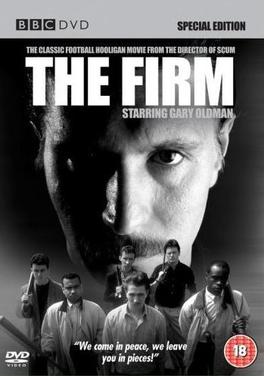
Plot and principal characters
The narrative follows a small circle of young men who travel to away matches and clash with rival supporters. The film concentrates on group dynamics and rites of passage rather than a single conventional protagonist’s arc, portraying how camaraderie, boredom, territorial identity and the search for reputation combine to foster violent behaviour. Gary Oldman plays a central role, supported by Phil Davis, Charles Lawson and Steve McFadden, in performances often described as raw and convincing.
Production, style and sound
Alan Clarke was known for a direct, austere filmmaking style; in The Firm he favoured handheld camerawork, tight observational sequences and long takes that give scenes a documentary immediacy. The film is notable for its near-total absence of background music: the only song used is Dean Martin’s rendition of "That’s Amore" over the opening titles, a choice that underlines the ironic distance between everyday life and the violent episodes shown. The script combines invented dialogue with realistic detail to evoke the period and subculture in which the action unfolds.
Historical context
Set against a backdrop of rising concerns about football-related disorder in Britain, the film reflects social anxieties of the late 20th century: economic stagnation, shifting male identities and urban territorialism. While it takes inspiration from the activities of the Inter City Firm linked to West Ham United, the film does not attempt a journalistic reconstruction and instead uses the subject as a prism to explore causes and consequences of group violence.
Reception and legacy
On first broadcast the film courted controversy for its frank depictions of fights and the lives of those who took part in them. Critics and scholars have since often cited it as a seminal screen portrayal of hooligan culture, praising both Clarke’s direction and the performances—Gary Oldman’s work in particular is frequently singled out as one of his early career highlights. The film has influenced later cinematic and television treatments of football violence and is still referenced in discussions about media representation of anti-social behaviour.
Notable cast and references
- Gary Oldman — central performance often singled out by reviewers
- Al Hunter Ashton — credited screenwriter
- The Firm (1989) — production entry and basic credits
- BBC — broadcaster and producer of the television drama
- West Ham United — club whose supporter firm inspired the story
- Dean Martin — performer of the single song used in the opening titles
Seen today, The Firm endures as a stark, tightly focused work: less a sensationalist chronicle than a character-driven study of how group loyalty and cultural pressures can escalate into repeated violence. It remains a frequently cited reference point for filmmakers and writers addressing football-related disorder and youth subcultures in modern Britain.
Questions and answers
Q: What is The Firm?
A: The Firm is a 1989 British made-for-television drama movie directed by Alan Clarke, based on the activities of the Inter City Firm, a football firm of West Ham United during the 1970s and 1980s.
Q: Who directed The Firm?
A: The Firm was directed by Alan Clarke.
Q: Who wrote The Firm?
A: The Firm was written by Al Hunter Ashton for the BBC.
Q: Who stars in The Firm?
A: The Firm stars Gary Oldman, Phil Davis, Charles Lawson and Steve McFadden.
Q: What controversy did The Firm court on release?
A: The Firm courted controversy on release.
Q: Why is The Firm notable?
A: The Firm is notable for having almost no background music and for being regarded among the best films on the subject of football hooliganism.
Q: Whose performance in The Firm has been hailed as one of the greatest of his career?
A: Gary Oldman's performance in The Firm has been hailed as one of the greatest of his career.
Related articles
Author
AlegsaOnline.com The Firm (1989 film) Leandro Alegsa
URL: https://en.alegsaonline.com/art/97983
Sources
- ftvdb.bfi.org.uk : "Screen Two: The Firm: TV Transmission"
- hollywoodreporter.com : "Critic's Picks: Gary Oldman's 10 Best Performances"
- allmovie.com : The Firm · web.archive.org
- film.list.co.uk : The Firm review
- vice.com : "Remembering Alan Clarke"
- theguardian.com : The Firm · web.archive.org
- bfi.org.uk : "Gary Oldman: 10 essential films"
- thenational.ae : "Five of the best football films"