
The Fox and the Grapes — Aesop's Fable and the Origin of 'Sour Grapes'
A concise account of Aesop's fable about a fox and unreachable grapes, its themes of rationalization and cognitive dissonance, historical context, cultural impact and the idiom "sour grapes."
Overview
The Fox and the Grapes is one of the short moral tales attributed to Aesop. In the simplest version, a hungry fox sees a cluster of grapes hanging from a high vine. After several attempts to reach them he fails, then declares that the grapes are sour and not worth having. The story is economical in plot but rich in implication.
Image gallery
5 Images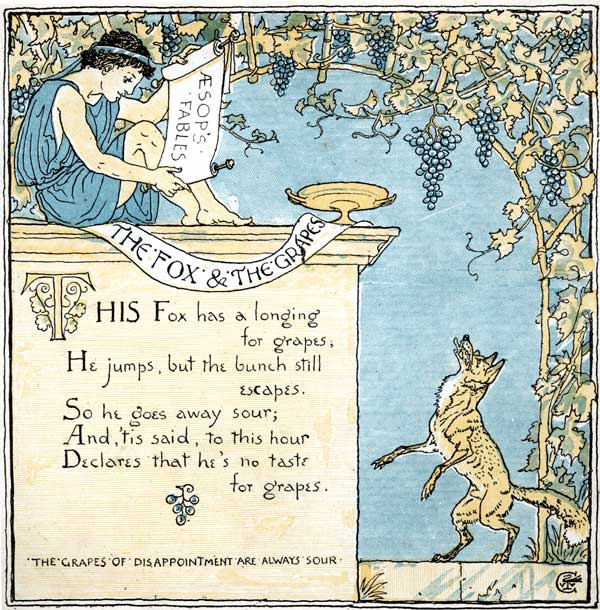



Themes and interpretation
The fable is commonly interpreted as an illustration of human tendency to devalue what one cannot obtain. Modern readers and scholars connect it to the psychological idea of cognitive dissonance, where people change their attitudes to reduce discomfort when reality conflicts with desires. From this comes the familiar moral about rationalization and self-justification.
Historical background
Versions of this brief tale have circulated for centuries in collections of Aesop's fables and in later retellings. Its form—an animal protagonist, a small but telling action, and an explicit moral—fits the oral and didactic traditions that preserved Aesop's work. Translators and commentators in different languages helped the story spread across Europe and beyond.
Cultural impact and the idiom
The phrase "sour grapes" entered common usage in many languages as a metaphor for disparaging what one cannot have. In English it appears in ordinary speech, literature and critical commentary to describe dismissive rationalizations. The simplicity of the tale makes it a convenient shorthand for a familiar psychological reaction.
Variants, uses and notable facts
There are many brief variants that alter details—how the fox tries, whether other animals comment, or the explicitness of the moral—but the core lesson remains. Educators use the fable to teach ethics and critical thinking; psychologists cite it when explaining bias and self-deception. Its economy also makes it a popular subject for illustrations, theatrical sketches and children's books.
Common lessons and modern relevance
- Self-awareness: Recognize when disappointment leads to unfair dismissal of a goal.
- Critical thinking: Examine whether negative judgments arise from evidence or from failed attempts.
- Language and metaphor: How a short story can seed idioms that last centuries.
As a compact fable, The Fox and the Grapes continues to be a touchstone for conversations about desire, failure and the ways people protect self-esteem. Its endurance lies in the clarity of the scenario and the ease with which the moral can be applied to everyday life.
Further reading and collections of Aesop's tales, modern psychological summaries, and illustrated retellings are widely available for readers who want to explore the tale's variants and uses in education and culture.
For concise references on this fable and its interpretations, see collections of fables and entries on related psychological concepts such as cognitive dissonance and discussions of language about judgment and desire.
Related topics and broader collections can be found in general compendia of fables and folklore studies (fable collections, Aesop studies), and in articles that examine how animal characters like the fox function as moral agents in short tales.
Questions and answers
Q: What is the fable "The Fox and the Grapes" about?
A: "The Fox and the Grapes" is a fable by Aesop that tells the story of a fox who sees some grapes hanging high on a vine, but he is unable to reach them.
Q: Why can't the fox reach the grapes?
A: The fox is unable to reach the grapes because they are hanging high on a vine.
Q: What does the fox tell himself when he's unable to get the grapes?
A: When he's unable to get the grapes, the fox tells himself that the grapes are probably sour anyway.
Q: What idea does the fable "The Fox and the Grapes" demonstrate?
A: The fable "The Fox and the Grapes" demonstrates the idea of cognitive dissonance.
Q: What does the English expression "sour grapes" come from?
A: The English expression "sour grapes" comes from the fable "The Fox and the Grapes."
Q: What does the English expression "sour grapes" mean?
A: The English expression "sour grapes" means to criticize something that you cannot have.
Q: Why is "The Fox and the Grapes" considered a fable?
A: "The Fox and the Grapes" is considered a fable because it teaches a moral lesson through the use of animal characters and a simple story.
Related articles
Author
AlegsaOnline.com The Fox and the Grapes — Aesop's Fable and the Origin of 'Sour Grapes' Leandro Alegsa
URL: https://en.alegsaonline.com/art/98009
Sources
- books.google.com : Fables ancient and modern, adapted for the use of children by Edward Baldwin