
The Cat in the Hat
Encyclopedic overview of Dr. Seuss's 1957 children's book The Cat in the Hat: origins, characters, publication, translations, adaptations, educational uses and cultural legacy.
Overview
The Cat in the Hat is a children's picture book first published in 1957 by Theodor Seuss Geisel, known as Dr. Seuss. The story follows a tall, mischievous anthropomorphic cat who appears at the house of two children on a rainy day and introduces a series of playful and disorderly events. Written in energetic rhyming verse and illustrated in Dr. Seuss's distinctive graphic style, the book was created to appeal to beginning readers and has become a staple of 20th-century children's literature. For information about the original editions and publishing history see original edition information, and for background on the author see Dr. Seuss biographies.
Image gallery
9 Images





Creation and publication
The book originated from a mid-1950s effort to produce an entertaining, accessible reading primer. Geisel accepted a challenge to write a compelling story using a limited vocabulary drawn from a list of high-frequency words intended for beginning readers. Accounts of the project note that he worked within a constrained word list and produced a narrative that balanced simplicity of vocabulary with lively rhythm and invention. For context about the reading-list challenge and its influence on early-reader publishing see reading-list background. The title sold widely after publication and has been reprinted in many editions worldwide.
Characters and structure
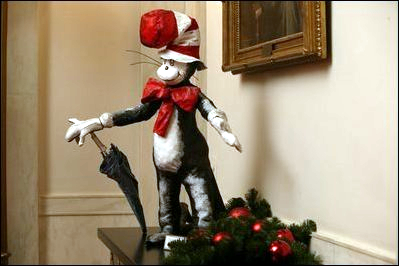
The central figure is the Cat, immediately recognizable by his tall striped hat and bow tie. He brings with him a mixture of charm and chaos. Supporting characters include the fish, who serves as the household's voice of conscience and caution, and Thing One and Thing Two, impish helpers who create escalating mayhem. The book's structure relies on short scenes, repeated motifs and brisk rhymes, which together promote decoding and oral reading. Illustrations are integral: bold lines and limited color palette emphasize action and make the page lively for young readers.
Translations, spin-offs and educational use
The Cat in the Hat has been translated into many languages, demonstrating broad international appeal. Notable translated editions include versions produced for less commonly represented languages, illustrating the title's adaptability across cultural contexts; see general translation listings at translation overview, and specific mentions of the Latin edition at Latin translation and a Yiddish edition at Yiddish edition. In 1998 the character was used to launch an educational spin-off, The Cat in the Hat's Learning Library, a series of nonfiction picture books that introduce basic science and social studies topics to young readers by pairing simple text with familiar characters.
Adaptations and media
- Television and specials: The story and character have been adapted for television in animated and puppet formats; a number of televised productions and educational programs have used the Cat as a presenter or protagonist. See a representative television adaptation reference at television special.
- Feature film: A live-action film adaptation was released in 2003, bringing the Cat into a feature-length narrative and attracting attention from mainstream film critics; further details are discussed in film and media commentary at 2003 film.
- Stage and musicals: The Cat appears among the ensemble of characters in the musical Seussical, a stage work that interweaves plots and characters from multiple Dr. Seuss books; more on the stage adaptation is available at Seussical (Broadway).
Reception and legacy
The book has been both celebrated and debated. Supporters praise its energetic language, strong visual design and effectiveness as an early-reader text that made reading pleasurable for many children. Critics and commentators have at times questioned the behavior modeled by the Cat or disagreed with particular adaptations, but the work's influence on publishing, literacy education and popular culture is widely acknowledged. Educators continue to reference the book in discussions about phonics, sight words and how to balance pedagogical aims with engaging storytelling. Over decades of reprints, anthologies and classroom use, The Cat in the Hat has remained an enduring example of how constrained vocabulary, playful rhyme and expressive illustration can together support emergent literacy while leaving a lasting cultural imprint.
Related articles
Author
AlegsaOnline.com The Cat in the Hat Leandro Alegsa
URL: https://en.alegsaonline.com/art/97741