
The Boring Company
An American infrastructure and tunneling company founded by Elon Musk in 2016, focused on building underground transport tunnels and related technologies to reduce urban traffic congestion.
The Boring Company is an American infrastructure and tunnel development company founded by entrepreneur Elon Musk. Announced in December 2016, the venture grew from Musk's long-standing interest in alleviating urban traffic and exploring high-speed subterranean transport. The firm concentrates on designing and constructing tunnels for short-range transit and freight, and on systems commonly described as "Loop" or Hyperloop-compatible corridors. It traces organizational roots to Musk's earlier aerospace work with SpaceX and a public call to action about surface congestion and mobility.
Image gallery
7 Images

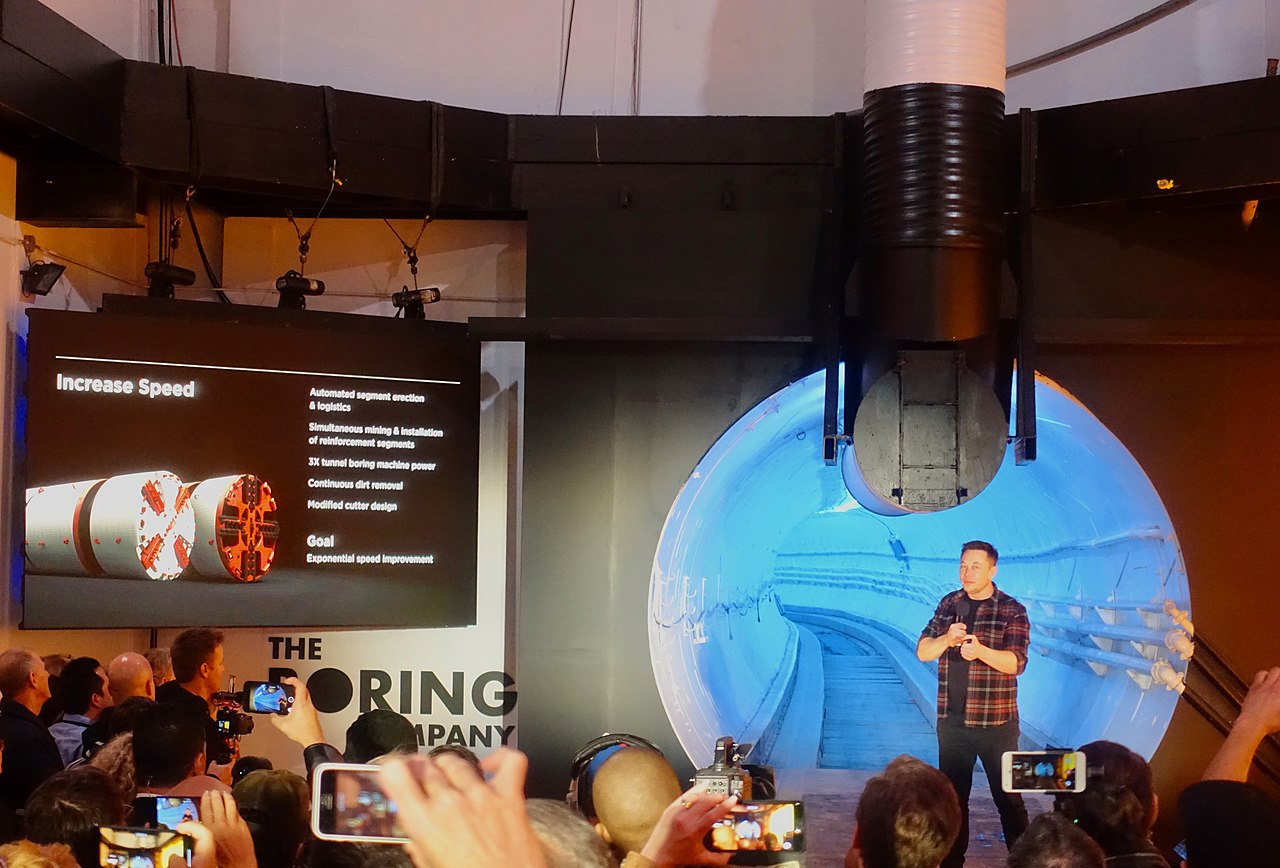


History and origins
The company was formed soon after Musk publicly complained about traffic, and it quickly moved to build experimental infrastructure such as a short test tunnel. Early activities included private research and pilot construction in the Los Angeles area and proposals for other cities. The Boring Company later pursued commercial projects, including a people-mover system at a major convention center and exploratory tunneling for urban transport. Its public profile combined engineering demonstration projects with unconventional fundraising and marketing approaches.
Goals, concepts and technology
At its core, the enterprise applies tunnel-boring techniques to create low-cost underground corridors intended to reduce surface congestion and speed transit. The firm develops modifications to tunnel-boring machines, tunnel lining practices and vehicle-sled concepts that would allow electric vehicles or autonomous pods to travel in a controlled subterranean environment. Proposals range from local "Loop" shuttles for short commutes to concepts that interface with high-speed Hyperloop ideas; critics and supporters alike emphasize the potential to reconfigure urban mobility while noting the technical and regulatory hurdles involved. For background on the general tunneling process see tunnel boring.
Funding, merchandise and public image
In addition to pursuing contracts and private financing, the company raised attention and capital by selling branded merchandise. Early items included caps and novelty products, and one notably marketed item carried the label "Not a flamethrower" to address customs concerns; this unusual campaign attracted media attention and generated revenue. The company also offered complementary accessories such as themed fire extinguishers, sometimes described on its storefront with tongue-in-cheek language. These sales were both fundraising and public-relations gestures that helped the firm maintain a high public profile.
Notable projects, criticisms and challenges
Among its recognizable achievements is the construction of demonstration tunnels and a public-facing loop system at a major convention center, which provided a real-world test of short-haul subterranean transit. Observers have praised the ambition and speed of prototype work but have raised questions about scalability, long-term costs, permitting, and safety. Regulatory approvals, utility relocation, and urban planning constraints are recurrent challenges. The company's approach continues to be scrutinized and debated in engineering and municipal circles as cities evaluate whether deep networks of small tunnels are preferable to traditional mass-transit investments.
Importance and distinctions
The Boring Company occupies a distinctive place at the intersection of private-venture infrastructure and public transit debate. Its combination of rapid prototyping, publicity-driven fundraising, and focus on a specific niche of short-distance subterranean transport sets it apart from conventional civil engineering firms. Whether its methods will be adopted widely depends on economic feasibility, regulatory outcomes and comparative performance against alternative mobility solutions. For discussions about urban congestion and transport alternatives see traffic congestion.
- Founder and public face: Elon Musk — connected to SpaceX.
- Early publicity: sale of branded items, including a product labeled via marketing as "Not a flamethrower" and related accessories described humorously on the company site.
- Demonstrations: test tunnel work in Los Angeles and a convention-center loop project.
- Regulatory note: some marketing choices referenced customs considerations when labeling items for shipment.
Related articles
Author
AlegsaOnline.com The Boring Company Leandro Alegsa
URL: https://en.alegsaonline.com/art/97662
Sources
- crunchbase.com : "The Boring Company - Crunchbase" · web.archive.org