
Tabulating machine
An electromechanical device that read punched cards to count and classify data, pioneered by Herman Hollerith for the 1890 U.S. census and foundational to modern data processing.
Overview
The tabulating machine is an electromechanical device designed to read, count and sort information encoded on punched cards. It is most widely known for its role in processing the 1890 census of the United States, where an inventor named Herman Hollerith applied the idea of using holes in paper cards to represent categorical data. The term can refer both to Hollerith's original apparatus and to later machines that performed similar operations for business and government data.
Image gallery
6 Images


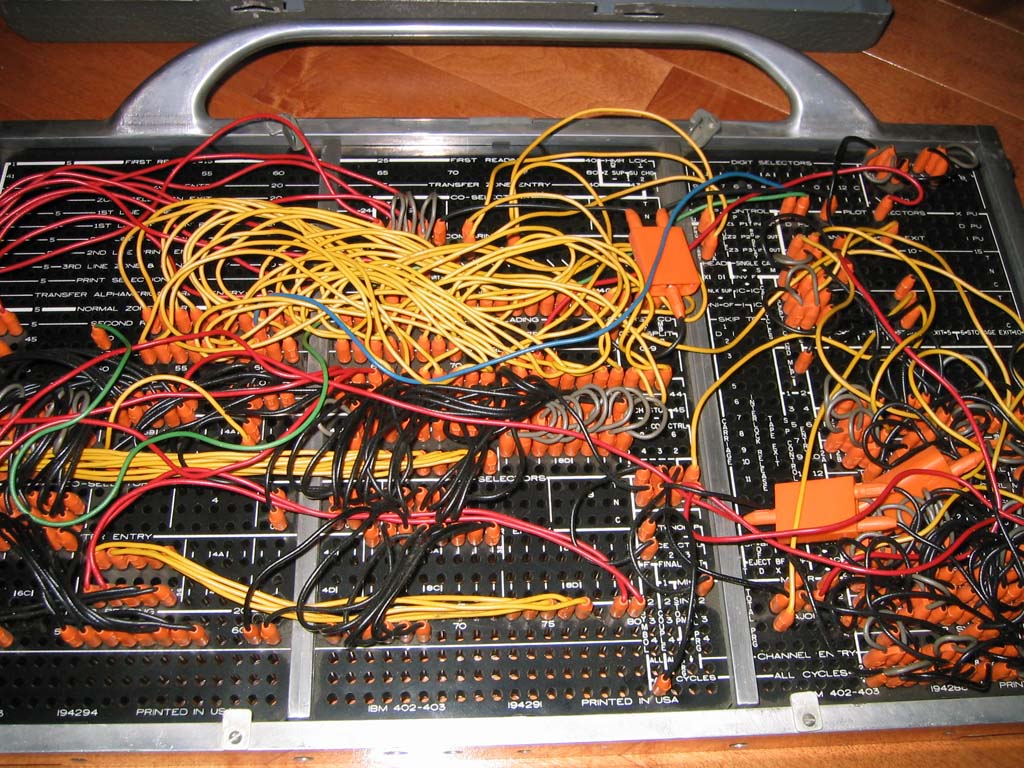
Design and characteristics
Tabulating machines worked by detecting the presence or absence of holes at predefined positions on a card. A mechanical or electrical sensing system completed circuits through those holes to increment counters, print results, or direct cards into different bins. Typical components included:
- Card reader or sensing head
- Mechanical or electrical counters and accumulators
- Sorters and control mechanisms
- Punch and keypunch devices to encode information
This combination allowed large volumes of categorical data to be summarized far more quickly than manual tabulation.
History and development
Hollerith developed his tabulating approach after observing that earlier censuses required extremely long periods of manual counting. His machines used a standardized punched card format and an electromechanical reader to automate classification and tallying. The success of that system for the 1890 census led to wider adoption by commercial enterprises and government agencies. Hollerith's business ventures grew into companies that later contributed to the formation of larger data-processing firms in the early 20th century.
Uses and legacy
Initially employed for national censuses, tabulating machines spread to banking, insurance, manufacturing and transportation for tasks such as payroll, inventory and statistics. They are an early step in the history of automated information processing and helped define the punched-card medium that dominated data handling for decades. Modern electronic computers ultimately supplanted tabulators, but the underlying ideas of coded records and automated counting persisted.
Notable distinctions and references
Tabulating machines differ from simple adding machines or calculators by their ability to read encoded records and perform classification and sorting as well as arithmetic. They are often cited in accounts of computing history as a bridge between manual recordkeeping and programmable machines. For more context on related topics, see resources on generic machines, the 1890 census (census) project, the inventor Herman Hollerith and the punched-card medium (punched cards). Additional background material is available through historic overviews and specialized histories of business data processing (machines, 1890, United States).
While later technologies removed many mechanical elements, the tabulating machine's role in standardizing data formats and automating repetitive classification remains an important milestone in the evolution of computing.
Related articles
Author
AlegsaOnline.com Tabulating machine Leandro Alegsa
URL: https://en.alegsaonline.com/art/95815