
Superposition Principle
The superposition principle: in linear systems, the total response equals the sum of individual responses. Applies broadly to waves, circuits, and electrostatics; limited or altered in nonlinear and quantum contexts.
The superposition principle is a fundamental idea in physics and engineering that applies wherever underlying relations are linear. In plain terms it says that when multiple influences act on a system, the resulting effect is the sum of the effects produced by each influence acting alone. This statement can be expressed operationally: if a system's behavior is described by a linear operator L, then L(au + bv) = aL(u) + bL(v) for arbitrary scalars a, b and states u, v. The principle provides a unifying way to analyze fields, waves, circuits and other phenomena where linear approximations hold.
Image gallery
5 Images

Key characteristics
Superposition depends on linearity: it requires that the governing equations do not include products or other nonlinear combinations of the unknowns. When linearity holds, responses scale proportionally and add without mutual modification. Important practical consequences follow: solutions can be built from simpler solutions, complex inputs can be decomposed into basic components, and standard techniques such as Fourier analysis and Green's functions become available. For a concise discussion of the ideal mathematical setting see linear systems.
Common examples and applications
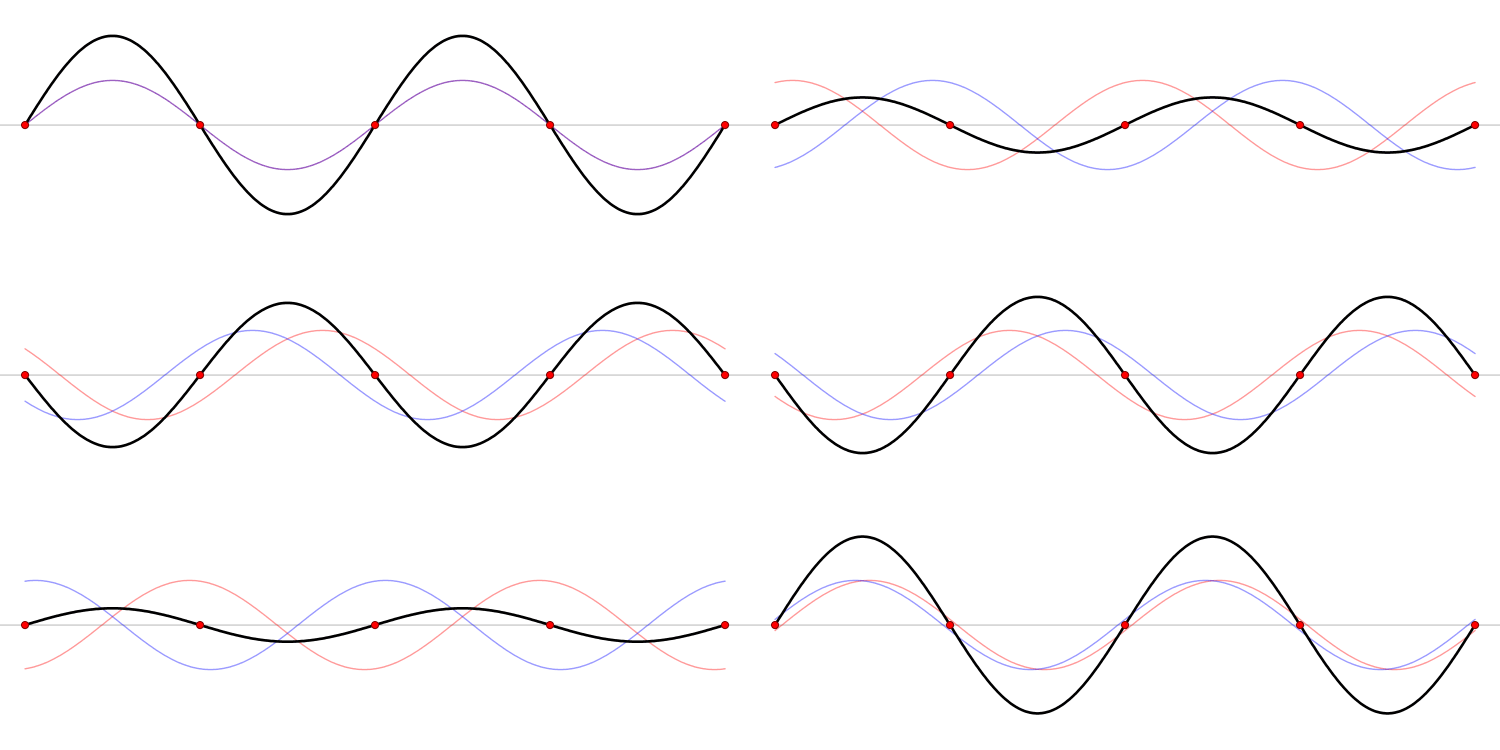
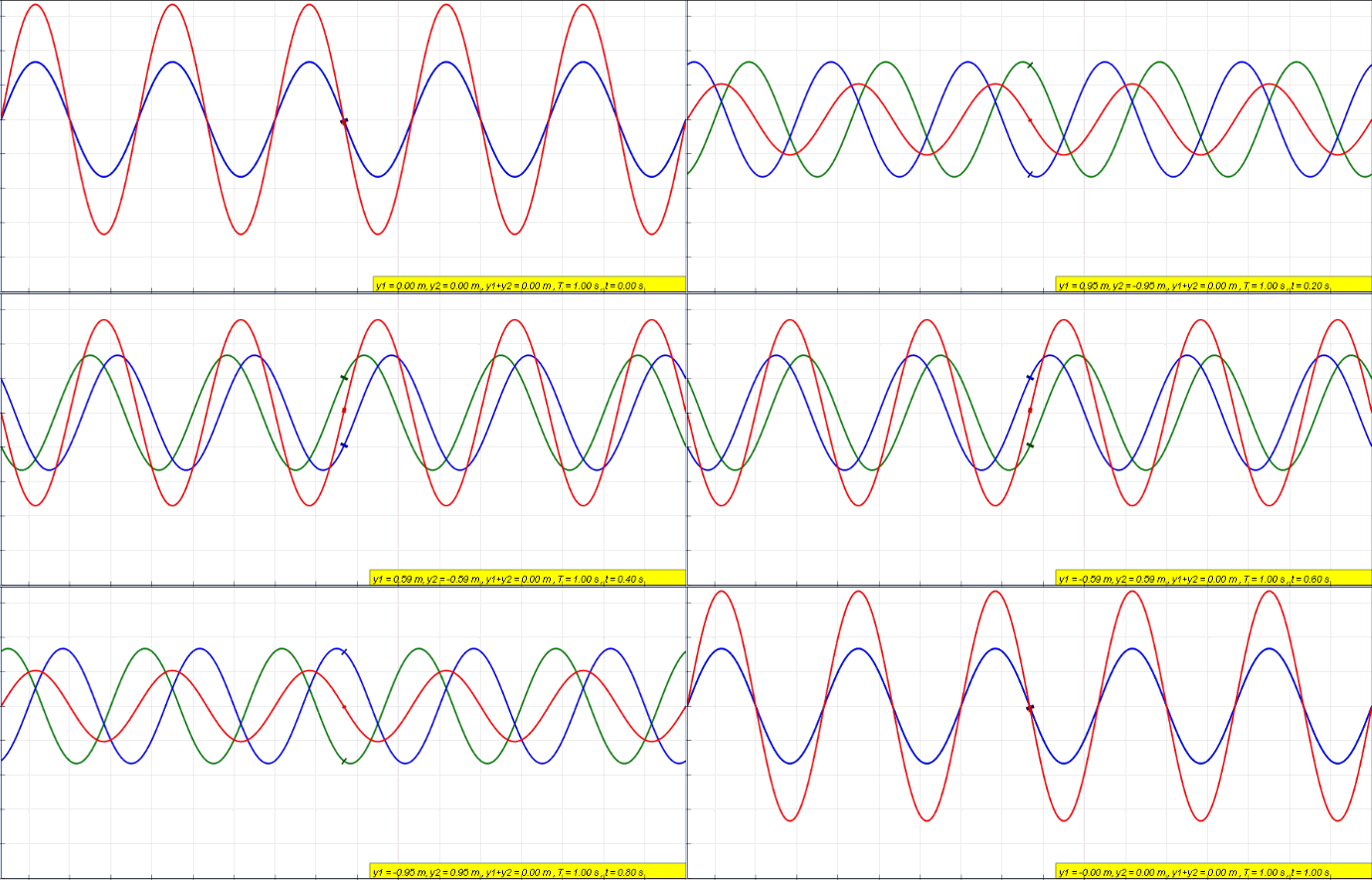
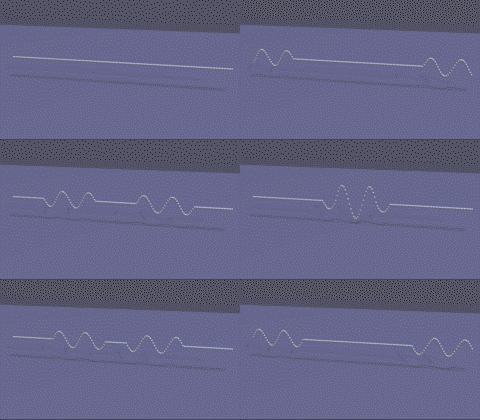
- Waves: In acoustics, water waves and electromagnetic waves, multiple waveforms pass through each other and the instantaneous displacement or field is the vector or algebraic sum of individual wave contributions.
- Electrostatics: The electric force on a charge equals the vector sum of forces due to each other charge, each computed from Coulomb's law. This additive property greatly simplifies field calculations for many-charge configurations.
- Electrical circuits: In networks governed by linear circuit elements (resistors, capacitors, inductors under linear conditions), voltages and currents from independent sources can be superposed; this is the basis of the superposition theorem used in circuit analysis.
- Structural mechanics: For small deformations, displacements and stresses in beams and plates add when loads are superposed, enabling modular design and analysis.
History and development
The idea of combining effects appears early in the study of oscillations and optics. Over the 18th and 19th centuries, it became formalized as differential equations and linear operators were developed. The language of superposition evolved alongside mathematical tools such as Fourier series and linear algebra that made decomposition and recombination of solutions systematic. For overviews linking physical examples to the mathematics see historical and mathematical accounts.
Limitations and important distinctions
Superposition fails when a system is nonlinear: interactions then cannot be reduced to sums of independent responses. Nonlinear effects lead to harmonics, solitons, bifurcations and other phenomena absent in linear theory. In quantum mechanics the term "superposition" refers to linear combinations of state vectors in a Hilbert space; while mathematically similar, quantum superposition relates to probability amplitudes and measurement outcomes and is subject to additional interpretive subtleties. For applications and caveats in engineering practice consult sources on modeling assumptions and linearization techniques at engineering resources.
Why it matters
Because many systems can be usefully approximated as linear over relevant ranges, the superposition principle is one of the most powerful simplifying tools in science and technology. It underpins analytical and numerical methods, allows reuse of elementary solutions to build complex answers, and guides intuition about interference, resonance and cancellation. When linear approximations break down, careful assessment is needed — but even then superposition often provides a first-order insight. For further practical examples and worked problems see applied references.
Related articles
Author
AlegsaOnline.com Superposition Principle Leandro Alegsa
URL: https://en.alegsaonline.com/art/95075