
Battle of Honey Springs (July 17, 1863)
A pivotal Union victory in the Indian Territory during the American Civil War, notable for significant Native American and African American participation and its strategic impact on control of the region.
Overview
The Battle of Honey Springs was fought on July 17, 1863, in what was then known as the American Civil War theater of the western Trans-Mississippi. The action took place in the Indian Territory (present-day eastern Oklahoma) and resulted in a clear Union victory that helped secure federal control of much of the territory. The engagement is often cited for the diverse composition of both forces: Native American regiments and African American troops played prominent roles, and white soldiers were in the minority on each side.
Image gallery
4 Images


Forces and composition
Troops on both sides included a mix of white volunteer units, Native American regiments drawn from several tribes, and African American soldiers fighting for the Union. Native contingents represented various nations whose communities had divided loyalties during the war. Union ranks also included black soldiers recruited in nearby Union-held states and territories. This mixture of units made Honey Springs distinctive among Civil War battles in the Trans-Mississippi.
Course of the battle
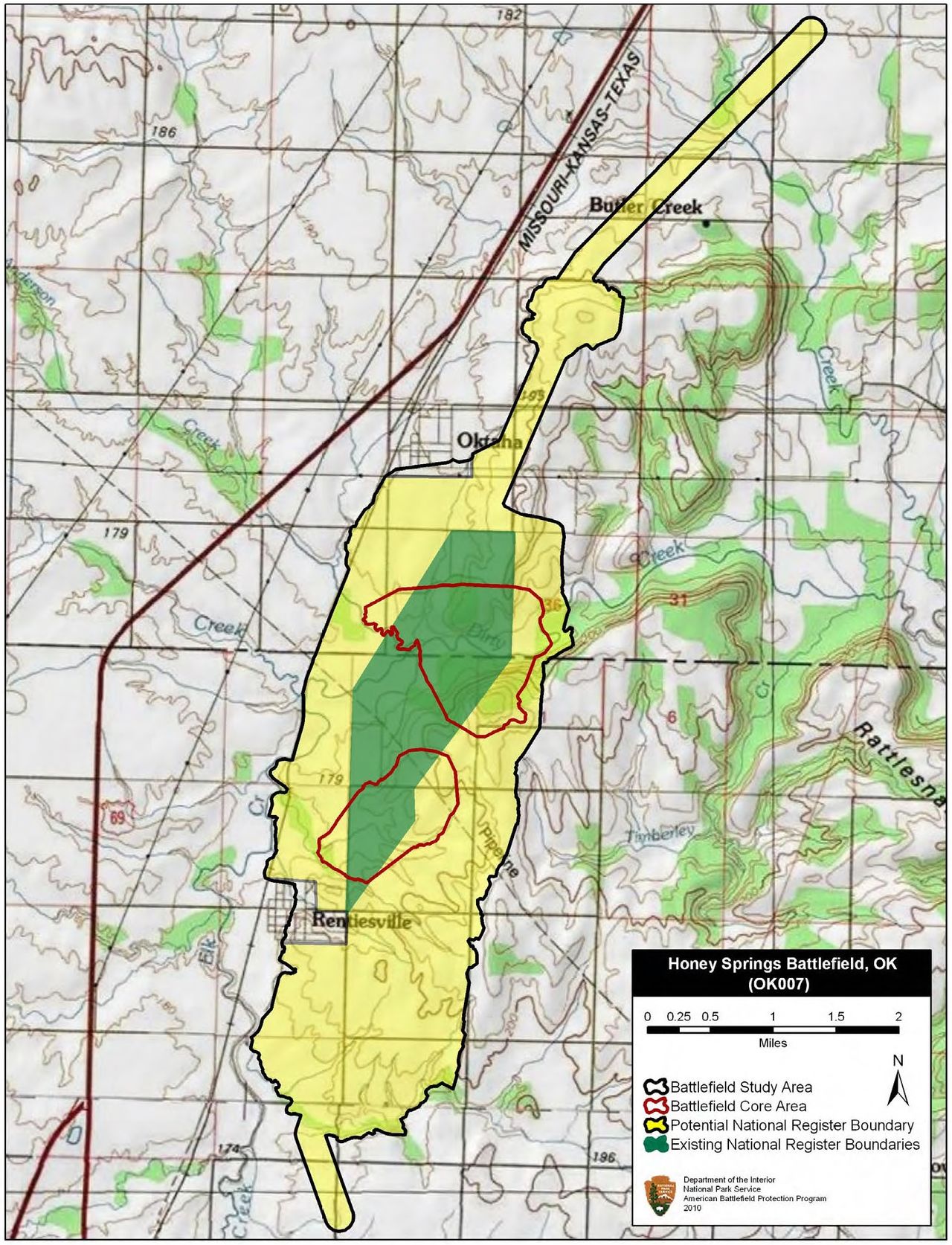
The engagement unfolded as Union forces advanced to secure supply lines and reduce Confederate resistance in the region. Fighting centered near a watering place and crossroads known locally as Honey Springs. Weather and logistics affected both sides; damp powder and shortages degraded some Confederate musketry, while Union artillery and coordinated infantry movements pressed the advantage. After several hours of combat the Confederate line broke and units withdrew from the field, leaving the Union in possession of the ground.
Aftermath and significance
The Union victory at Honey Springs had immediate strategic effects: it undermined Confederate control of the Indian Territory, opened routes for further Union operations, and weakened Confederate influence among Native American communities. The engagement also carried symbolic weight because of the prominent role of Native American and African American soldiers. The battlefield is preserved today as a historic site and interpreted for visitors as part of the region's Civil War heritage.
Notable facts
- Honey Springs is frequently noted for the multiethnic composition of the combatants and for being one of the most important Union successes in the Indian Territory.
- Native communities experienced deep internal divisions during the war, and Honey Springs illustrates how those divisions were fought out on the battlefield.
- The site and its story are interpreted today to explain the broader wartime experience in the western theater and in the Indian Territory.
Together, these aspects make the Battle of Honey Springs a key episode for understanding military operations and social dynamics in the western Civil War theater.
Related articles
Author
AlegsaOnline.com Battle of Honey Springs (July 17, 1863) Leandro Alegsa
URL: https://en.alegsaonline.com/art/9489