
Battle of Inkerman (5 November 1854)
A major engagement of the Crimean War on 5 November 1854 near Sevastopol; Anglo-French forces repelled a Russian attack in foggy, close-range fighting with heavy casualties on all sides.
The Battle of Inkerman was fought on 5 November 1854 during the Crimean War on the heights east of Sevastopol. It developed when Russian forces launched a morning attack intended to break the allied siege. The encounter quickly became a confused series of close-range infantry actions fought in poor visibility, with small units and junior officers playing decisive roles.
Image gallery
7 Images


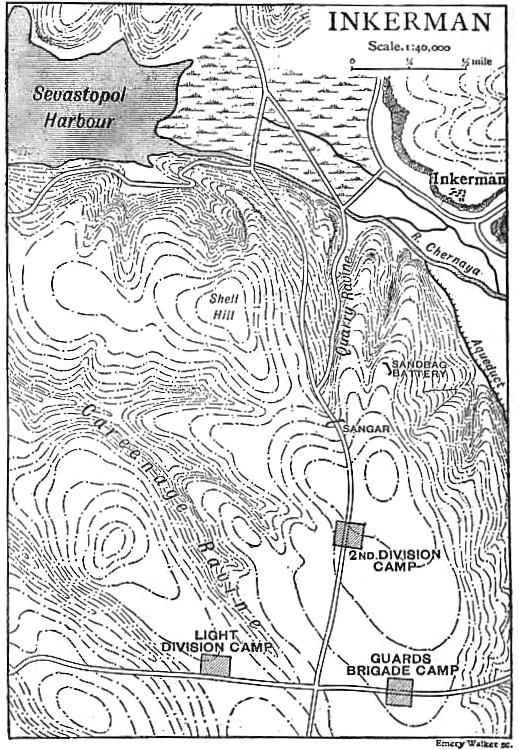

Background
Allied British and French armies had been investing Sevastopol for months. The Russians sought to drive the besiegers off the peninsula by concentrating troops in the Inkerman valley and on surrounding ridges. Weather and terrain—fog, low cloud and broken ground—removed the advantage of large formations and artillery, producing a battle characterized by sudden clashes and hand-to-hand fighting.
Battle and tactics
Rather than one continuous engagement, Inkerman consisted of a number of sharp, localized fights as Russian columns collided with outlying allied pickets and support units. Command and control were difficult, so initiative at company and battalion level determined outcomes. Artillery supported the infantry where lines could be formed, but much of the day relied on musketry, bayonet charges and counterattacks to regain positions.
Casualties and immediate aftermath
Contemporary returns list significant losses: British casualties included 597 killed and 1,860 wounded, while French losses were reported as 143 killed and 750 wounded; Russian casualties were far higher in the summaries of the time. These losses left the battlefield littered and exhausted the striking units. The allies held their ground and the attack failed to lift the siege, which continued through the winter and the following year.
Significance and legacy
Inkerman is often remembered as a "soldiers' battle"—where lower-ranked leaders and common soldiers determined success more than grand strategy. It demonstrated the limits of large-scale assaults against determined defensive positions and reinforced the difficulties the Russians faced in fielding coordinated offensives against the Anglo-French forces. The engagement is widely cited in studies of mid-19th century warfare and casualty reporting; see period casualty returns and contemporary accounts for primary documentation.
Notable facts
- The action took place in a single day but had consequences for the wider siege.
- Poor visibility made centralized command nearly impossible and elevated the importance of small-unit leadership.
- While decisive in its immediate effect, Inkerman was one of several costly engagements in a protracted campaign around Sevastopol.
For further reading on the campaign context and allied operations consult general histories of the conflict and archival material compiled by British and French military authorities; some overviews are available through collection summaries and battlefield studies (Anglo-French forces).
Questions and answers
Q: When was the Battle of Inkerman fought?
A: The Battle of Inkerman was fought on November 5, 1854.
Q: Who won the Battle of Inkerman?
A: British and French troops defeated the Imperial Russian Army.
Q: How many British soldiers were killed in the Battle of Inkerman?
A: 597 British soldiers were killed in the Battle of Inkerman.
Q: How many British soldiers were wounded in the Battle of Inkerman?
A: 1,860 British soldiers were wounded in the Battle of Inkerman.
Q: How many French soldiers were killed in the Battle of Inkerman?
A: 143 French soldiers were killed in the Battle of Inkerman.
Q: How many Russian soldiers were killed or wounded in the Battle of Inkerman?
A: The Russians lost 10,729 killed and wounded in the Battle of Inkerman.
Q: What was the significance of the Battle of Inkerman?
A: The Battle of Inkerman broke the spirit of the Russian Army which never again fielded an army against the British and French allies. It was followed by the Siege of Sevastopol.
Related articles
Author
AlegsaOnline.com Battle of Inkerman (5 November 1854) Leandro Alegsa
URL: https://en.alegsaonline.com/art/9491
Sources
- britishbattles.com : "The Battle of Inkerman"
- militaryhistory.about.com : "Crimean War: Battle of Inkerman"
- victorianweb.org : "The British landing at Eupatoria"