
Suddenly, Last Summer (1959 film)
1959 psychological drama directed by Joseph L. Mankiewicz, adapted from Tennessee Williams's play. Noted for its stage-derived structure, intense performances and three 1960 Academy Award nominations.
Overview
Suddenly, Last Summer is a 1959 British–American psychological drama film directed by Joseph L. Mankiewicz and adapted from the stage play by the American dramatist Tennessee Williams. The motion picture brings Williams's concentrated, dialogue-driven material to the screen and centers on memory, reputation and the long shadow of a young man's death.
Image gallery
3 Images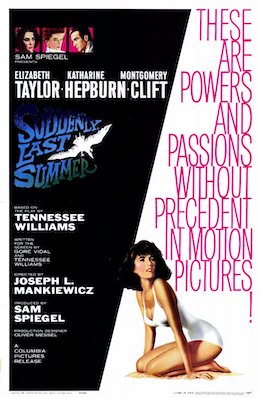


Plot and dramatic structure
The narrative focuses on a wealthy, controlling matriarch and her niece, whose traumatic recollections threaten the family's public image. A physician is asked to perform a radical procedure to erase those memories; instead he seeks to determine what truly happened. The film keeps much of the play's claustrophobic, confrontational tone and uses extended testimony and flashback-like scenes to unfold the central mystery.
Cast and production
The principal cast includes Elizabeth Taylor, Katharine Hepburn, Montgomery Clift and Albert Dekker. Joseph L. Mankiewicz, known for his literate adaptations and emphasis on performance, preserves the play's intense interpersonal drama while adapting it for cinematic pacing and visual emphasis. The film was released by Columbia Pictures.
Themes, censorship and adaptation
Williams's original play addressed unsettling subjects such as sexual exploitation and social hypocrisy. For the 1959 film adaptation, certain elements were treated more obliquely than on stage because of contemporary production codes and mainstream distribution considerations. Critics and scholars have noted how the film negotiates the tension between theatrical frankness and mid-20th-century screen constraints, producing a work that is suggestive rather than explicit about some of its darker implications.
Reception and legacy
On release the picture drew attention for its performances and its faithful retention of Williams's confrontational dialogue. It received three Academy Award nominations in 1960, reflecting industry recognition of its craft and acting. Over time the film has been studied as an example of stage-to-screen adaptation, as well as for its portrayal of memory, trauma and the social pressures that seek to suppress uncomfortable truths.
Further reading and resources
Related articles
Author
AlegsaOnline.com Suddenly, Last Summer (1959 film) Leandro Alegsa
URL: https://en.alegsaonline.com/art/94586