
Sunday Bloody Sunday (1971 film)
A concise encyclopedia entry on the 1971 British drama film Sunday Bloody Sunday: production, cast, themes, reception and its place in British cinema.
Overview
Sunday Bloody Sunday is a 1971 British drama film directed by John Schlesinger and written by Penelope Gilliatt. Set in contemporary London, the story examines the emotional lives of three adults caught in a triangular relationship. The film is noted for its restrained, matter-of-fact approach to sexuality and urban loneliness, and for treating its characters with a degree of sympathy unusual in mainstream cinema of the period.
Image gallery
1 Image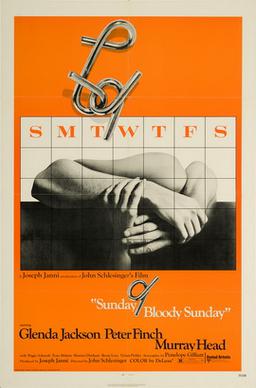
Cast and characters
The central performances and the film's naturalistic tone drew much of its critical attention. Principal cast members include:
- Peter Finch as a middle-aged doctor struggling with romantic commitment.
- Glenda Jackson as a professional woman who must choose between competing attachments.
- Murray Head as a younger man involved with both principals.
- Peggy Ashcroft in a supporting role as a figure from the protagonists' social circle.
- Daniel Day-Lewis in one of his earliest screen appearances, in a small part.
Themes and style
The film foregrounds themes of modern relationships, bisexuality, generational differences and the search for emotional honesty. Rather than sensationalize its subject matter, the screenplay and direction favor a conversational realism: scenes unfold in everyday settings, and dialogue often emphasizes awkwardness and restraint. Critics and scholars have noted the film's contribution to a more open depiction of adult relationships in mainstream British film.
Production, release and reception
Produced in the United Kingdom and released in 1971, the film was distributed by United Artists. It won praise for its acting and screenplay and was nominated for multiple awards, including four Academy Award nominations in 1972. Reviewers highlighted the performances of the leads and the director's subtle handling of delicate material.
Legacy and distinctions
Sunday Bloody Sunday is often cited as an important work in British cinema for its frank yet empathetic portrayal of adult sexuality and for its contribution to social-realist storytelling. Its influence can be seen in later films that attempt candid, character-driven explorations of intimate life without moralizing judgment. For further information about the director and principal actors, see the linked entries for John Schlesinger, Peter Finch, Glenda Jackson and Daniel Day-Lewis.
References and further reading
Contemporary reviews and retrospectives provide detailed accounts of the film's production and cultural impact; consult major film archives and scholarly overviews for extended analysis.
Questions and answers
Q: Who directed Sunday Bloody Sunday?
A: John Schlesinger directed Sunday Bloody Sunday.
Q: When was Sunday Bloody Sunday released?
A: Sunday Bloody Sunday was released in 1971.
Q: Who wrote the screenplay for Sunday Bloody Sunday?
A: Penelope Gilliatt wrote the screenplay for Sunday Bloody Sunday.
Q: Who starred in Sunday Bloody Sunday?
A: The cast of Sunday Bloody Sunday includes Peter Finch, Glenda Jackson, Murray Head, Peggy Ashcroft, and Daniel Day-Lewis.
Q: Was Sunday Bloody Sunday nominated for any awards?
A: Yes, Sunday Bloody Sunday was nominated for four Oscars in 1972.
Q: Who distributed Sunday Bloody Sunday?
A: United Artists distributed Sunday Bloody Sunday.
Q: What genre is Sunday Bloody Sunday?
A: Sunday Bloody Sunday is a British drama movie.
Related articles
Author
AlegsaOnline.com Sunday Bloody Sunday (1971 film) Leandro Alegsa
URL: https://en.alegsaonline.com/art/94880