
Star system (stellar system)
A star system (stellar system) is a small number of stars bound by gravity that orbit a common center. This article describes types, dynamics, formation, notable examples and how they differ from planetary systems.
Overview
A star system, often called a stellar system, is a gravitationally bound collection of a small number of stars that move under their mutual attraction. Unlike a star cluster, which contains many stars, a star system usually consists of just a handful of members whose motions are dominated by a shared center of mass rather than by random encounters. A star system is distinct from a planetary system, which is centered on a star and includes planets, moons, asteroids and other minor bodies.
Image gallery
9 Images







Types and common configurations
Star systems are classified by the number of stellar components and by how those components interact. Typical categories include:
- Binaries — systems of two stars; the most common stable stellar pairings. See binary star.
- Triples and higher multiples — hierarchical arrangements in which close pairs orbit a more distant third star, or more complex nested orbits.
- Contact and interacting systems — where stellar envelopes touch or mass flows from one star to another, leading to phenomena such as novae.
Whether a particular configuration remains unchanged depends on factors such as tidal forces and energy exchange. Absence of significant tidal distortion, external perturbations, or mass transfer contributes to long-term stability.
Dynamics and physical principles
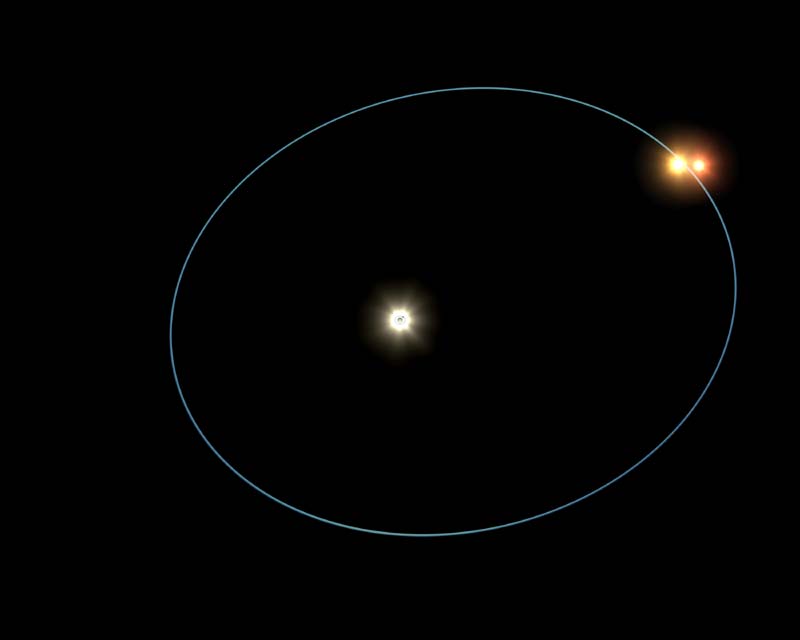
Members of a stellar system orbit their mutual center of mass; each component traces a path determined by the total mass distribution and initial velocities. In the simplest two-body case both stars orbit the system's center of mass in closed paths (ellipses under Newtonian gravity) and continue to orbit indefinitely if undisturbed. In systems with three or more bodies, motions can be more complex and sometimes chaotic unless the bodies form hierarchical subsystems.
Formation and evolution
Star systems typically originate in the same molecular cloud core. Fragmentation during collapse can produce multiple dense centers that become stars, often with similar ages and chemical composition. Over time, stellar winds, supernovae, and close encounters can reshape or dissolve systems. Interactions such as mass transfer or common-envelope evolution can dramatically change stellar structure and produce compact remnants.
Observational importance and examples
Studying stellar systems is crucial for measuring stellar masses, testing theories of stellar evolution, and detecting compact objects. Well-known binary systems include Sirius and Procyon, both of which are bright stars with faint companions. High-energy systems such as Cygnus X-1 are notable because they often contain a compact object; in Cygnus X-1 the companion is widely believed to be a black hole.
Distinctions and notable facts
Important distinctions to keep in mind: a star system emphasizes multiple stellar bodies bound to one another, while a planetary system emphasizes planets orbiting a dominant star. Large assemblages of many bound stars are generally called star clusters. Observationally, multiplicity affects the interpretation of brightness, motion, and spectra, so unresolved companion stars can bias measurements unless accounted for.
Further reading
For more on specific phenomena and observational techniques, see introductory resources on stellar dynamics, binary evolution, and surveys of multiple-star systems. Relevant entries and databases often provide catalogs, orbital elements, and high-resolution images for professional and amateur study. Example resources include data services and review articles accessible from astronomy literature portals such as stellar databases and catalogs referenced in the scientific literature (cluster studies, planetary system comparisons, specialized binary star compilations).
Questions and answers
Q: What is a star system?
A: A star system is a group of stars that orbit each other, held together by gravitational attraction.
Q: How is a star cluster different from a star system?
A: A star cluster is a larger group of stars bound by gravity, while a star system is a smaller group of stars.
Q: What is a binary star system?
A: A binary star system is a star system containing two stars that orbit around their center of mass.
Q: What conditions are necessary for a stable binary star system?
A: A stable binary star system requires no tidal effects, disturbance from other forces, or transfer of mass from one star to the other.
Q: Can a star system be confused with a planetary system?
A: No, a star system should not be confused with a planetary system, which is made up of planets and similar bodies.
Q: What are some examples of binary star systems?
A: Some examples of binary star systems are Sirius, Procyon, and Cygnus X-1.
Q: What is the likely composition of Cygnus X-1?
A: Cygnus X-1 probably consists of a star and a black hole.
Related articles
Author
AlegsaOnline.com Star system (stellar system) Leandro Alegsa
URL: https://en.alegsaonline.com/art/93445
Sources
- rssd.esa.int : Hipparcos: double and multiple stars
- adsabs.harvard.edu : MSC – a catalogue of physical multiple stars
- seds.org : Binary and multiple stars
- arxiv.org : arxiv.org/abs/1504.07065
- aip.de : Statistics of multiple stars: some clues to formation mechanisms
- adsabs.harvard.edu : 2001IAUS..200...84T
- eaa.iop.org : Institute of Physics