
Sparrowhawk (Accipiter nisus): small Eurasian woodland raptor
A compact encyclopedia entry on the Eurasian sparrowhawk (Accipiter nisus): identification, behaviour, distribution, breeding, conservation history and cultural associations.
Overview
The sparrowhawk (Accipiter nisus) is a small bird of prey native to much of Europe, large parts of Asia and North Africa. A member of the Accipitridae family, it is a typical accipiter: compact-bodied with short, rounded wings and a long tail that aid manoeuvrability through trees. Sparrowhawks occupy woodlands, hedgerows and increasingly, towns and gardens where small passerines are abundant. Northern populations tend to migrate south for the winter while many southern birds are resident or make only short seasonal movements.
Image gallery
10 Images




Identification and sexual differences
Sparrowhawks show marked sexual dimorphism. Adult males are generally smaller and slimmer, with blue-grey upperparts and fine orange or rufous barring across the chest and belly. Females and juveniles are browner above and have brown streaking below rather than the more rufous tones of adult males. Females are noticeably larger — commonly up to about 25% heavier — one of the larger size differences between sexes in any bird species. The species' overall build, short rounded wings and long tail distinguish it from broader-winged raptors; in flight sparrowhawks display quick, low flapping interspersed with short glides.
Distribution, habitat and movement
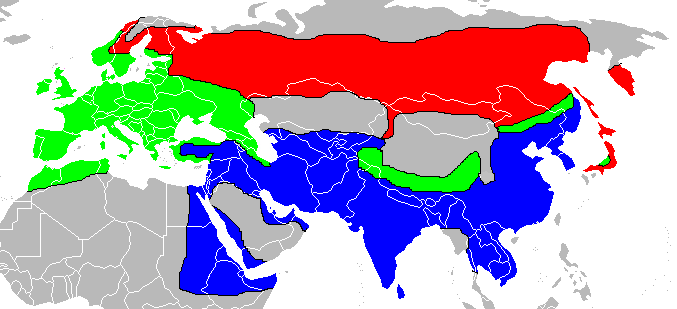
Sparrowhawks breed across most of Europe, into western and central Asia and in parts of North Africa. They favour wooded habitats for nesting and hunting but readily use urban and suburban green spaces that support dense small-bird populations. Where climate and food conditions permit, birds remain near breeding areas year-round; birds from higher latitudes or harsher climates commonly migrate to milder regions in winter. Within its range the species can be locally common and adaptable, exploiting both rural and city edge environments.
Diet and hunting behaviour
The sparrowhawk is a specialized bird-hunter. Prey consists mainly of small to medium-sized passerines and other small birds that inhabit trees and shrubs. Males typically take smaller prey such as tits, finches and sparrows, while females, being larger, can capture bigger birds including thrushes and starlings; individuals are capable of killing prey weighing several hundred grams. Sparrowhawks hunt by stealth and agility: they use cover to approach, then burst into a short, rapid chase through branches or perform a surprise dash into gardens and parks. Their short wings and long tail allow sudden turns and rapid changes of direction.
Breeding, development and lifespan
Nesting usually occurs in trees within woodland, orchards or mature hedgerows. Pairs build a stick nest often lined with greenery; nests can be substantial and up to several tens of centimetres across. Typical clutches number around four to five eggs, pale bluish in colour. Incubation and brooding are primarily by the female and last about a month, and chicks fledge roughly three to four weeks after hatching. Juvenile survival can be limited: studies report that about one third of young survive to their first birthday, while typical adult annual survival is higher. Average lifespans in the wild are modest, with many individuals living only a few years, although some survive longer in favourable conditions.
Conservation history and human interactions
The 20th century brought serious threats to sparrowhawks in some regions. Widespread use of persistent pesticides and insecticides in the mid-1900s led to accumulation of toxic residues in food chains, causing mortality and reproductive failures such as egg-shell thinning. Following restrictions and bans on the most harmful chemicals, sparrowhawk populations recovered in many countries and the species is now one of the commoner birds of prey in parts of its range. Nevertheless, conflicts persist: pigeon keepers and game managers sometimes regard sparrowhawks as pests, and persecution has occurred historically. Field studies have generally found that sparrowhawks are not the principal drivers of long-term declines in farmland or woodland songbird populations, with habitat change and agricultural practices playing larger roles.
Human uses and cultural notes
People have used sparrowhawks in falconry for many centuries. Their agility and boldness make them suited to short-range hunting of small birds, though they can be challenging to train. The species also appears in folklore and literature across its range and is mentioned in classical and modern works. Such cultural associations reflect the bird's visibility near human settlements and its striking hunting style.
Key distinctions and notable facts
- Typical accipiter proportions: short, rounded wings and long tail for manoeuvrability in wooded environments.
- Large sexual size dimorphism influences prey choice and hunting roles within pairs.
- Was severely affected by mid-20th century pesticide use but has recovered where protections and regulation reduced contamination.
Related links
- General overview
- Accipitridae family reference
- Eurasian distribution details
- North African populations
- Male plumage notes
- Woodland habitat and ecology
- Habitat variety
- Urban and garden occurrences
- City habitat studies
- Prey: tits
- Prey: finches
- Prey: sparrows
- Prey: thrushes
- Prey: starlings
- European occurrence
- Asian range
- Breeding behaviour
- Migration patterns
- Nesting sites and construction
- Egg and clutch information
- Lifespan and survival statistics
- Pesticide exposure history
- Food chain contamination
- Interactions with pigeon keeping
- Alleged impacts on small bird populations
- Studies of farmland bird trends
- Regional research examples
- Cultural and myth references
- Literary references
- Shakespearean mention
- Modern poetry and writing
Questions and answers
Q: What does the adult male sparrowhawk look like?
A: The adult male sparrowhawk has a blue-grey back and wings, with thin orange stripes on its chest and belly.
Q: How big is the size difference between male and female sparrowhawks?
A: The female is up to 25% larger than the male, which is one of the biggest size differences in any bird species.
Q: What type of birds do they eat?
A: Male sparrowhawks eat smaller birds like tits, finches and sparrows while females eat bigger birds like thrushes and starlings. They can kill birds weighing more than 500 grams (18 oz).
Q: Where are they found?
A: Sparrowhawks are seen in Europe, parts of Asia and parts of Africa. Birds that breed in the north migrate south for winter while those living further south stay there or fly shorter distances.
Q: How do they build their nests?
A: Sparrowhawks build a nest in woodland made from twigs which can be up to 60 cm (2 ft) wide. The female lays four or five eggs with pale blue shells.
Q: How long does it take for chicks to hatch from eggs laid by a female sparrowhawk?
A: Chicks hatch after 33 days and leave the nest after another 24 to 28 days.
Q: Why did their population decrease in Europe during 1950s? A: Their population decreased due to pesticides used on seeds before planting that were eaten by small birds which were then eaten by sparrowhawks, resulting in increased amount of chemicals in food chain affecting them negatively - some were poisoned while others laid eggs with shells too thin that broke before hatching chicks.
Related articles
Author
AlegsaOnline.com Sparrowhawk (Accipiter nisus): small Eurasian woodland raptor Leandro Alegsa
URL: https://en.alegsaonline.com/art/92504