
Sine wave (sinusoid): definition, properties, and applications
A sine wave (sinusoid) is the fundamental smooth periodic oscillation described by the sine function; it characterizes simple harmonic motion and serves as a basis for Fourier analysis and many applications.
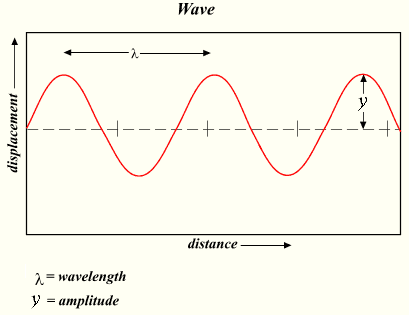
Sine wave (or sinusoid) denotes the smooth, repetitive curve traced by the trigonometric sine function. It is the simplest continuous periodic waveform and appears throughout mathematics, physics and engineering. A standard one‑dimensional form is y(t)=A sin(ωt+φ), where A is amplitude, ω is angular frequency and φ is phase. In spatial waves the equivalent expression is y(x,t)=A sin(kx−ωt+φ). Continuous function graphs of this type are infinitely differentiable and have a characteristic single‑frequency oscillation.
Image gallery
3 Images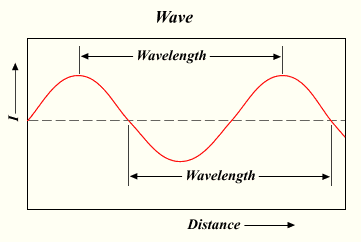

Key characteristics
- Amplitude: peak deviation from the central value.
- Period: time for one full cycle; its reciprocal is frequency.
- Wavelength: spatial distance between repeating features such as successive peaks; commonly measured as the distance between adjacent maxima or minima. See wave concepts for related terms.
- Phase: horizontal offset that shifts the waveform left or right.
- Angular frequency and wavenumber: convenient alternatives (ω and k) used in differential equations and wave mechanics.
Mathematically, sinusoids solve the simple harmonic oscillator equation y''+ω^2y=0 and are intimately related to circular motion and rotation in the complex plane. The derivative of a sine is a cosine, and repeated differentiation cycles through sine and cosine with sign changes. This simple structure gives sinusoids many useful analytical properties.
History and theoretical importance
The sine function has roots in classical trigonometry and geometry. Its central role in representing oscillations was elevated by the development of Fourier analysis: Joseph Fourier showed that many complicated periodic shapes can be expressed as sums of sines and cosines. This idea underpins modern signal processing, acoustics, optics and heat theory. For background on periodic decomposition, see periodic patterns and wavelength concepts.
Applications and examples
- Sound: a pure musical tone approximates a sine wave; complex sounds are sums of harmonics.
- Electrical engineering: alternating current and many filter responses use sinusoidal analysis.
- Mechanical vibrations: small oscillations of springs and pendulums follow sinusoidal time dependence.
- Signal processing and communications: modulation, spectral analysis and synthesis rely on sinusoids as building blocks; see signal theory and transform methods.
Because of their mathematical simplicity and physical relevance, sine waves serve both as a descriptive tool for single‑frequency phenomena and as a fundamental basis set for reconstructing and analyzing complex signals across science and engineering.
Related articles
Author
AlegsaOnline.com Sine wave (sinusoid): definition, properties, and applications Leandro Alegsa
URL: https://en.alegsaonline.com/art/90610