
Soap bubble: structure, colours, behaviour and cultural meaning
A soap bubble is a thin liquid film enclosing air that forms a near-spherical membrane. This article explains how bubbles form, why they show colours, how they behave, and their uses and symbolism.
Overview
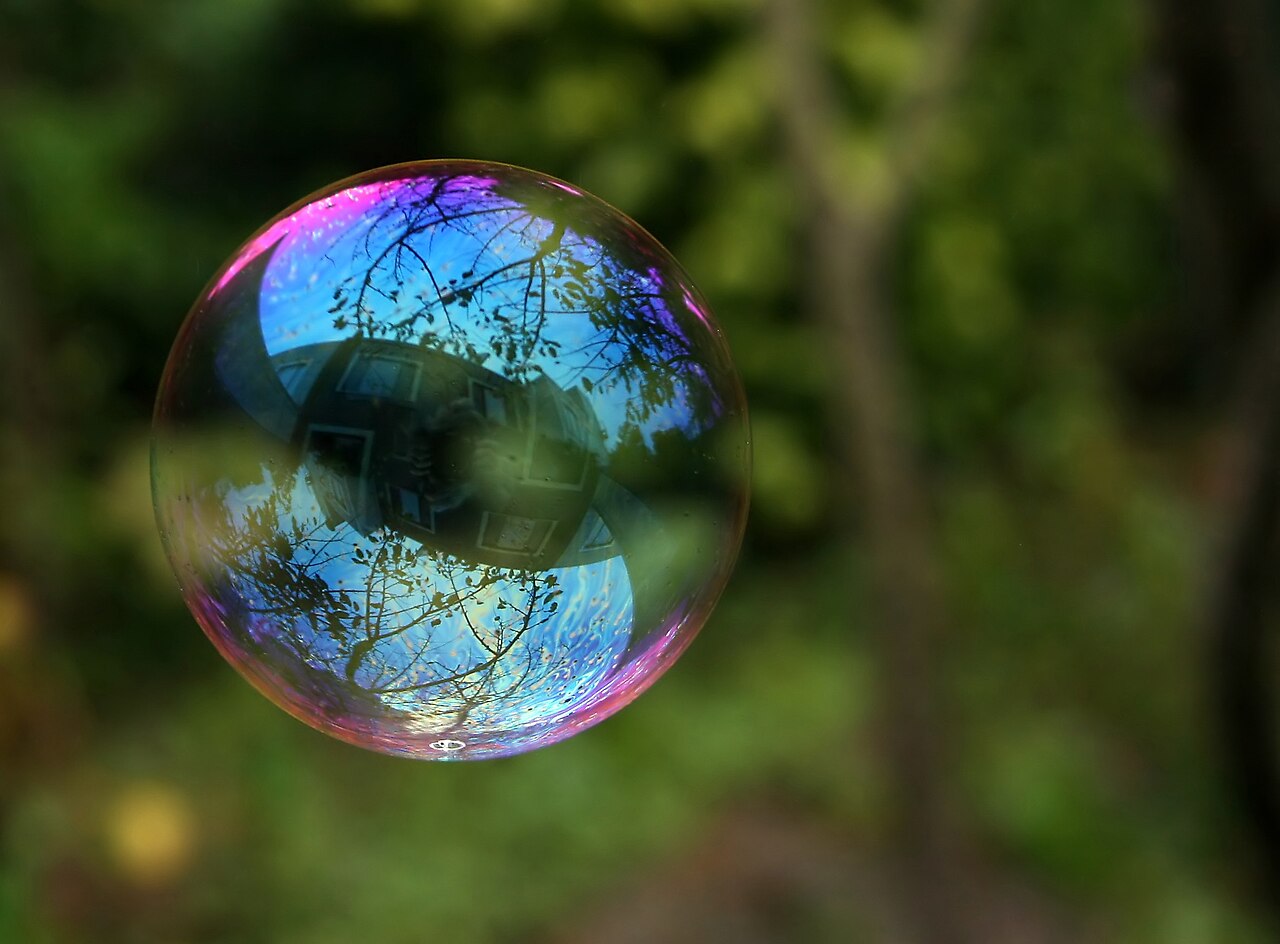
A soap bubble is a thin film of water containing soap or other surfactant that traps a volume of air. The film forms a hollow, usually near-spherical envelope whose shape comes from the tendency of surface tension to minimize surface area. Bubbles are familiar from children's play, from scientific demonstrations, and from artistic installations that make large or complex bubble structures. For basic information about the liquid film and typical recipes, see soap-water mixtures.
Image gallery
10 Images



Physical characteristics
Structurally, a bubble consists of a layer of liquid bounded by two air–liquid interfaces. The film thickness is typically only a few hundred to a few thousand nanometres; thickness varies across the surface as fluid drains under gravity. Because a sphere has the smallest surface area for a given volume, isolated free bubbles adopt a rounded form: more on the idealized geometry is available at sphere and surface-tension concepts. Collections of bubbles pack in characteristic ways that produce foams and networks of thin films.
Colour and optical effects
The shimmering colours that decorate a bubble arise from thin-film interference: portions of light reflected from the outer and inner surfaces of the film interfere constructively or destructively at different wavelengths. This iridescence changes as the film thickness varies and as viewing angle changes; a short explanation is linked at iridescence and interference. Photographs and galleries showcasing the visual effects can be found at colourful bubble images.
Formation, stability and bursting
Bubbles form when air becomes enclosed by a soap-stabilized film, for example when blowing through a wand. Surfactant molecules reduce surface tension and help the film remain intact. Several dynamic processes determine lifetime: drainage of liquid toward the base, evaporation of the water component, and disturbances from air currents or contact with objects. Stabilizing effects such as the Marangoni flow (redistribution of liquid when the surface tension varies) can temporarily delay rupture. Practical factors that influence behaviour include:
- soap concentration and additives (glycerine or polymers) that slow evaporation;
- environmental humidity and temperature;
- mechanical disturbances or contact with dry or rough surfaces.
Uses, cultural roles and examples
Beyond play, bubbles are used for demonstration in physics and chemistry education, as motifs in art and performance, and in engineering contexts where foams and films matter (cleaning, flotation, material science). Artists and performers sometimes create giant bubbles or bubble sculptures; see creative bubble work at bubble art examples. Because of their brief, fragile existence, soap bubbles are also a common metaphor and symbol for transience and fragility in literature and visual culture — a use discussed at bubble as symbol.
Notable distinctions and further reading
Single free bubbles differ from the closely packed films of a foam in both geometry and dynamics. Mathematicians and physicists study bubble clusters to learn about minimal surfaces and energy minimization. For accessible introductions and demonstrations, instructional pages and collections of experiments are available at soap-water mixtures and surface-tension resources, while optical explanations are collected under iridescence. A selection of color photographs and artistic projects can be explored via colourful bubble images and bubble art examples.
Related articles
Author
AlegsaOnline.com Soap bubble: structure, colours, behaviour and cultural meaning Leandro Alegsa
URL: https://en.alegsaonline.com/art/91385
Sources
- commons.wikimedia.org : Soap bubbles
- trivials.com : "Facts About Bubbles"
- tomnoddy.com : "Tom Noddy, Tom Noddy's Bubble magic, Bubbles, Bubble Magic"
- youtube.com : "Tom Noddy - Bubbleman"
- keithmichaeljohnson.com : keithmichaeljohnson.com/
- youtube.com : "Soap Bubble Show First Library Tour 2006 :: Keith Johnson BubbleArtist.com"
- bubbleart.com : bubbleart.com/
- tangenttoy.com : tangenttoy.com/bubbleman/
- rinaldo.de : rinaldo.de
- news.bbc.co.uk : "World soap bubble record popped"
- worldslargestbubble.com : worldslargestbubble.com
- xtremebubbles.com : xtremebubbles.com