
Simply connected space (topology)
A simply connected space is a path-connected topological space in which every closed loop can be continuously contracted to a point, equivalently having trivial fundamental group.
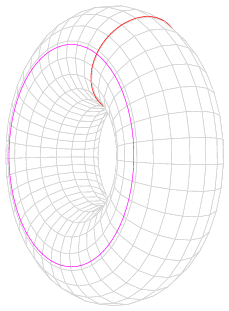
A simply connected space is a basic notion in topology that captures the idea of a region without holes that pass all the way through. Informally, a region is simply connected if it is all in one piece and every loop drawn inside it can be tightened continuously to a single point without leaving the region. Typical intuitive examples are a solid ball or a disk; a torus (doughnut) and a punctured plane are not simply connected.
Image gallery
2 Images
Formal definition
Formally, a topological space X is called simply connected if it is path-connected and every continuous map from the circle S1 into X is homotopic (through maps S1→X) to a constant map. Equivalently, the fundamental group π1(X,x0) at any base point x0 is the trivial group. When X is path-connected, the triviality of π1 does not depend on the choice of base point, so authors often state simply connected without repeating the base point condition.
Examples and non-examples
- Euclidean space R^n is simply connected for every n≥1; in particular R and R^2 are simply connected.
- The 2-sphere S^2 and higher-dimensional spheres S^n (n≥2) are simply connected, but S^1 is not.
- An open disk or a filled ball is simply connected; an annulus (a ring-shaped region) is not because loops around the hole cannot be contracted.
- The torus and any surface of genus ≥1 are not simply connected. The plane with a point removed (the punctured plane) is also not simply connected.
- Some spaces are path-connected but still fail to be simply connected because they contain essential loops—e.g., a figure-eight curve in the plane.
Related concepts and importance
Simply connected is a weaker condition than contractible: every contractible space is simply connected, but the converse need not hold. For example, S^2 is simply connected but not contractible. The property is detected algebraically by the fundamental group: X is simply connected iff π1(X) is the trivial group. Many tools in algebraic topology, such as covering space theory and the Seifert–van Kampen theorem, use simple connectedness to classify spaces and compute invariants.
In complex analysis, simply connected domains in the complex plane have special significance: on any simply connected open subset of C, holomorphic functions have primitives and certain mapping theorems apply. The Riemann mapping theorem further characterizes simply connected proper open subsets of the complex plane by conformal equivalence to the unit disk.
Notable facts and history
The notion of the fundamental group and related ideas arose in the late 19th and early 20th centuries as algebraic topology developed; Henri Poincaré played a central role. A famous result connected to simple connectedness is the Poincaré conjecture (now a theorem): in dimension three, every closed, simply connected 3-manifold is homeomorphic to the 3-sphere. This conjecture was proven by Grigori Perelman in the early 21st century.
For further reading on geometric intuition and rigorous statements about "holes," see an elementary exposition of topology and algebraic invariants: topology resources and examples.
Related articles
Author
AlegsaOnline.com Simply connected space (topology) Leandro Alegsa
URL: https://en.alegsaonline.com/art/90571