
Siege of Jerusalem (1187)
The 1187 Siege of Jerusalem saw Saladin capture the city after months of campaigning, ending nearly a century of Crusader rule and prompting the European response that became the Third Crusade.
Overview
The Siege of Jerusalem took place between September 20 and October 2, 1187. It followed a campaign by the Ayyubid sultan Saladin against the Latin Kingdom of Jerusalem and resulted in the surrender of the city. The fall of Jerusalem ended the principal territorial holdings of the Crusader kingdom and triggered calls in Europe that led to the expedition known as the Third Crusade.
Image gallery
5 Images



Background and principal actors
In the months before the siege Saladin had won decisive victories, most notably at the Battle of Hattin, which left the Crusader field armies broken and their ability to relieve cities severely impaired. Jerusalem’s defense was organized under local nobles and burghers, the most prominent being Balian of Ibelin, who negotiated terms on behalf of the civilian population. Opposing them was the Muslim commander Saladin, who sought to reassert Muslim rule over the city and to restore access to its holy sites.
Course of the siege
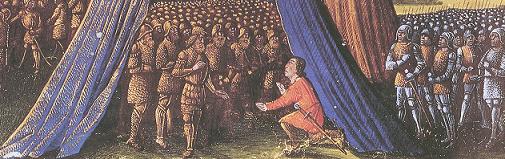
The siege itself combined military pressure with negotiation. Saladin’s forces encircled the city and cut supply lines while skirmishing along the walls. The defenders were short of experienced troops and supplies, and civilian refugees had crowded the town. Recognizing the untenable position, Balian led delegations to parley with Saladin, seeking terms that would spare the inhabitants and the churches.
Negotiation, ransom and consequences
After negotiations, Saladin accepted terms that permitted many inhabitants to leave the city after paying a ransom; clergy, the very poor, and some groups were released without payment. Contemporary accounts differ on the precise numbers and on the extent of enslavement and killing—chroniclers provide varying estimates—so historians treat the sources cautiously. Nonetheless, large numbers of Christians were taken captive or enslaved, and many were later ransomed by relatives, religious institutions, or Christian rulers.
Aftermath and significance
The fall of Jerusalem was a watershed: it dissolved the core territory of the Latin Kingdom and transformed the political map of the Levant under Ayyubid influence. News of the city’s capture provoked a strong reaction in Western Europe and was a principal impetus for the mobilization of forces under figures such as Richard I of England, Philip II of France and Frederick I of the Holy Roman Empire during the subsequent crusading effort.
Notable facts and cultural memory
- Key participants: Balian of Ibelin (defender) and Saladin (attacker).
- Dates often cited: September 20 to October 2, 1187.
- The event spurred the European response known as the Third Crusade.
The siege has been dramatized in modern culture. A fictionalized depiction appears in the film Kingdom of Heaven, which draws on historical characters and events but alters details for narrative effect; discussions of that portrayal note differences between the movie and contemporary chronicles. Scholars and popular commentators alike continue to debate the human and political consequences of the siege, which remain a pivotal moment in medieval Near Eastern history and in the memory of the Crusades. For cinematic and literary treatments, see commentary on the film and its director Ridley Scott and other modern retellings described as fictionalized adaptations.
Related articles
Author
AlegsaOnline.com Siege of Jerusalem (1187) Leandro Alegsa
URL: https://en.alegsaonline.com/art/90249