
Revolver: design, history, use and distinctions
A revolver is a repeating firearm with a rotating cylinder that holds cartridges. This article summarizes its design, operation, historical development, common uses and how it differs from semi-automatic pistols.
Overview
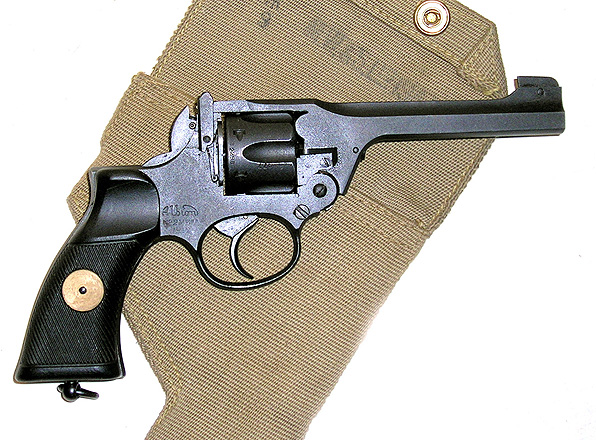
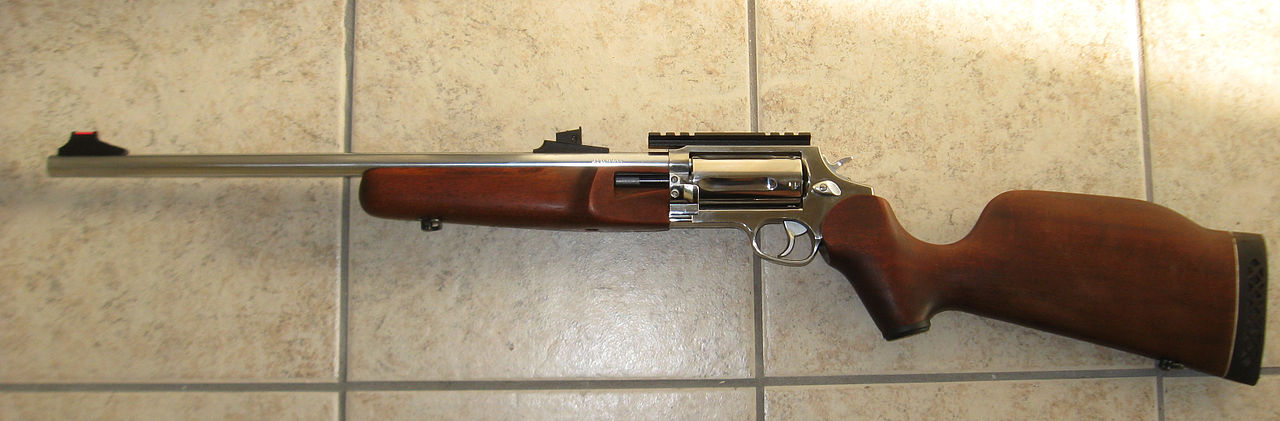
A revolver is a type of repeating handgun that stores cartridges in a rotating chambered cylinder. When the trigger is pulled or the hammer released, the cylinder indexes to align a single chamber with the barrel and firing mechanism, allowing one cartridge to be fired at a time. The term "revolver" is used more often than the older phrase "revolving gun." While most revolvers are pistols intended for one-handed or two-handed use, the revolving-cylinder concept has been adapted to other firearms as well.
Image gallery
10 Images



Design and operation
Core components include the frame, barrel, cylinder and firing mechanism. The cylinder contains several chambers—commonly five or six in many models—each sized to hold one cartridge. Cartridges themselves are the complete ammunition units that include the bullet, propellant and primer; see cartridges for more on ammunition types. The mechanism for firing may be single-action (the hammer must be cocked manually before each shot) or double-action (pulling the trigger both cocks and releases the hammer). Other practical features include a loading gate, ejector rod or a swing-out cylinder to assist loading and unloading.
History and development
Early concepts of revolving firearms appeared in Europe in the late 16th and 17th centuries as craftsmen experimented with multi-shot mechanisms. Practical and commercially successful revolvers emerged in the late 18th and early 19th centuries, with improvements that allowed for safer ignition systems and more reliable cylinders. Inventors and manufacturers—most famously Samuel Colt in the 19th century—helped popularize mass-produced revolvers, making them widely available to militaries, law enforcement and civilians.
Uses and importance
Revolvers have served as military sidearms, police service weapons and civilian self-defense firearms. Their mechanical simplicity and inherent reliability—especially in adverse conditions or with varied ammunition—made them a standard for many decades. Today they remain popular for concealed carry, hunting small game, sport shooting and as reliable backup guns. Law enforcement agencies historically issued revolvers but many shifted to semi-automatic pistols for higher capacity and faster reloading; nevertheless, revolvers are still used by some officers and specialist units.
Variations and notable distinctions
There are several common types of revolver actions and frames. Examples include top-break designs with hinge mechanisms, swing-out cylinders that facilitate faster reloading, and fixed-cylinder styles with a loading gate. Revolvers are available in a wide range of calibers and sizes, from small "pocket" models to large-frame guns chambered for powerful cartridges. Compared with semi-automatic pistols, revolvers generally offer simpler mechanics and easier clearing of some malfunctions, while semi-automatics tend to have higher ammunition capacity and faster reloads using magazines.
Advantages and limitations
- Advantages: robust reliability, simple operation, and often easier maintenance.
- Limitations: lower capacity, typically slower to reload without accessories, and generally larger cylinders adding bulk.
For further technical diagrams or historical references consult sources linked here: early designs, regional histories in Europe, and general ammunition guides at cartridge resources.
Related articles
Author
AlegsaOnline.com Revolver: design, history, use and distinctions Leandro Alegsa
URL: https://en.alegsaonline.com/art/82425
Sources
- smith-wesson.com : "S&W history"
- gunweek.com : "Revolvers' Actions and Tips for Lefties"