
Great Seal of the State of Missouri
Summary of the Great Seal of Missouri: its design elements, symbolism, adoption, historical context, official uses, and distinctions from other state emblems.
Overview
The Great Seal serves as the official emblem of the U.S. state of Missouri. It appears on important state documents, the state flag, and other governmental insignia. The seal identifies Missouri's authority and is used to authenticate official acts. The outer legend around the central image reads "The Great Seal of the State of Missouri," marking it as the state's primary seal.
Image gallery
2 Images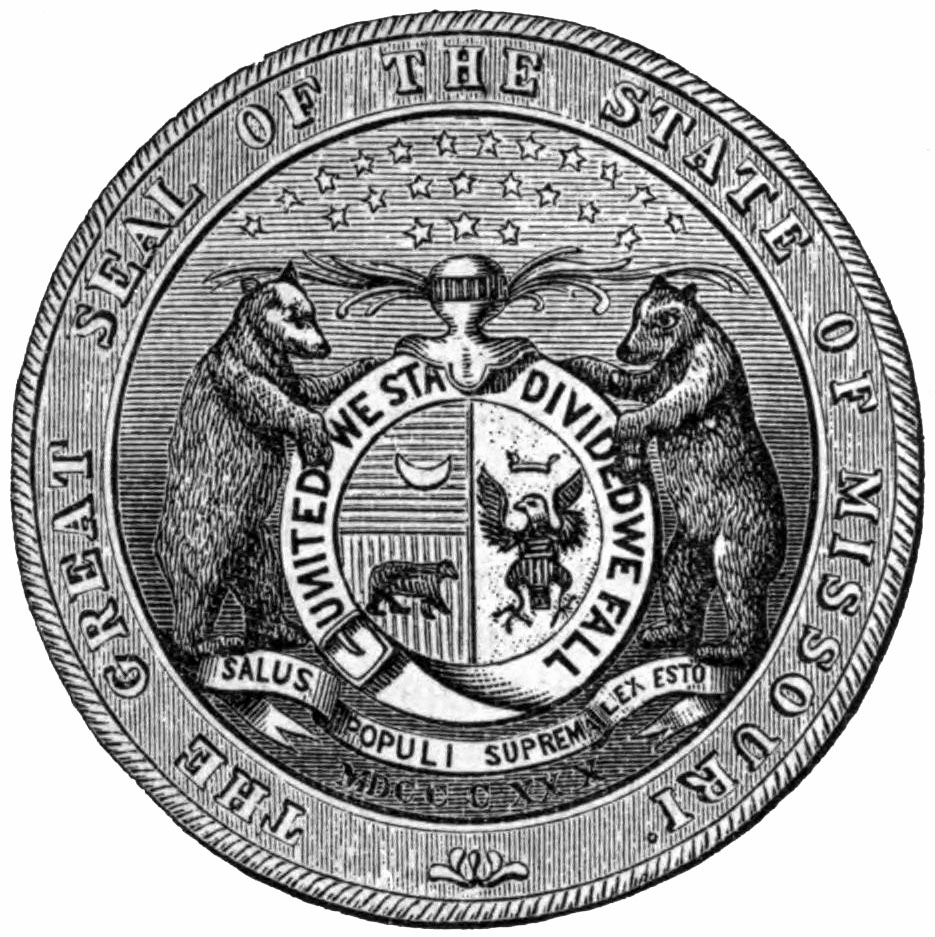

Design and symbolism
At the center of the seal is a shield supported by two bears. Above the shield is a helmet and other heraldic elements, while the shield itself contains additional motifs—most notably a crescent and elements that refer to Missouri's status and resources. The English motto "United we stand, divided we fall" appears on a scroll and expresses the value placed on unity. The bears represent strength and bravery; the helmet and shield reflect sovereignty and preparedness. Many of these symbols are commonly interpreted as statements about the state's character and its aspirations.
History and adoption
The seal was officially adopted on January 11, 1822. It also displays the date "1820" in Roman numerals; this marks the year when Missouri drafted its first state constitution and held the constitutional convention that preceded admission to the Union. Missouri was admitted as the 24th state in August 1821, so the seal preserves both the constitutional milestone and the formal adoption that followed.
Uses and variations
The Great Seal is used to authenticate proclamations, commissions, and other formal documents issued by state government. A depiction of the seal appears at the center of the Missouri state flag, and simplified or derivative elements from the seal are commonly used by various agencies and departments. Many offices maintain their own seals or stamps that incorporate aspects of the Great Seal while remaining distinct for administrative purposes. For information about official use and reproductions, consult state resources such as the Secretary of State or archival authorities at state reference.
Interpretations and notable facts
Interpretations of the seal's elements—such as the crescent, the helmet, and the supporting bears—emphasize growth, defense, and unity. The presence of the Roman numerals for 1820 alongside the 1821 statehood date highlights the sequence of constitutional formation and later admission. The seal's imagery has been preserved with only minor stylistic changes since the early 19th century, and it remains a central visual shorthand for Missouri government and identity. For additional context on the seal's meaning and history, researchers often consult official state histories and archival materials at archival sources and departmental guides at official agencies.
Distinctions
Although closely related, the terms "state seal," "coat of arms," and the design elements appearing on the state flag are sometimes used interchangeably in casual usage. Legally, however, the Great Seal is a specific insignia with prescribed uses and an official text describing its components. Understanding the distinctions helps clarify how the emblem functions across ceremonial, legal, and graphical contexts within Missouri government.
Related articles
Author
AlegsaOnline.com Great Seal of the State of Missouri Leandro Alegsa
URL: https://en.alegsaonline.com/art/88311