
Sassarese (Sassaresu) — Romance language of northwest Sardinia
Sassarese is a Romance language spoken in northwest Sardinia. It shows influences from Corsican, Sardinian and Italo-Dalmatian varieties and is used in local speech, culture and media.
Overview
Sassarese (endonym: Sassaresu or locally Turritanu) is a Romance language traditionally spoken in the northwest coastal area of Sardinia. It occupies a boundary position within the Romance family: while it shares features with the Corsican and Italo-Dalmatian varieties, it also carries strong Sardinian traits related to the island's historic dialects. Estimates place its number of speakers at roughly 120,000 concentrated around the city of Sassari and neighbouring communities.
Image gallery
2 Images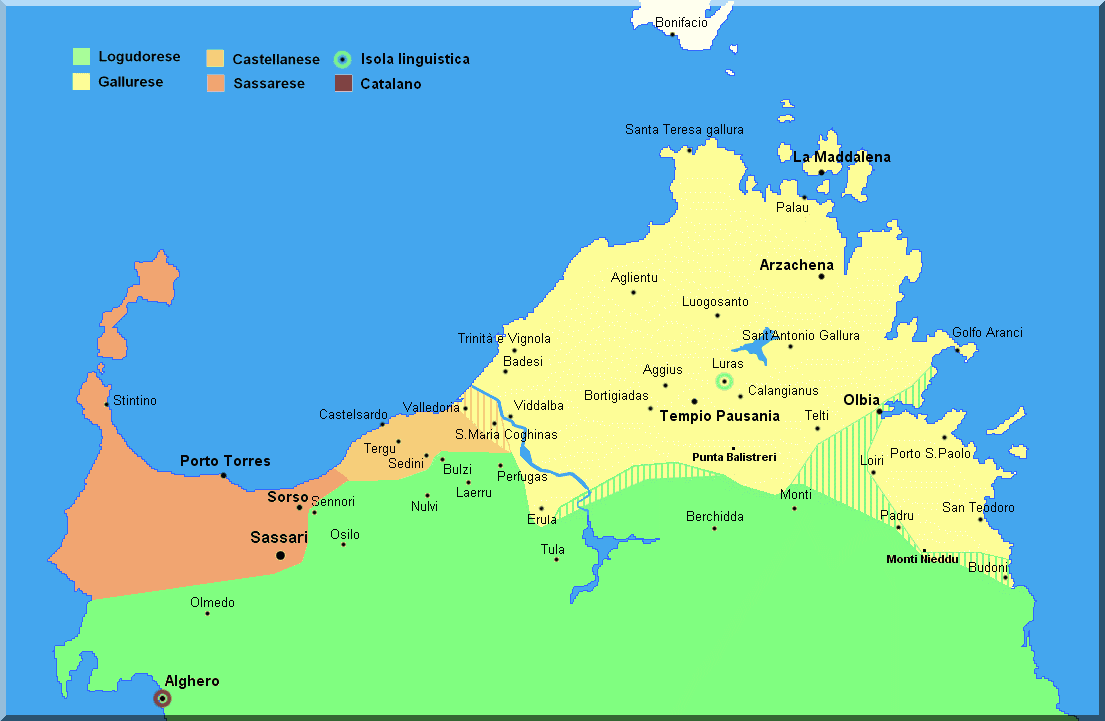

Characteristics
Sassarese is typified by a mixed linguistic profile. Its vocabulary, phonology and syntax reflect a layering of influences: central and northern Italian dialects, Corsican forms, and Sardinian substratum. The language retains Romance morphology but shows localized sound changes and a lexicon with loanwords from historical contacts with Genoese, Catalan and Spanish due to past maritime and political connections.
History and development
The development of Sassarese is tied to the complex settlement and political history of northwest Sardinia. Over centuries, movement of people and shifting rule produced a linguistic continuum in which Corsican-speaking settlers, mainland Italian merchants and the native Sardinian-speaking population contributed to an evolving speech variety. This gradual mixture resulted in a transitional idiom located between Italo-Dalmatian and Sardinian languages.
Uses and cultural role
Sassarese is primarily a regional vernacular used in everyday communication, local music, oral tradition and some written literature. Italian remains the language of administration and formal education in Italy, but Sassarese appears in folk poetry, theater, radio programs and cultural initiatives that aim to preserve regional identity. There are ongoing efforts by local associations to document and teach elements of the language.
Distinctions and relationships
Sassarese is closely related to the nearby Gallurese variety and shows affinity to Sardinian in several structural respects. Linguists may classify it variously as an independent language, part of a dialect continuum, or a transitional speech form; such labels depend on criteria like mutual intelligibility, historical origin and sociolinguistic factors. While intelligibility with Corsican and Gallurese is partial, Sassarese remains distinct in local pronunciation and idiom.
Notable facts
- Sassarese illustrates how island contact zones can produce hybrid Romance varieties.
- Its preservation is linked to community identity and cultural transmission rather than official status.
- Resources for learners and researchers include local grammars, recordings and cultural programs supported by regional cultural groups.
Related articles
Author
AlegsaOnline.com Sassarese (Sassaresu) — Romance language of northwest Sardinia Leandro Alegsa
URL: https://en.alegsaonline.com/art/87424