
SAM Colombia Flight 501 — 1993 Boeing 727 crash near Medellín
May 19, 1993 crash of a SAM Colombia Boeing 727 into Mount Páramo Frontino near Medellín. All 132 aboard were killed; navigational errors, unserviceable navaids and thunderstorms were cited.
Overview: On 19 May 1993 SAM Colombia Flight 501, operated with a Boeing 727-200 series aircraft, collided with mountainous terrain while on approach to Medellín, Colombia. All 132 people on board perished. The accident is commonly described as a controlled flight into terrain (CFIT) that occurred during descent in instrument meteorological conditions.
Image gallery
2 Images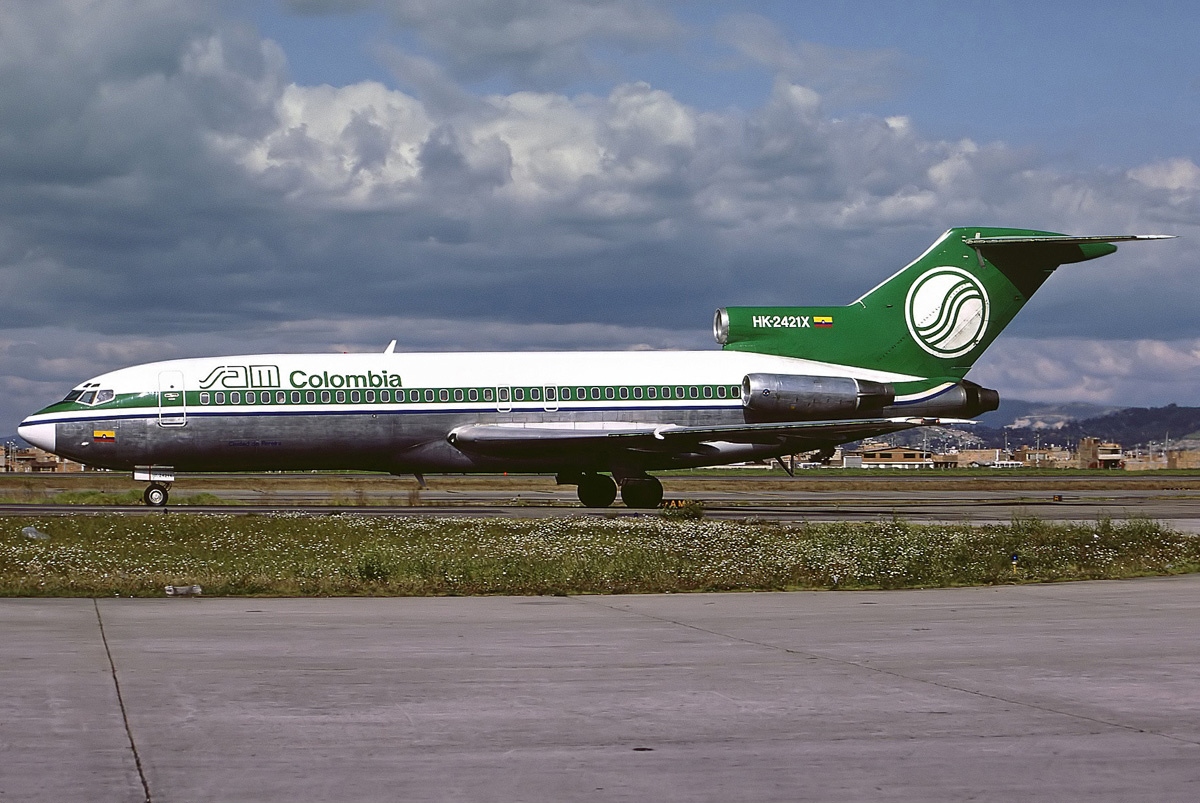

Flight sequence and impact
The flight crew reported passing the Abejorral non-directional beacon (NDB) at flight level 160 (FL160) and subsequently received clearance to descend to FL120. In reality the aircraft had not yet reached the beacon when it began descending. While descending in an area of high terrain the jet struck Mount Páramo Frontino at an elevation reported near 12,300 feet, resulting in total loss of life. The accident occurred amid thunderstorm activity that complicated radio-directional navigation.
Navigation aids and contributing conditions
Investigations and contemporary reports emphasized several navigational and environmental factors. Thunderstorms in the region can cause erratic signals and reduce the accuracy of ADF (Automatic Direction Finder) bearings to NDBs. At the same time, the Medellín VOR/DME — a more precise ground-based aid — was unserviceable after being rendered inoperable by an attack, forcing crews to rely on degraded navigation aids. The combination of adverse weather, imperfect position awareness and descent below a safe altitude is believed to have resulted in the aircraft striking terrain.
Aircraft and operational context
The Boeing 727 is a three-engine, narrow-body jet that was widely used for short- and medium-haul routes. Like many airliners of its era, safe operation in challenging terrain depended heavily on accurate ground-based navigational aids and crew situational awareness. In mountainous regions, instrument procedures require strict adherence to published altitudes and fixes; deviation from those protections can lead to CFIT when visibility is limited.
Aftermath, lessons and significance
The crash of Flight 501 underscored vulnerabilities that arise when crews must rely on limited or unreliable navigational signals amid severe weather. Accidents of this type contributed to an industry-wide emphasis on improved avionics, better crew training in navigation and crew resource management, and the later widespread adoption of satellite navigation (GPS) and enhanced ground proximity warning systems (EGPWS/TAWS) that reduce the risk of inadvertent descent into terrain. The accident also highlighted the operational impact when critical ground facilities are unavailable.
Notable facts
- Total fatalities: 132 (all on board).
- Aircraft type: Boeing 727-200 series operated by SAM Colombia.
- Location: Mount Páramo Frontino, in the approach area for Medellín.
- Contributing factors frequently cited: navigational error, thunderstorms affecting ADF/NDB signals, and an unserviceable VOR/DME.
- The accident is remembered as a CFIT event that reinforced the need for redundant, modern navigation and terrain awareness systems.
Questions and answers
Q: What was SAM Colombia Flight 501?
A: SAM Colombia Flight 501 was a Boeing 727-46 that crashed on May 19, 1993, killing all 132 passengers on board.
Q: What caused the crash of SAM Colombia Flight 501?
A: SAM Colombia Flight 501 crashed because it descended into mountainous terrain while approaching Medellín. The crew reported being over the Abejorral NDB beacon, but they had not yet reached it.
Q: Why was ADF navigation more difficult for SAM Colombia Flight 501?
A: Thunderstorm activity in the area made ADF navigation more difficult for SAM Colombia Flight 501.
Q: Why was the Medellín VOR/DME unserviceable?
A: The Medellín VOR/DME was unserviceable because it had been attacked by terrorists.
Q: How many people were killed in the crash of SAM Colombia Flight 501?
A: All 132 people on board SAM Colombia Flight 501 were killed in the crash.
Q: Were there any specific people who were on board SAM Colombia Flight 501?
A: Yes, several Panamanian dentists were on board SAM Colombia Flight 501 on their way to a convention.
Q: What altitude was the SAM Colombia Flight 501 at when it struck Mount Paramo Frontino?
A: SAM Colombia Flight 501 was at an altitude of 12,300 feet when it struck Mount Paramo Frontino.
Related articles
Author
AlegsaOnline.com SAM Colombia Flight 501 — 1993 Boeing 727 crash near Medellín Leandro Alegsa
URL: https://en.alegsaonline.com/art/86616
Sources
- aviation-safety.net : "Aircraft accident Boeing 727-46 HK-2422X Medellín" · webcitation.org
- jetphotos.net : "Boeing 727-46 HK-2422" · webcitation.org
- nytimes.com : "132 on Missing Colombian Plane" · webcitation.org