
Saudia Flight 163
A 1980 in-flight fire aboard a Lockheed L-1011 TriStar that led to the deaths of all 301 people on board after an emergency landing in Riyadh; investigation focused on a cargo-area fire and evacuation delays.
Saudia Flight 163 was a scheduled international service on 19 August 1980 that became one of the most tragic aviation accidents involving an onboard fire. The flight, operated by Saudia, carried 287 passengers and 14 crew aboard a Lockheed L-1011 TriStar. The aircraft departed from Karachi and was en route to Jeddah, with a planned stop at Riyadh International Airport.
Image gallery
7 Images


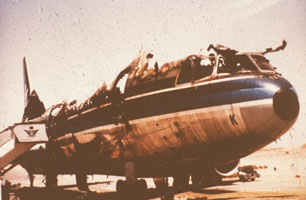


Aircraft and flight details
The airliner involved was a widebody Lockheed L-1011 TriStar, a three-engine jetliner commonly used on medium- to long-haul routes in that era. Shortly after takeoff, crew members detected indications of a fire; the source was later determined to be in or near the rear compartment. Seven minutes after becoming airborne the crew reported the emergency and returned to Riyadh for an immediate landing.
Sequence of events and casualties
After the airplane touched down at Riyadh and taxied to a stop, passengers and crew remained aboard. Despite the successful landing, smoke quickly spread through the cabin. All 301 people on board succumbed to smoke inhalation before an effective evacuation could be completed, and the aircraft was subsequently destroyed by the post-landing fire.
Investigation findings
Subsequent inquiries focused on the origin and propagation of the fire and on operational decisions made after landing. Investigators concluded that the fire began in the aft baggage or equipment area, but they did not identify a single, conclusively proven ignition source. Contributing factors cited included the rapid accumulation of smoke, limitations in early detection and suppression systems, and delays or complications in initiating an immediate evacuation once the aircraft was on the ground.
Consequences and legacy
The accident prompted review of in-flight fire procedures, cargo and baggage fire protection standards, cabin smoke detection, and crew training for rapid evacuation. It illustrated how a survivable landing can nonetheless result in total loss of life when smoke control and evacuation are inadequate. The event remains a reference point in discussions of onboard fire safety and emergency response protocols.
Notable distinctions
- The crash is often cited among the deadliest aviation incidents in which post-landing evacuation failures and smoke inhalation were primary causes of fatalities.
- It emphasized the vulnerability of rear cargo and equipment compartments to hidden fires and the critical need for reliable detection and suppression.
For further contextual information about the airline and the route, see sources associated with Saudia and the airports at Karachi, Riyadh and Jeddah.
Questions and answers
Q: What was Saudia Flight 163?
A: Saudia Flight 163 was a scheduled passenger flight from Karachi to Jeddah, via Riyadh.
Q: What kind of airplane was used for Saudia Flight 163?
A: The airplane used for Saudia Flight 163 was a Lockheed L-1011 TriStar.
Q: How many passengers and crew members were on-board the flight?
A: There were 287 passengers and 14 crew members on-board the flight.
Q: When did the fire on the flight occur?
A: The fire on the flight occurred seven minutes after take-off.
Q: Did the plane land safely after the fire broke out?
A: The plane made an emergency landing at Riyadh International Airport.
Q: How did the passengers and crew members die?
A: All 301 people on-board died of smoke inhalation.
Q: Was the plane salvageable or destroyed by the fire?
A: The plane was destroyed by the fire.
Related articles
Author
AlegsaOnline.com Saudia Flight 163 Leandro Alegsa
URL: https://en.alegsaonline.com/art/87529