
Bakhshali manuscript
An early South Asian mathematical manuscript on birch bark featuring arithmetic and algebra, found near Bakhshali in 1881; notable for its problem-oriented style and debated dating.
Overview
The Bakhshali manuscript is an ancient South Asian mathematical manuscript written on birch bark. It was recovered in 1881 near the village of Bakhshali in what was then the North-West Frontier Province of British India (today in Pakistan). Only a fragmentary portion has survived: roughly seventy leaves remain, and most scholars view the extant pages as a copy of an even older ancient text.
Image gallery
3 Images

Physical characteristics and language
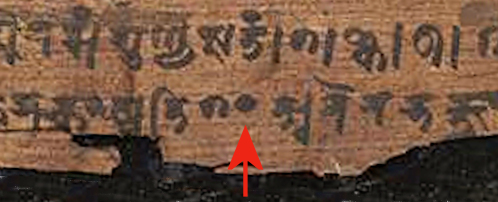
The manuscript is composed of many small birch-bark folios written in a form of classical and vernacular language used for technical manuals. The leaves contain compact prose rules followed by worked numerical examples rather than extended narrative exposition. The handwriting and orthography show regional features that have contributed to uncertainty about precise origins and date.
Mathematical contents
The material is practical and problem-oriented. Topics represented among the leaves include arithmetic algorithms, fractions, methods for extracting square roots, rule-based procedures for linear and certain quadratic problems, mensuration-type examples, and compound computations used in trade and land measurement. The manuscript typically states a rule in concise form and then demonstrates it with numerical problems and solutions, a common style for mathematical manuals in South Asia.
Dating and scholarly debate
The age of the manuscript has been debated for over a century. Proposals have ranged widely; some scholars have argued for an early medieval date while others have suggested later copyist activity. Scientific dating of individual folios conducted in recent years produced disparate results, which reinforced the idea that the surviving leaves may not be contemporary with the original composition. Most modern researchers treat the Bakhshali manuscript as a parchment of transmission: a copy representing older mathematical traditions rather than proof of a single fixed date of composition.
Importance and notable features
Despite its fragmentary state, the Bakhshali manuscript is widely valued for showing the techniques and pedagogy of mathematics in South Asia. It preserves computational practices that illuminate how merchants, land surveyors, and scholars handled everyday quantitative problems. The pages also contain a symbol used as a numerical placeholder, which has attracted attention in discussions of the historical development of the concept of zero; scholars debate how to interpret this sign and its relationship to later numeral systems.
Provenance and current status
After its discovery, the manuscript entered collections and has been studied by historians of mathematics and philologists. It remains an important object for research into transmission of mathematical knowledge, copyist practices, and the vernacular technical literature of the region. Ongoing work combines philological analysis with careful scientific testing to clarify the chronological and cultural context of this compact but significant text.
- Discovery site: Bakhshali
- Material: birch bark
- Surviving folios: seventy leaves
- Scholarly view: copy of an earlier ancient text
- Contextual references: mathematical manuscript, text
For readers interested in deeper study, academic publications and museum catalogues provide detailed transcriptions, translations, and photographic plates that facilitate close comparison of the script and mathematical content.
Related articles
Author
AlegsaOnline.com Bakhshali manuscript Leandro Alegsa
URL: https://en.alegsaonline.com/art/8414
Sources
- www-history.mcs.st-andrews.ac.uk : The Bakhshali manuscript