
Bambi's Children: The Story of a Forest Family
A sequel by Felix Salten that follows the twin fawns Geno and Gurri as they grow, learning the pleasures and dangers of forest life; gentler in tone than the original Bambi.
Bambi's Children: The Story of a Forest Family is a continuation of the forest saga created by Felix Salten. Written originally in German, the work follows the next generation of deer after the events of the earlier book Bambi, A Life in the Woods. It is commonly cited under its German title Bambis Kinder. The narrative centers on Bambi's twin fawns and presents an animal-centered view of growing up in a woodland community.
Image gallery
1 Image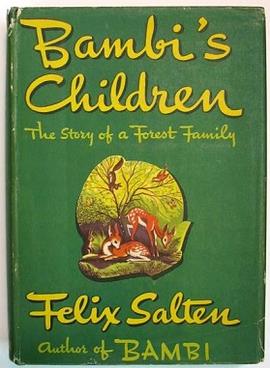
Plot and principal characters
The story concentrates on the experiences of two young deer twins, Geno (male) and Gurri (female), as they move from playful infancy toward the responsibilities of maturity. Their circle includes friends Lana and Boso, who are members of a neighboring family led by Aunt Rolla. The novel also introduces two orphaned fawns, Nello and Membo, whose presence broadens the book's exploration of care, loss, and social bonds within the forest. The parents, Bambi and Faline, appear chiefly as guides and protectors, with Faline ultimately encouraging her offspring to begin independent life.
Structure and tone
Compared with the original novel about Bambi, this book is often described as gentler and more child-centered in style. Where the earlier story contains darker meditations on survival and human impact, the sequel focuses more on daily lessons: foraging, play, avoiding predators and hunters, the development of senses, and the seasonal rhythms of the woods. The book closes at a turning point in the fawns' lives, when Geno begins to grow his first antlers.
Themes and notable elements
- Coming of age: the central arc follows physical growth, learning, and changing social roles.
- Community and family: care, mentorship, and the obligations of kinship appear throughout.
- Nature's cycles: seasonal change and the continuity of life are persistent backdrops.
- Human presence: hunters and other human influences remain a subtle but important threat, shaping behavior and caution.
The book uses anthropomorphic perspective to make animal life accessible while retaining an observational tone about instincts and survival. This balance gives Salten room to treat both tender moments and necessary harshness without relying on overt moralizing.
Publication, relation to the original, and adaptations
The work was issued in English translation in 1939, with a German edition following soon after. Its chronological relationship to the earlier novel has drawn comment: some readers treat it as a straightforward sequel, while others note gaps in the timeline that allow different readings of where it sits in the larger narrative arc—an ambiguity discussed in critical overviews and bibliographies (see commentary). The Disney studio adapted the first novel for film in the early 1940s, but the sequel was not used as the basis for that feature.
Readers interested in characters and genealogy will find repeated references to the original title character, Bambi, and to his mate, Faline, which help connect family dynamics across the two books. Editions and translations vary in presentation and paratextual material; readers seeking a particular version should consult library catalogues or specialist guides.
Questions and answers
Q: Who is the author of the book Bambi's Children?
A: The book was written by Felix Salten.
Q: When was Bambi's Children first printed and translated into English?
A: Bambi's Children was first printed and translated from German to English in 1939.
Q: What is Bambi's Children a sequel to?
A: Bambi's Children is a sequel to Salten's book Bambi, A Life in the Woods.
Q: Who are the main characters in Bambi's Children?
A: The main characters are Bambi's twin fawns, Geno and Gurri, and their friends Lana and Boso.
Q: What happens at the end of Bambi's Children?
A: Faline sends off her children to live their own lives.
Q: How does the language of Bambi's Children compare to the language of Bambi, A Life in the Woods?
A: The language of Bambi's Children is more gentle than that of Bambi, A Life in the Woods.
Q: Is it possible to determine whether Bambi's Children is a sequel or a midquel to Bambi?
A: It is not possible to determine whether Bambi's Children is a sequel or a midquel to Bambi as there are no references to the former.
Related articles
Author
AlegsaOnline.com Bambi's Children: The Story of a Forest Family Leandro Alegsa
URL: https://en.alegsaonline.com/art/8639
Sources
- books.google.com : A Companion to the Works of Arthur Schnitzler