
Reticulated python
Large non-venomous snake from Southeast Asia, often cited as the world's longest. A powerful constrictor found in diverse habitats, kept in captivity and subject to hunting, but rarely involved in attacks on people.
Overview
The reticulated python (Python reticulatus) is a large species of python native to parts of Southeast Asia. It belongs to the broader python group and is widely known for its length: individuals commonly reach several metres and the species includes the longest reliably measured snakes. Reticulated pythons are non-venomous constrictors that subdue prey by coiling and applying pressure rather than by toxin.
Image gallery
10 Images


Physical characteristics
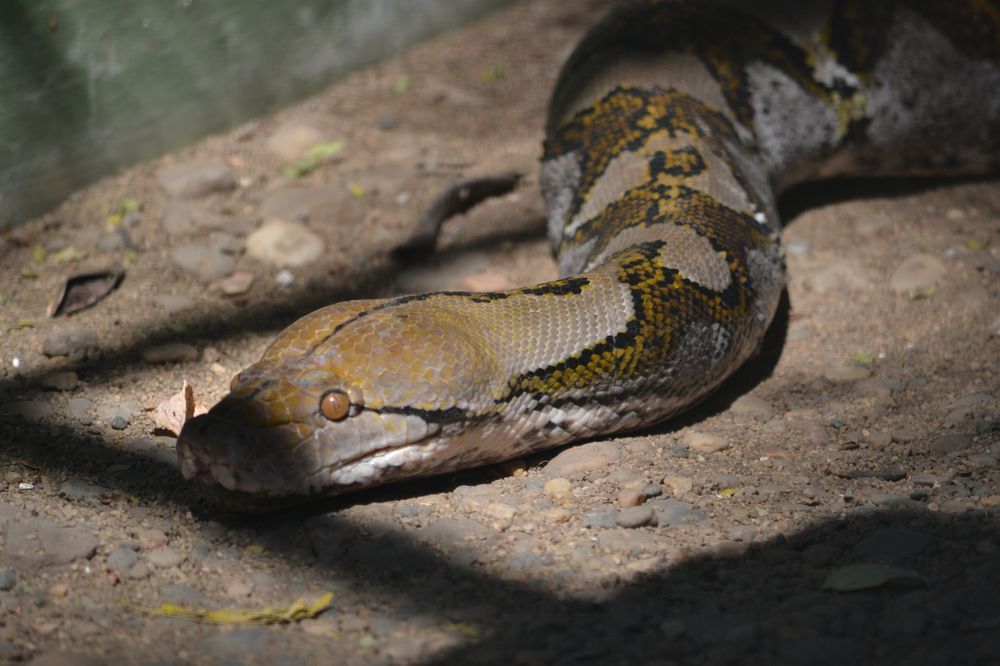
Reticulated pythons have a slender but muscular build with complex, net-like patterns of brown, black and gold on their scales, which provides camouflage in forest and scrub habitats. Adult sizes vary with geography and sex, and while many adults measure in the mid-range of a few metres, some exceptionally large specimens have been recorded. Key features include heat-sensing pits along the jaw, a broad head distinct from the neck, and strong, muscular bodies adapted to constriction.
Distribution and habitat
These pythons inhabit a wide range across islands and mainland areas of Southeast Asia, from rainforests and woodlands to grasslands and areas close to watercourses. They are adaptable and may be found near human settlements where suitable prey is present. Their capacity to swim well allows them to disperse across island systems and occupy varied microhabitats.
Behavior and diet
Reticulated pythons are primarily nocturnal ambush predators. Their diet consists of mammals and birds; larger adults can take substantial prey such as pigs, deer and occasionally primates. Typical hunting behavior involves stalking or ambushing, then seizing with the jaws and killing by constriction. Juveniles feed on smaller rodents and birds, growing steadily as they consume larger meals.
Reproduction and lifecycle
Like other pythons, reticulated pythons are oviparous and lay clutches of eggs. Females commonly coil around their eggs to protect and thermoregulate them until hatching. Young are independent upon emergence and must hunt small prey items. Growth rates depend on food availability and environmental factors.
Relationship with people and conservation
Reticulated pythons have long been hunted for their skins and sometimes collected for the pet trade and zoos. They are powerful animals capable of killing large prey and, in rare cases, have killed humans; however, attacks on people are uncommon. The species' interactions with people also include occasional conflicts where snakes enter villages or farms. Their populations face pressures from habitat loss and hunting in parts of their range, and trade and protection are regulated in some jurisdictions. For comparisons to other large snakes, note that the green anaconda is heavier-bodied though generally shorter, and guidance for safe coexistence can be found in resources about human encounters.
- Notable traits: extreme length, distinctive reticulated pattern.
- Feeding: mammals and birds; larger adults can take sizeable prey.
- Human relevance: skins, captivity, rare dangerous encounters.
Related articles
Author
AlegsaOnline.com Reticulated python Leandro Alegsa
URL: https://en.alegsaonline.com/art/82342