
Python (snake): overview, biology, distribution and conservation
Comprehensive overview of pythons (family Pythonidae): appearance, anatomy, behaviour, reproduction, distribution, taxonomy, human interactions, captivity and conservation.
Overview
In common usage, the term "python" refers to a group of large, primarily nonvenomous constricting snakes traditionally placed in the family Pythonidae. Some references use the name for a single genus and others apply it more widely to related genera within the family. Pythons are ambush predators that subdue prey by coiling and applying sustained pressure rather than by using venom. They are closely related to boas and share a number of anatomical and ecological similarities with that group; historical treatments sometimes allied them with the family Boidae.
Image gallery
7 Images

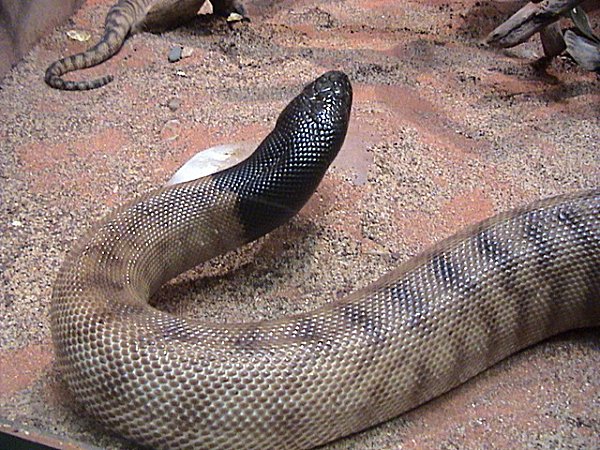


Key characteristics
Pythons share a set of features that are common across the family. Typical traits include:
- Robust, muscular bodies adapted for seizing and constricting prey.
- Sensory pits (heat-sensitive organs) along the jaws in many species, enabling detection of warm-blooded prey at close range.
- Oviparity in most species: females lay eggs and some species exhibit active maternal care during incubation.
- Recurved teeth and wide, flexible skulls that permit ingestion of large prey items relative to head size.
- Substantial size variation across species, from compact forms often kept as pets to some of the world’s longest snakes.
Anatomy and senses
The skull of a python is highly kinetic: multiple movable bones and ligaments allow the jaws to expand around prey. Many species possess labial pits or loreal pits that detect infrared radiation, supplementing visual and chemical cues when locating endothermic prey. The skin is covered in scales that vary in texture and patterning by species; coloration often provides camouflage matching their preferred habitat.
Locomotion and behaviour
Pythons use lateral undulation, concertina motion, and rectilinear progression to move, depending on substrate and situation. Most are primarily terrestrial or semi-arboreal, though some species spend considerable time in trees or near water. They are predominantly sit-and-wait predators: a python will remain motionless, concealed, and then strike quickly when a suitable prey item comes within reach.
Feeding and digestion
After capturing and constricting prey, a python swallows it whole, typically head-first. Larger species are capable of subduing substantial prey items, including medium-sized ungulates in some regions. Digestion can be slow, with metabolic and physiological processes adjusted to cope with infrequent large meals. Pythons can fast for extended periods between successful hunts.
Distribution and habitat
Pythons occur across a broad range of tropical and subtropical regions. Representative areas include Southeast Asia, much of Africa, New Guinea and Australia. Individual species are adapted to diverse habitats such as rainforests, savannas, wetlands, rocky outcrops and human-modified landscapes. Local abundance and habitat preferences vary widely between species.
Reproduction and lifecycle
Most pythons lay eggs. Females of several species coil around their clutch and may exhibit thermoregulatory behaviour—including muscular shivering that generates heat—to maintain optimal incubation temperature. Clutch size, incubation duration and juvenile growth rates vary with species and environmental conditions. Young are typically independent at hatching and must fend for themselves immediately.
Taxonomy and evolution
Classification of pythonids has been refined by comparative anatomy and molecular studies. Modern work supports Pythonidae as a distinct family closely allied to other henophidian snakes such as boas. Genetic research has also contributed to understanding of deep evolutionary patterns among snakes, including the origins and distribution of genes associated with venom in various lineages, even though pythons themselves are nonvenomous in the sense of lacking a functional venom-delivery system.
Ecology and interactions
As predators, pythons play a role in controlling populations of small to medium-sized vertebrates. Their prey typically includes rodents, birds and other small mammals; in some regions larger species take sizeable ungulates and similar animals, and there are reports of African pythons feeding on animals like gazelles where ecological conditions allow. Pythons are in turn affected by parasites, predators when young, and competition with other carnivores.
Humans, captivity and conservation
Pythons are valued in some cultures for meat, skins and other uses, and several species are popular in the global pet trade. Some species have been overexploited or suffer habitat loss and persecution, leading to conservation concern for particular taxa. Conversely, when introduced outside their native range—most notably when certain large pythons became established in parts of the southeastern United States—they can become invasive and impact local wildlife. Conservation status is assessed species-by-species by regional and international authorities.
Notable species and records
- Smaller species, such as the ball python, are common in the pet trade and are known for their manageable size and temperament.
- Large species, including the reticulated python and the Burmese python, are among the longest snakes and are often cited in discussions of size extremes and ecological impact when introduced outside their native range.
Further reading and resources
For taxonomic summaries and regional identification consult specialist field guides and scientific reviews. General introductions to the genus and family can be found at resources treating the genus Python, broader articles on constriction and constricting snakes, and family-level treatments at Pythonidae. Historical perspectives on relationships with boas are discussed in older literature that references Boidae.
Questions and answers
Q: What is the scientific name for Python?
A: The scientific name for Python is Pythonidae.
Q: How do Pythons reproduce?
A: Pythons are oviparous, meaning they lay eggs to reproduce.
Q: Where can Pythons be found in the wild?
A: Pythons can be found in Southeast Asia, Africa, New Guinea and Australia.
Q: What type of predators are Pythons?
A: Most members of the Python family are ambush predators; they stay motionless in a camouflaged position and then strike suddenly at passing prey.
Q: How big can a Python get?
A: The size of a python depends on its species; some species like ball pythons can grow up to 3 feet long while others like reticulated pythons can reach 29 feet long.
Q: Are Pythons dangerous to humans?
A: Despite their size, pythons are rarely dangerous to humans.
Q: How long do Pythons typically live for?
A: On average, pythons can live up to 30 years.
Related articles
Author
AlegsaOnline.com Python (snake): overview, biology, distribution and conservation Leandro Alegsa
URL: https://en.alegsaonline.com/art/80263
Sources
- doi.org : 10.1038/nature04328
- pubmed.ncbi.nlm.nih.gov : 16292255
- zoo-hannover.de : Python
- usgs.gov : usgs.gov/faqs/how-have-invasive-pythons-impacted-florida-ecosystems?qt-news_science_produ…
- thestar.com : thestar.com/news/canada/2015/03/31/man-charged-in-python-asphyxiation-death-of-boys.html