
Rhacophoridae: Old World shrub, bush and flying frogs
Rhacophoridae is a family of mostly arboreal frogs from Asia and Africa, known for foam nests, adhesive toe pads and some gliding 'flying frogs'. Overview, traits, reproduction, taxonomy and conservation.
The Rhacophoridae are a distinct family of amphibians composed of many species found primarily in tropical parts of Asia and parts of Africa. Members of this group are commonly referred to as shrub frogs, bush frogs or Old World tree frogs. The family includes a remarkable variety of forms, from small ground‑dwelling types to large, web‑winged gliders often called flying frogs.
Image gallery
3 Images

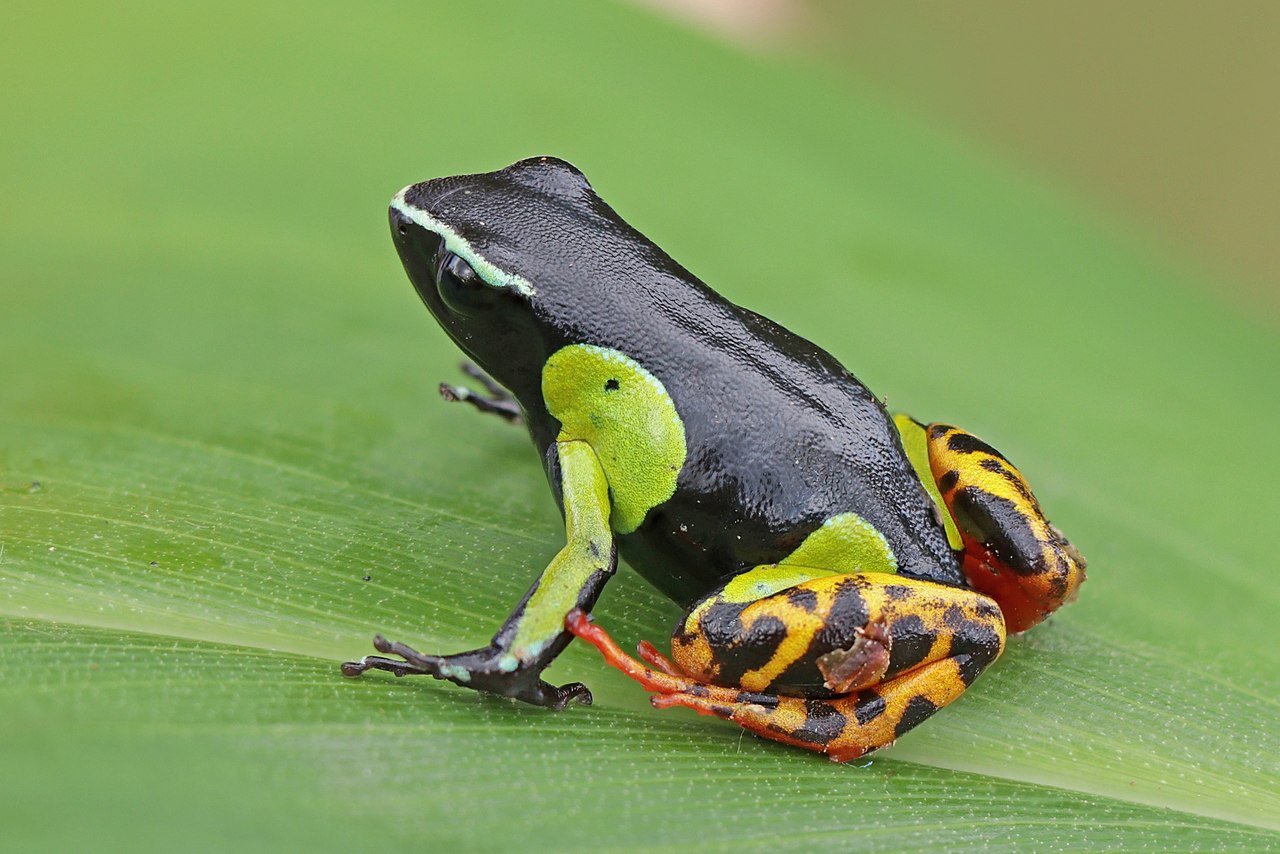
Key characteristics
Rhacophorids are typically adapted to life above ground. Many species are strongly arboreal, possessing expanded toe pads and adhesive skin surfaces that let them cling to leaves and branches. The degree of webbing between fingers and toes varies broadly across the family: in some genera the webbing is modest, while in gliding forms it is extensive and enables controlled aerial descent from the canopy.
Size across the family ranges from very small frogs (a few centimetres) to larger species reaching about 12 centimetres in body length. Common morphological features include long limbs, flattened bodies in some tree‑dwelling species, and specialized pads on fingers and toes; internal features used by taxonomists include skull shape and elements of the limb skeleton.
Reproduction and life cycle
Reproductive strategies in Rhacophoridae are diverse and often tied to arboreal habits. A well known strategy is foam‑nesting: mating pairs in amplexus produce a frothy matrix in which eggs are embedded. This foam—created and mixed with glandular and seminal secretions during pairing—hardens into a protective mass placed above standing water so that developing tadpoles drop into the water after hatching. Other genera lay eggs in leaf axils, tree holes or on the ground; some taxa exhibit direct development, where eggs hatch as miniature froglets without a free‑swimming tadpole stage.
Taxonomy, distribution and notable genera
Rhacophoridae are part of the Old World radiation of tree‑frogs and are distinct from the New World Hylidae. Taxonomic treatments have changed over time as molecular studies refine relationships; commonly recognized genera include Rhacophorus, Polypedates, Chiromantis and various shrub‑frog groups, with some species reassigned as new data appear. Their distribution spans South and Southeast Asia, parts of East Asia, India, Madagascar and continental Africa, occupying forests, secondary vegetation and sometimes agricultural landscapes.
Ecology, importance and conservation
These frogs play important roles in food webs as insect predators and as prey for larger animals. Their varied reproductive modes illustrate adaptive responses to life in trees and seasonal waters. Many rhacophorids are sensitive to habitat loss from deforestation, fragmentation and wetland drainage; amphibian diseases (for example chytridiomycosis) and climate change also pose risks. Several species are subjects of conservation concern and captive breeding programs, and some—like the spectacular Wallace's flying frog (Rhacophorus nigropalmatus)—attract public interest for education and ecotourism.
Notable facts and identification tips
- Common names: shrub frogs, bush frogs, Old World tree frogs; some are called tree frogs and others are famed as flying frogs.
- Most are arboreal, with sticky toe discs and variable webbing.
- Foam‑nesting behavior is widespread: eggs are mixed into foam during amplexus and placed above water so tadpoles can drop down.
- The family contains many species with a range of life histories and sizes from small shrub‑dwellers to larger canopy specialists.
For further reading and species lists see family accounts and regional field guides that treat Rhacophoridae in detail, which can be found through taxonomic databases and conservation resources (family overview, species lists): these resources document geographic records, natural history and current conservation status.
Questions and answers
Q: What is Rhacophoridae?
A: Rhacophoridae is a family of frog species.
Q: Where do Rhacophoridae family of frogs typically live?
A: Rhacophoridae family of frogs typically live in tropical regions of Asia and Africa.
Q: What are some common names for Rhacophoridae frogs?
A: Some common names for Rhacophoridae frogs are shrub frogs, moss frogs, bush frogs, and tree frogs.
Q: What are flying frogs?
A: Flying frogs are members of the Rhacophoridae family of frogs that have extensive webbing between their hands and feet, allowing them to glide through the air.
Q: What is the method of reproduction for Rhacophoridae frogs?
A: The method of reproduction for Rhacophoridae frogs is mating while in amplexus, holding onto a branch, beating their legs to form foam, laying eggs in the foam, and covering the eggs with seminal fluid. The foam hardens into a protective casing, and in some species, this is done in a large group. The foam is then laid above a water source for the tadpoles to fall into the water once they hatch.
Q: What is the size range of Rhacophoridae species?
A: The size range of Rhacophoridae species varies from 1.5 centimetres to 12 centimetres.
Q: What distinguishes the Old World flying frogs?
A: The Old World flying frogs, including Wallace's flying frogs (Rhacophorus nigropalmatus), have extensive webbing between their hands and feet, allowing them to glide through the air.
Related articles
Author
AlegsaOnline.com Rhacophoridae: Old World shrub, bush and flying frogs Leandro Alegsa
URL: https://en.alegsaonline.com/art/82460
Sources
- amphibiaweb.org : "Rhacophorus nigropalmatus, Wallace's Flying Frog"
- commons.wikimedia.org : Rhacophoridae