
Resonator: Principles, Types and Applications
A resonator is any object or system that naturally oscillates at particular frequencies. This article explains how resonators work, common types, historical notes, and typical uses in sound, electronics and optics.
A resonator is any object, structure or system that naturally supports oscillations at one or more preferred frequencies. When energy is supplied near those frequencies, the system responds strongly and stores vibrational energy for longer than at other frequencies. In simple terms, a resonator tends to amplify a particular frequency of a sound or other vibration, producing a pronounced peak in response.
Image gallery
5 Images
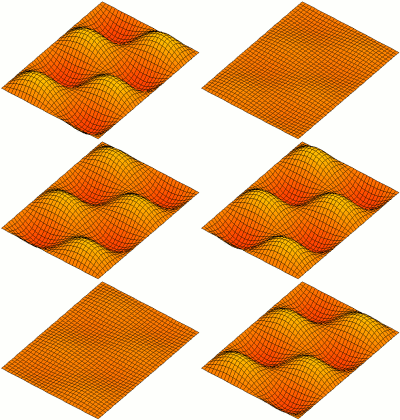


Key characteristics
Important properties of resonators include the resonant frequency (or frequencies), the quality factor or Q (which quantifies how narrow and long-lived the response is), and the damping or losses that limit amplitude. Resonators support modes — spatial patterns of oscillation — and may show standing waves, nodes and antinodes. Coupling to an external source determines how much energy is exchanged and whether the resonance appears as a sharp peak or a broad response.
Common types and examples
- Acoustic resonators: cavities and bodies that shape musical tones (guitar and violin bodies, organ pipes, Helmholtz resonators).
- Mechanical resonators: tuning forks, beams, mass–spring systems, and engineered MEMS devices used as sensors.
- Electrical resonators: LC circuits, crystal oscillators and filters that select radio or clock frequencies.
- Optical resonators: mirrors and cavities in lasers (Fabry–Pérot), and photonic resonators that confine light.
History and development
Resonance has been exploited since antiquity in musical instruments and architecture. Systematic scientific study emerged in the 18th and 19th centuries, with contributors such as Hermann von Helmholtz clarifying acoustic resonances. The concept became central to radio engineering, electronics and later to optics and quantum devices as technology enabled precise control of frequency and loss.
Uses, importance and cautions
Resonators are critical in tuning, timing and sensing: they form filters in communications, frequency references in clocks and microphones and transducers in sensors. High-Q resonators provide stable, narrowband performance, while low-Q resonators are used where broader response or faster settling is needed. Resonance can also be hazardous; excessive excitation can cause structural failure (as in famous bridge and building examples), so designers control damping and coupling to avoid unwanted amplification.
Related articles
Author
AlegsaOnline.com Resonator: Principles, Types and Applications Leandro Alegsa
URL: https://en.alegsaonline.com/art/82298