
Radius (bone)
The radius is the lateral forearm bone that enables wrist motion and rotation of the hand. This article covers its anatomy, function, development, evolutionary context and clinical importance.
The radius is one of the two long bones of the lower forearm, paired with the ulna. It lies on the thumb side of the forearm and, together with the humerus above and the wrist bones below, forms joints that permit flexion, extension and rotation of the hand. The radius and ulna are the primary skeletal elements of the lower forearm in tetrapods, and they articulate proximally at the elbow and distally with the carpus.
Image gallery
10 Images


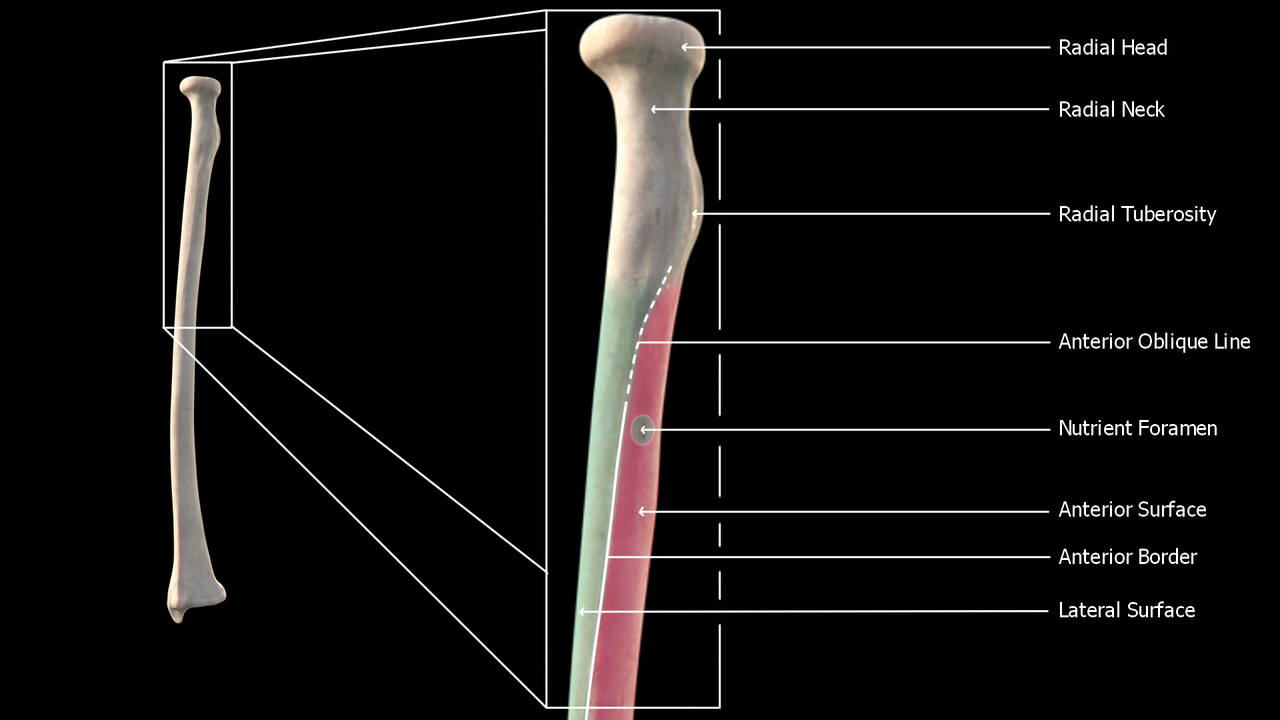


Structure and parts
The radius has a distinct proximal end, a shaft and a distal end. Key surface features include the rounded head that articulates with the humerus and the ulna, a neck, the radial tuberosity for tendon attachment, the shaft with a gentle twist, and a distal end that terminates in a styloid process. These regions serve as attachment sites for muscles and ligaments and determine the bone's mechanical behavior during movement.
Function and movement
Functionally, the radius enables pronation and supination—the rotational movements that turn the palm down or up—by rotating around the ulna. It also transmits forces from the hand to the elbow and contributes to wrist stability. Its proximal and distal articulations and ligamentous connections allow coordinated motion between the two forearm bones and the wrist.
Development and evolution
The radius develops from one or more ossification centers during childhood and fuses with growth plates as maturity is reached. Across vertebrates the relative size and shape of the radius differ according to limb use: in running or digging animals the bone may be robust, while in climbing or flying species it can be modified or reduced. In human anatomy the pair of forearm bones is commonly grouped as paired forearm bones forming the lower forearm.
Clinical relevance
Fractures of the radius are among the most frequent limb injuries, especially near the wrist. Common patterns include distal radius fractures that affect wrist alignment and growth-plate injuries in children. Treatment ranges from immobilization to surgical fixation depending on displacement and joint involvement. Understanding the radius's anatomy is essential for diagnosing trauma and planning reconstructive procedures.
- Main parts: head, neck, radial tuberosity, shaft, distal styloid.
- Common issues: distal fractures, tendon-related pain, growth-plate injuries.
- Comparative note: its form reflects functional demands across tetrapods.
Related articles
Author
AlegsaOnline.com Radius (bone) Leandro Alegsa
URL: https://en.alegsaonline.com/art/80785