
Proprioception (kinesthetic sense)
Proprioception is the internal sense of body position and movement, produced by receptors in muscles, tendons and joints. It underlies balance, coordination, posture and many reflexes.
Proprioception, often called the kinesthetic sense, is the internal ability to perceive the position, movement and orientation of the body and its parts without relying on vision. It lets people reach for objects, adjust posture and walk without constantly looking at their limbs. The term describes a combination of sensory signals and neural processing that together create an awareness of where the body is in space. For a simple demonstration, most people can touch the tip of their nose with their finger while their eyes are closed; this is a classic illustration of proprioceptive ability. More detail about the term is often provided in physiology resources.
Image gallery
1 Image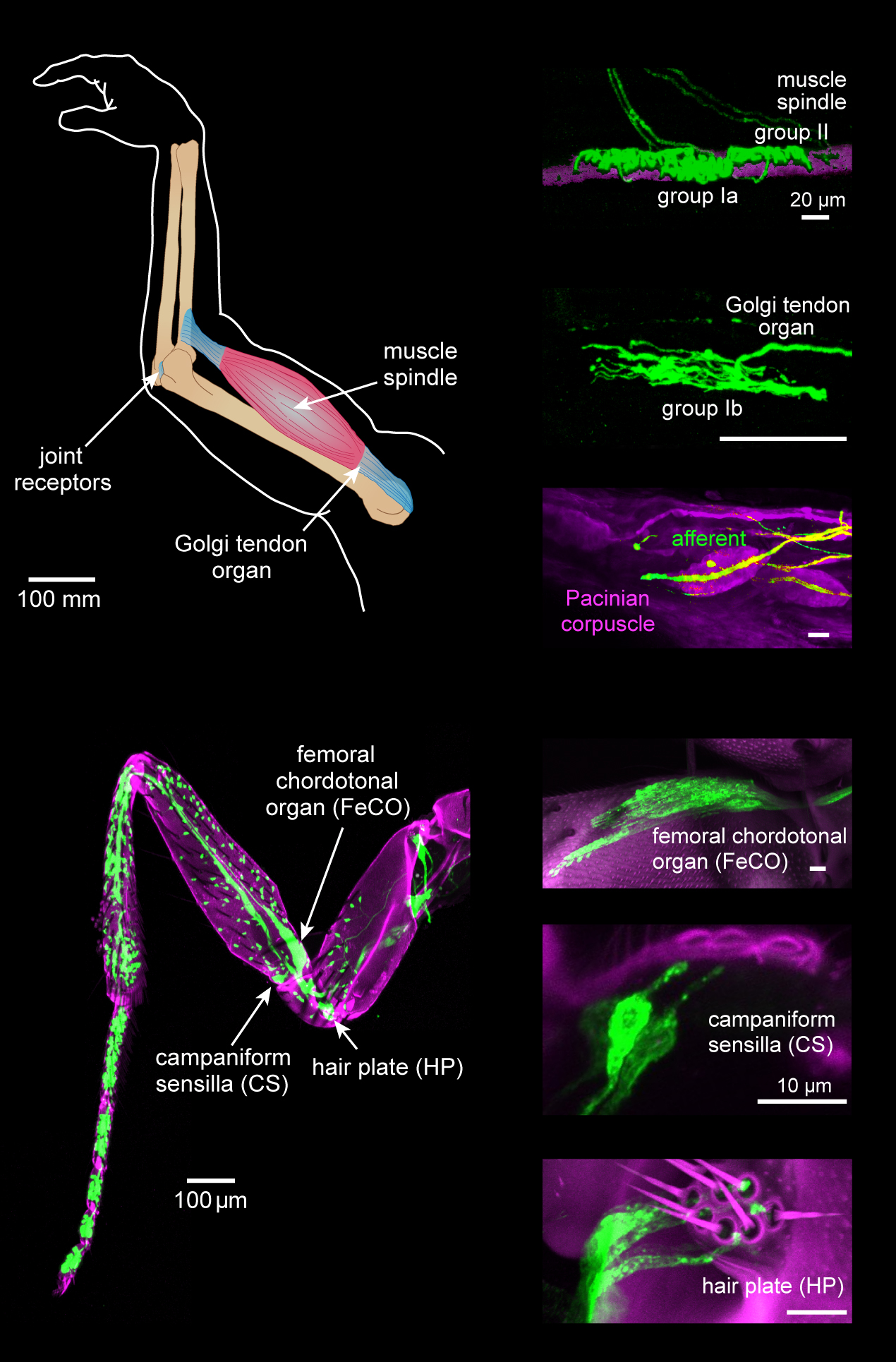
Mechanisms and receptors
Proprioception arises from specialized receptors located in muscles, tendons, joints and skin. Key receptor types include:
- Muscle spindles — detect changes in muscle length and the speed of those changes, important for sensing position and initiating reflexes.
- Golgi tendon organs — monitor tension in tendons and help protect muscles from excessive force.
- Joint receptors — respond to pressure, movement and angle at joints.
- Cutaneous receptors — give additional information about contact and pressure that contributes to limb position sense.
Integration and neural pathways
Sensory signals from these receptors travel via peripheral nerves to the spinal cord and then to several brain regions, especially the cerebellum and somatosensory cortex. The cerebellum integrates proprioceptive input to fine-tune movement and coordination, while the cortex contributes to conscious awareness of limb position. Proprioceptive information is combined with visual and vestibular cues to produce stable posture and smooth voluntary movements.
Functions and examples
Proprioception supports many everyday and complex tasks. Examples include:
- Walking and running without constant visual monitoring of the feet.
- Reaching accurately for objects — for instance, touching the nose with eyes closed demonstrates internal position sense; see this example.
- Maintaining balance while turning or standing on uneven ground, in coordination with the inner ear; compare the roles of proprioception and vision by trying the same task with eyes open or closed (vision contrast).
Clinical importance and training
Impaired proprioception can result from peripheral neuropathies, joint injuries, aging, or neurological disease and leads to clumsiness, instability and increased fall risk. Clinicians assess proprioception with bedside tests and functional exams. Rehabilitation often includes proprioceptive training — balance work, controlled joint movements and strength exercises — to restore coordination and reduce injury recurrence.
Proprioception is distinct but complementary to other senses: the vestibular system senses head motion and balance, and vision supplies external spatial cues. Together these systems allow humans to move efficiently in changing environments without constant conscious monitoring of every muscle or joint.
Related articles
Author
AlegsaOnline.com Proprioception (kinesthetic sense) Leandro Alegsa
URL: https://en.alegsaonline.com/art/79469