
Professor X (Charles Xavier) — founder and leader of the X-Men
Professor Charles Xavier, known as Professor X, is a telepathic mutant and the founder of the X-Men. He promotes peaceful coexistence between humans and mutants and appears across comics, film, and other media.
Overview
Professor Charles Xavier, commonly called Professor X, is a fictional character in the Marvel Comics universe. He is best known as a powerful telepath and the founder of the X-Men, a team of mutants who work to protect both mutantkind and humanity. Xavier is usually depicted as an intellectual leader and educator who seeks peaceful coexistence between mutants and non-mutants.
Image gallery
3 Images

Characteristics and abilities
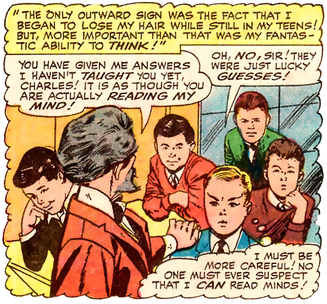
Xavier's signature ability is telepathy: he can read and influence minds, communicate mentally, and project his consciousness. He often uses specialized devices such as Cerebro to locate other mutants and amplify his powers. Although widely shown in a wheelchair, depictions of his mobility have varied across stories and adaptations. Xavier combines his psychic gifts with training, diplomacy, and scientific knowledge.
Role, school, and methods
As head of the Xavier Institute (sometimes called Xavier's School for Gifted Youngsters), Professor X trains young mutants to control their abilities and to contribute positively to society. His approach emphasizes education, restraint, and legal means for securing mutants' rights, contrasting with more militant viewpoints within the mutant community.
History and cultural context
Created in the early 1960s for the original X-Men comics, the character has served as both a narrative leader and a symbolic figure. Writers and critics have long noted that Xavier's philosophy—advocating nonviolent integration—was influenced by real-world civil rights debates of the era. He is often paired in fiction with the character Magneto, whose opposing tactics highlight tensions similar to those in historical social movements.
Appearances and portrayals
Professor X has been a central figure across comic book series, animated television, and major motion pictures. Film portrayals have included actors who played different life stages of the character, and adaptations vary in how they handle his backstory, powers, and physical condition. The character's leadership, moral complexity, and occasional fallibility have made him a continuing subject of reinterpretation.
Notable facts and distinctions
- Founder and long-time leader of the X-Men, a team focused on mutant-human relations.
- Renowned for telepathic abilities and for creating institutions devoted to mutant education and advocacy.
- Often represented in a wheelchair, a defining visual element that also speaks to themes of vulnerability and authority.
- Frequently contrasted with Magneto to explore differing responses to discrimination and injustice.
References and further reading
- Character overview
- Superhero entries
- Publisher information
- Creator: Stan Lee
- Creator: Jack Kirby
- X-Men franchise
- Telepathy and powers
- Visual depiction: wheelchair
- Comics as social commentary
- Civil rights parallels
- Influence of Martin Luther King Jr.
- Magneto character
- Influence of Malcolm X
- Film portrayal: Patrick Stewart
- Film portrayal: James McAvoy
Questions and answers
Q: Who created Professor Charles Xavier?
A: Professor Charles Xavier was created by Stan Lee and Jack Kirby for the X-Men.
Q: What is Professor X's superpower?
A: Professor X has telepathy, which allows him to read and control minds.
Q: What is Professor X's role in the X-Men world?
A: Professor X is the founder and leader of the X-Men.
Q: What was Professor X based on when the comics started addressing civil rights?
A: When the comics started being used as a social commentary about civil rights, Professor X was based on Martin Luther King Jr.
Q: What is significant about the supervillain Magneto in relation to Professor X?
A: The supervillain Magneto was based on Malcolm X, in contrast to Professor X's Martin Luther King Jr. inspiration.
Q: Who has played Professor X in the X-Men movies?
A: In the X-Men movies, Professor X has been played by Patrick Stewart and James McAvoy.
Q: What is unique about Professor X's appearance in the comics?
A: Professor X has always been depicted as being in a wheelchair in the comics.
Author
AlegsaOnline.com Professor X (Charles Xavier) — founder and leader of the X-Men Leandro Alegsa
URL: https://en.alegsaonline.com/art/79361