
Potassium bromide (KBr): properties, uses and history
Potassium bromide (KBr) is an inorganic ionic salt used in spectroscopy, photography, and historically as a sedative and anticonvulsant. It is colorless, water-soluble, and handled with care due to bromide toxicity.
Overview
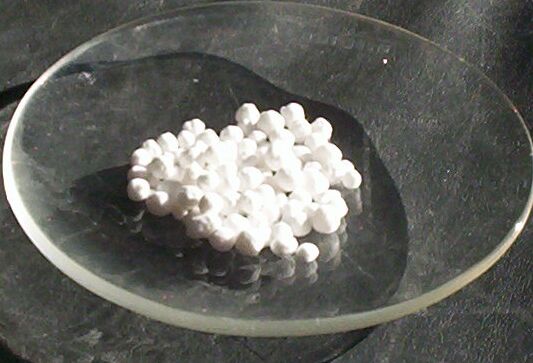
Potassium bromide is an ionic salt with the chemical formula KBr. It consists of potassium cations and bromide anions and appears as a colorless crystalline solid that dissolves readily in water. As a simple binary salt it is classified among common inorganic reagents and has been used across chemistry, industry and medicine. For a general chemical description see this reference.
Image gallery
4 Images


Properties and structure
KBr crystallizes in a halide lattice similar to many alkali halides and conducts electricity when molten or dissolved because of mobile ions. It is stable under ordinary conditions, is typically odorless and nonvolatile, and is moderately hygroscopic. The potassium component contributes alkali metal behavior while the bromide gives it the chemical reactivity typical of halide ions; compare the roles of potassium and bromide in ionic compounds.
History and development
In the late 19th and early 20th centuries, bromide salts including potassium bromide were widely used as sedatives and anticonvulsants in human medicine. Their popularity declined as safer and better‑tolerated drugs were developed, but their historical importance influenced neurology and pharmacology.
Uses and applications
- Spectroscopy and optics: KBr is commonly used to make infrared-transparent windows and to prepare pellets for FTIR analysis because it transmits across a broad infrared range; manufacturers and laboratories reference technical data for safe handling (infrared use).
- Photography and chemistry: it serves as a bromide source or restrainer in certain photographic processes and as a reagent in synthetic chemistry.
- Veterinary medicine: KBr is still used as an anticonvulsant for some animals when other treatments are unsuitable.
Safety and notable distinctions
Chronic exposure to bromide salts can lead to accumulation and neurological symptoms historically termed bromism; because of this, use in humans is limited and dosing requires care in veterinary contexts. Potassium bromide is distinct from photosensitive silver bromide despite both containing bromide: silver bromide is a photographic light-sensitive compound, while KBr is not photosensitive. Consult safety data before laboratory or clinical use.
Related articles
Author
AlegsaOnline.com Potassium bromide (KBr): properties, uses and history Leandro Alegsa
URL: https://en.alegsaonline.com/art/78410