
Potassium hydroxide (KOH) — properties, uses, production and safety
Potassium hydroxide (KOH) is a strong, hygroscopic base used across industry and laboratories. This article summarizes its composition, properties, production history, common uses and safe handling practices.
Overview
Potassium hydroxide, commonly written as KOH, is an inorganic compound consisting of potassium and hydroxide. In aqueous solution it dissociates into the potassium ion and the hydroxide ion; this ionic character gives KOH its strongly alkaline behaviour. It is often described as a caustic lye and is a fundamental reagent in chemistry and many industrial processes. See a basic reference for the compound here.
Image gallery
4 Images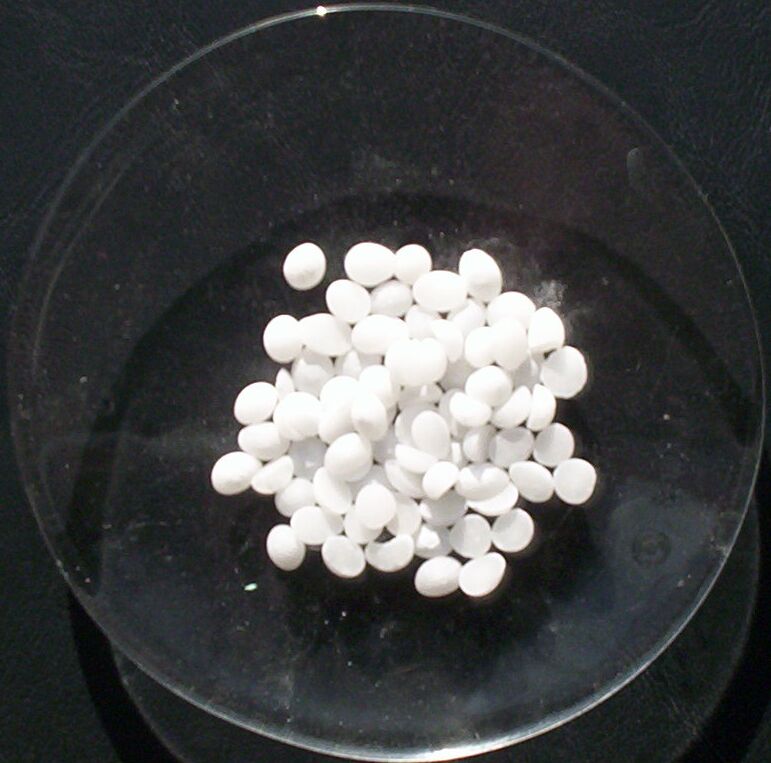



Characteristics and chemical behavior
KOH is a white, crystalline solid that is highly soluble in water; dissolution is exothermic and the solid is hygroscopic and deliquescent, absorbing moisture and carbon dioxide from the air. The active species in solution is the potassium ion paired with the hydroxide ion, which is responsible for high pH and strong corrosivity. It reacts with acids to produce salts and water and can attack many metals, releasing hydrogen gas. For additional technical details see compound data.
Origin and industrial production
Historically, alkaline solutions derived from wood ashes (potash) were the earliest source of potassium compounds and lye. The modern chemical potassium was isolated in the early 19th century, and industrial KOH is now produced mainly by electrolysis of potassium chloride solutions, a chloralkali-type process analogous to sodium hydroxide manufacture. Other laboratory routes include neutralization of potassium carbonate with calcium hydroxide.
Main uses and examples
- Manufacture of liquid soaps and soft cleansers: potassium soaps remain more soluble than sodium soaps, making KOH preferred for liquid formulations.
- As a strong base and catalyst in organic synthesis and laboratory titrations.
- Electrolyte in some types of alkaline batteries and in certain fuel cell and electrochemical applications.
- In biodiesel production, pH adjustment, metal cleaning and as a precursor to potassium salts and fertilizers.
Handling, hazards and comparisons
KOH is corrosive to skin, eyes and mucous membranes; appropriate personal protective equipment (gloves, goggles, lab coat) and ventilation are recommended. Contact with acids or water can liberate heat; contact with some metals generates flammable hydrogen. Compared with sodium hydroxide (NaOH), potassium hydroxide often yields more soluble potassium salts and is favored where liquid products or specific potassium salts are required. Dispose of residues in accordance with local regulations and avoid release to the environment.
Related articles
Author
AlegsaOnline.com Potassium hydroxide (KOH) — properties, uses, production and safety Leandro Alegsa
URL: https://en.alegsaonline.com/art/78417