
Pitjantjatjara language
Pitjantjatjara is a Western Desert Aboriginal language of central Australia. This article summarizes its distribution, linguistic features, historical relations, cultural role, and contemporary use.
Pitjantjatjara is an Australian Aboriginal language of the Western Desert family spoken across parts of central Australia. It is the traditional language of the Pitjantjatjara people and forms part of a larger dialect continuum shared by neighbouring groups. Speakers are found primarily where the borders of South Australia, the Northern Territory and Western Australia meet. The language is usually written in a Latin-based orthography and appears in bilingual education, community media and some published texts.
Image gallery
1 Image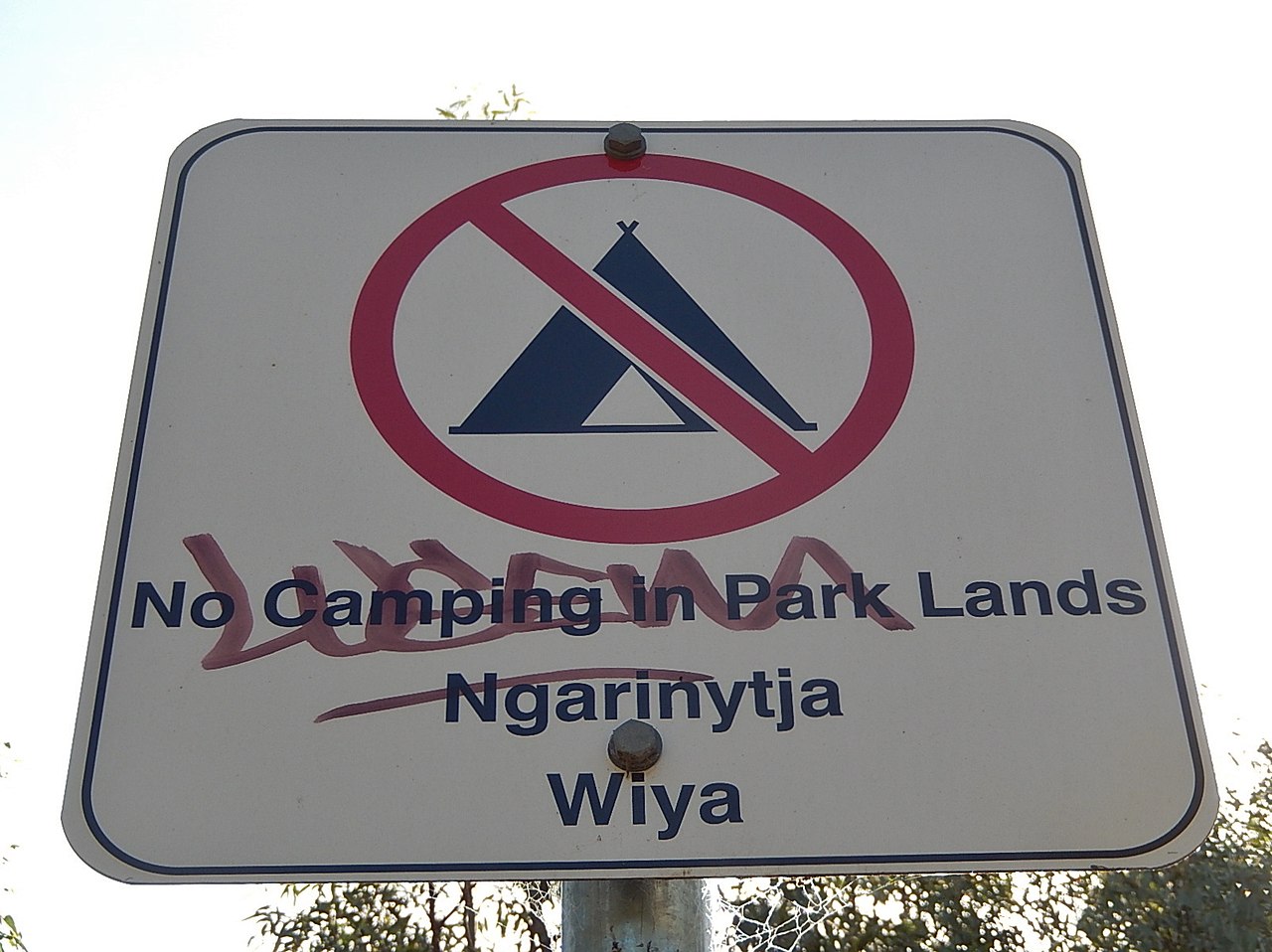
Classification and distribution
Pitjantjatjara belongs to the large Pama–Nyungan family and is one variety within the Western Desert languages. These varieties form a continuum in which nearby varieties are largely mutually understandable. The language is spoken in communities of central Australia, often in remote settlements and on homelands where traditional cultural life continues alongside modern institutions.
Linguistic characteristics
The language shares common structural features with many Australian languages: a relatively small vowel inventory (often described as a three-vowel system), a richer set of consonant places of articulation including dental, alveolar and retroflex series, and no phonemic fricatives in many analyses. Grammatically, Pitjantjatjara is primarily suffixing: words are marked with case and other affixes rather than by strict word order. The language exhibits flexible word order supported by case marking on nouns and extensive verb morphology for tense, aspect and other categories.
History, name and relations
The name Pitjantjatjara derives from a characteristic verb form pitjantja, meaning a form of “coming/going”, and the people’s name reflects linguistic identity. Pitjantjatjara is closely related to Yankunytjatjara and other nearby varieties; scholars and communities sometimes describe these varieties as dialects of a single Western Desert language, while in other contexts they are treated as distinct languages. Mutual understanding across adjacent speech varieties is common and has been noted in descriptions of mutual intelligibility.
Uses, cultural role and contemporary status
Pitjantjatjara remains an important vehicle for cultural knowledge, song, ceremony and land-related practices. It appears in educational programs, community radio and religious translations. Local efforts support language maintenance through teaching, dictionaries, and recordings. At the same time, pressures from English and community change have prompted renewed focus on intergenerational transmission and resources for learners.
Further reading and resources
- Overview of Western Desert varieties: Western Desert languages
- Context within Australian Indigenous languages: Australia language surveys
- Discussion of dialect versus language distinctions: dialect
- Studies of intercomprehension and community reports: mutual intelligibility
Related articles
Author
AlegsaOnline.com Pitjantjatjara language Leandro Alegsa
URL: https://en.alegsaonline.com/art/77136
Sources
- stat.data.abs.gov.au : "Census 2016, Language spoken at home by Sex (SA2+)"
- glottolog.org : "Pitjantjatjara"
- austlang.aiatsis.gov.au : Pitjantjatjara