
Pioneer program (NASA unmanned probes, 1958–1978)
NASA's Pioneer program was a series of unmanned space missions from 1958 to 1978, notable for early lunar attempts, the first probes to Jupiter and Saturn, and the Pioneer plaques carried into interstellar space.
The Pioneer program was a sequence of unmanned spacecraft missions managed by NASA and its predecessor organizations between 1958 and 1978. Intended to test rockets, study nearby celestial bodies and conduct pioneering interplanetary observations, the program produced several distinct families of spacecraft. It is best known for the two deep-space probes, Pioneer 10 and Pioneer 11, which were the first human-made objects to travel through the asteroid belt and to make close-up observations of Jupiter; Pioneer 11 later made the first close encounter with Saturn. Earlier flights tested lunar techniques and investigated the near-Earth environment.
Image gallery
10 Images


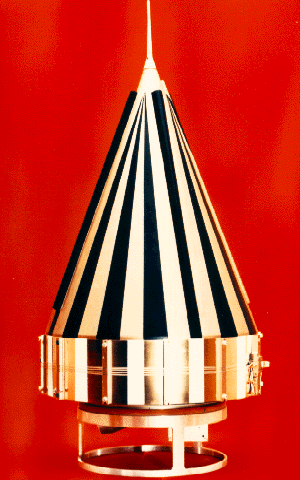


Overview and objectives
Pioneer missions had varied goals across the two decades of activity. Early launches in 1958 and 1959 attempted to reach the Moon and to validate launch vehicles and guidance systems. Later efforts focused on planetary science: measuring magnetic fields, charged particles, cosmic rays and the conditions of the outer solar system. The program combined engineering demonstration flights with scientific exploration, paving the way for later, more complex interplanetary missions.
Notable spacecraft and timeline
- Pioneer 0 (1958): an early launch that failed during ascent; these initial flights revealed the difficulty of early rocketry.
- Pioneer 1 and Pioneer 2 (1958): early attempts to reach lunar vicinity and to test vehicle performance; they returned engineering and partial scientific data related to the Moon.
- Pioneer 10 (launched 1972) and Pioneer 11 (1973): deep-space probes that traversed the asteroid belt, studied Jupiter, and in Pioneer 11's case later flew past Saturn; both carried the famous Pioneer plaque.
- Pioneer Venus (1978): a later set of missions under the Pioneer name that explored Venus with an orbiter and descent probes, extending the program's scientific reach.
These missions combined to demonstrate long-duration operations in deep space and to provide baseline measurements of the heliosphere and planetary environments.
Design and instrumentation
Pioneer spacecraft typically used simple, robust engineering: spin-stabilized bodies, a high-gain radio antenna for communications, and radioisotope thermoelectric generators (RTGs) for long-life electrical power on the deep-space probes. Payloads consisted of particle detectors, magnetometers, plasma analyzers and, in the case of the Jupiter encounters, imaging systems that returned the first close-up pictures of that planet. Their straightforward designs emphasized reliability over sophistication, allowing some probes to operate for decades beyond their planned lifetimes.
Achievements and scientific importance
Pioneer 10 and 11 provided the first direct observations of Jupiter's magnetosphere, radiation belts, moons and atmosphere, transforming understanding of giant-planet environments. Pioneer 11's Saturn flyby yielded the first in situ studies of Saturn's magnetosphere and ring region. The long radio-tracking records from these probes also contributed to studies of the solar wind and the outer heliosphere. Their journeys made them among the most distant human-made objects; they retained cultural significance through the small plaques they carried as messages for any future interstellar encounter, designed by a small team that included Carl Sagan.
Controversies and legacy
The trajectories of Pioneer 10 and 11 prompted detailed study after scientists detected a small, unexplained sunward acceleration known as the "Pioneer anomaly." Subsequent analyses have shown that anisotropic thermal emissions from the spacecraft could account for much of the effect, demonstrating how precise spacecraft engineering details can influence celestial mechanics studies. Over time, both probes ceased reliable contact: the last unambiguous signal from Pioneer 11 was received in 1995, and the final confirmed contact with Pioneer 10 occurred in 2003. For a period Pioneer 10 was the most distant man-made object from Earth until it was overtaken by Voyager 1, and later by Voyager 2.
Beyond their scientific output, the Pioneer missions are remembered for their role in early space engineering, for expanding humanity's reach into the outer solar system and for the symbolic Pioneer plaques that mark the probes' long, ongoing trajectories into interstellar space. For further reading and mission specifics, see material from program overviews and mission pages that document individual flight histories and instrument suites (Pioneer probes).
Related articles
Author
AlegsaOnline.com Pioneer program (NASA unmanned probes, 1958–1978) Leandro Alegsa
URL: https://en.alegsaonline.com/art/77034