
Pisces (constellation)
Pisces is a zodiac constellation crossing the celestial equator, depicted as two fish joined by a cord; faint externally but notable for Messier 74 and its role in celestial history.
Overview
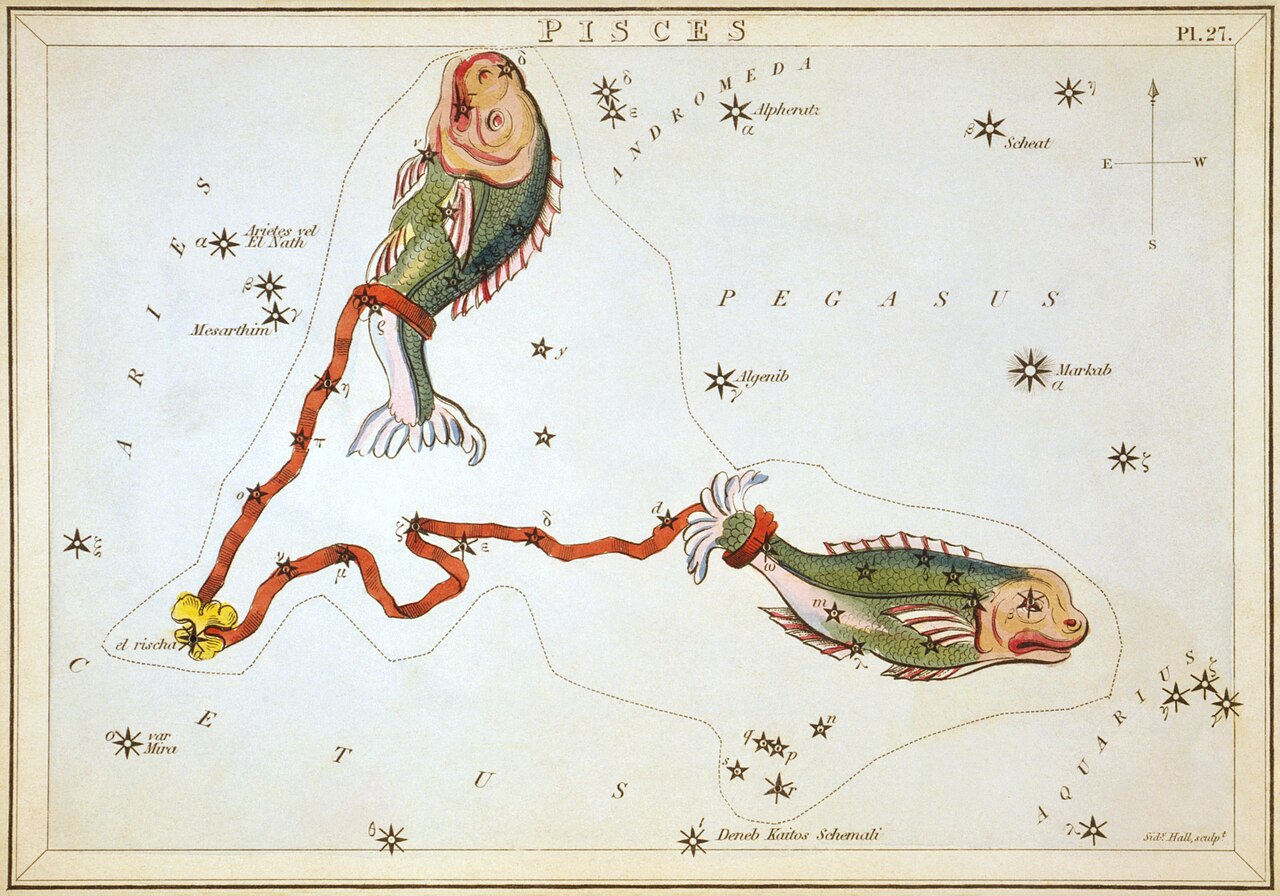
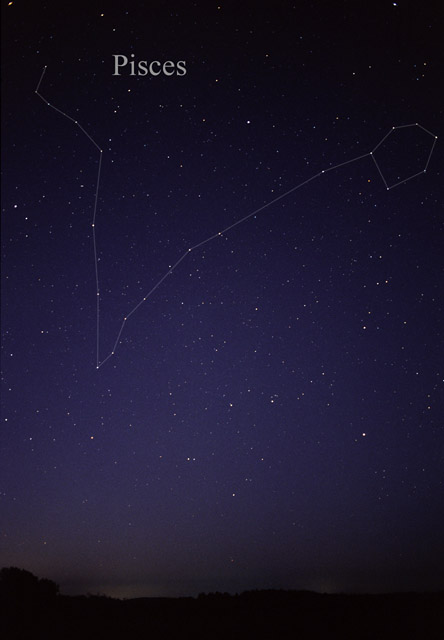
Pisces is one of the twelve traditional zodiac constellations and lies along the plane of the ecliptic, crossing the celestial equator. It is usually represented as two fish connected by a cord and is most apparent as a broad, diffuse pattern of modestly bright stars rather than a cluster of vivid stars.
Image gallery
6 Images


Location and neighbors
The constellation occupies a large, elongated region of sky and its official boundaries were set by the International Astronomical Union in the 20th century. Because it straddles the celestial equator it is visible from most latitudes in both hemispheres at the appropriate season.
- Neighboring constellations include Aries, Cetus, Pegasus, Aquarius, Andromeda and Triangulum.
Stars and notable features
Pisces contains relatively few bright stars; its leading stars are of roughly third magnitude and the pattern is subdued compared with many zodiacal neighbors. Alpha Piscium (traditionally called Alrescha) is often noted as a double or multiple star and marks the knot that links the two fish. Beta Piscium and several other stars form the faint outlines that observers stitch together to imagine the two fish.
Deep-sky objects
Despite its faint stars, Pisces hosts several interesting deep-sky objects. The best-known is the face-on spiral galaxy Messier 74, which can be seen in small to medium telescopes under dark skies. Beyond M74 there are numerous more distant galaxies and faint nebulae that attract amateur astrophotographers and observers interested in extragalactic targets.
History, mythology and astronomical significance
In classical Greek tradition Pisces commemorates the fish that rescued the gods Aphrodite and Eros when they fled a monster, and older Near Eastern star lore also associated the region with fish. Astronomically, Pisces has symbolic importance because the vernal equinox once lay within its boundaries; this slow shift due to axial precession led to the cultural concept known as the "Age of Pisces."
Observing tips
Pisces is easiest to observe on autumn evenings in the Northern Hemisphere when it rises higher in the sky. Because its stars are not very bright, find reference points such as the Great Square of Pegasus and nearby Andromeda to help locate it. Binoculars and small telescopes will reveal companion stars and many of the galaxies mentioned above; dark skies improve visibility significantly.
Related articles
Author
AlegsaOnline.com Pisces (constellation) Leandro Alegsa
URL: https://en.alegsaonline.com/art/77095