
Phosphorus trichloride (PCl3): properties, production, uses, and safety
Phosphorus trichloride (PCl3) is a colorless, reactive phosphorus halide used as an industrial intermediate for organophosphorus chemicals, produced by chlorinating elemental phosphorus.
Overview
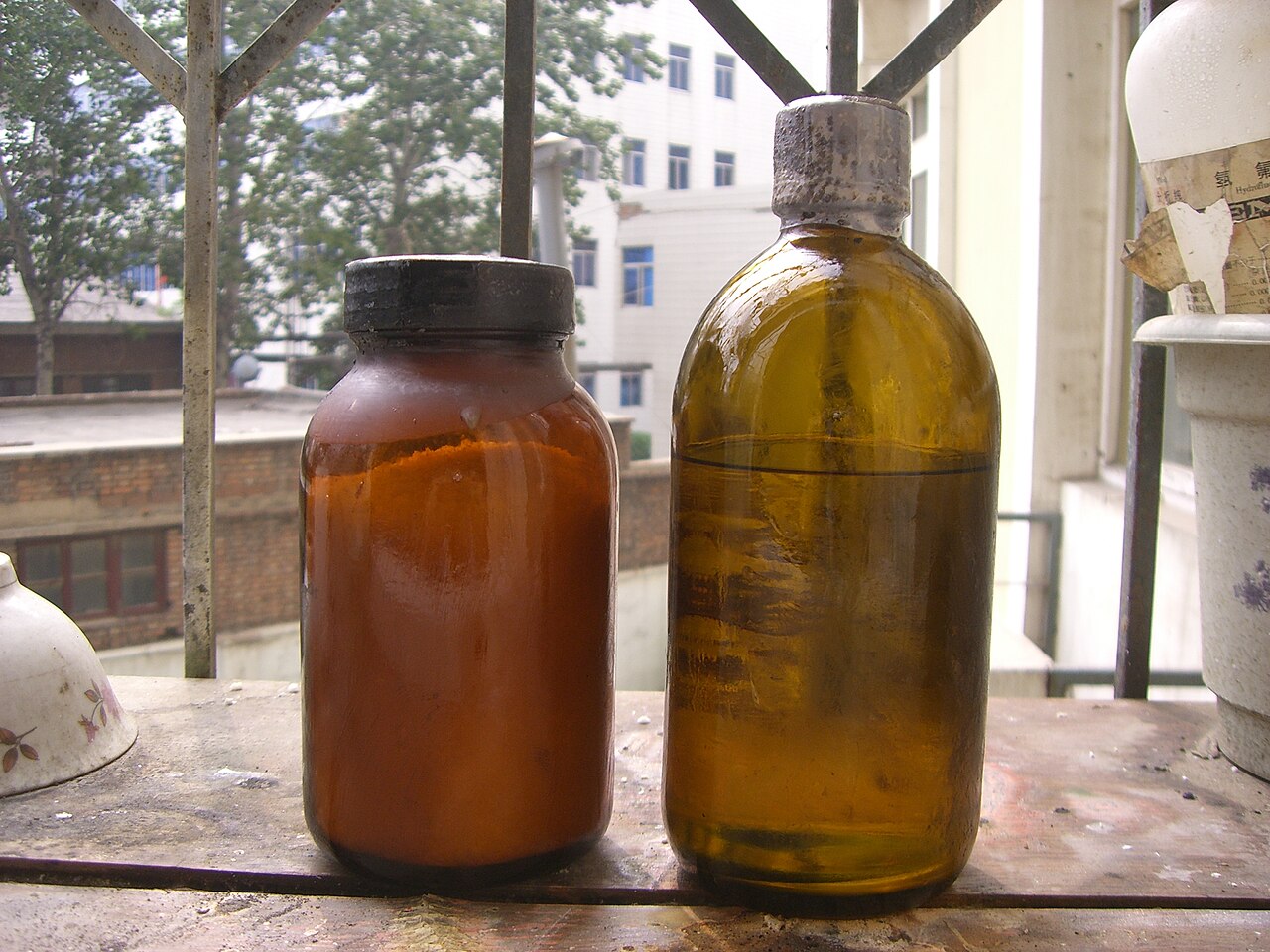
Phosphorus trichloride is an inorganic molecular compound with the chemical formula PCl3. It is a common phosphorus halide that serves primarily as an intermediate in the manufacture of a variety of organophosphorus chemicals and phosphorus oxychlorides. In its pure form it is a colourless to slightly yellow fuming liquid with a pungent odor and high chemical reactivity. As a basic descriptor, PCl3 is often described as a chemical compound in which a central phosphorus atom is bonded to three chlorine atoms.
Image gallery
4 Images


Structure and basic properties
The phosphorus atom in PCl3 bears one lone pair and three covalent P–Cl bonds, giving the molecule a trigonal pyramidal geometry. This arrangement leads to bond angles slightly smaller than the tetrahedral ideal because of the lone pair's influence. Phosphorus in this compound is commonly assigned a formal oxidation state of +3, while each chlorine is assigned −1; these are formal bookkeeping conventions that describe electron distribution rather than complete ionic character. The molecule is reactive toward nucleophiles and water, undergoing hydrolysis to yield phosphorous acid and hydrogen chloride.
Production and historical notes
Industrially, PCl3 is made by direct chlorination of elemental phosphorus, typically white phosphorus, under controlled conditions. This straightforward synthesis — combining phosphorus and chlorine gas — has been used for many decades and established PCl3 as an important feedstock for downstream chemical manufacture. Historically it was among the earliest phosphorus chlorides prepared and studied as chemists classified and explored the behavior of halogenated phosphorus compounds.
Uses and applications
PCl3 is a versatile reagent and intermediate. Major applications include production of phosphorus-containing acids and derivatives, such as phosphoryl chlorides, and a broad family of organophosphorus compounds used as plasticizers, flame retardants, oil additives and agrochemicals. In organic and industrial chemistry it is employed as a chlorinating and phosphorylating agent and as a precursor to reagents that introduce phosphorus-containing functional groups into molecules. For references about phosphorus chemistry see sources on phosphorus and related reagents.
Handling, hazards and environmental behavior
PCl3 reacts violently with water, releasing corrosive hydrogen chloride gas; therefore it is handled under dry, inert conditions and stored in appropriately designed containers. It is toxic by inhalation and can cause severe irritation or corrosive injury to skin and respiratory tissues; standard industrial controls include containment, ventilation, and personal protective equipment. In the environment, hydrolysis and further oxidation convert PCl3 into inorganic phosphorus compounds and hydrochloric acid, so spill response focuses on containment and neutralization.
Distinctions and related compounds
- PCl3 is distinct from phosphorus pentachloride (PCl5), which contains phosphorus in a formal +5 oxidation state and has different reactivity and structure.
- Oxidized derivatives such as phosphoryl chloride (POCl3) are formed by controlled oxidation of PCl3 and are themselves important reagents in industry and synthesis; see links on chlorine and oxidized phosphorus species for broader context.
- Because of its central role as an intermediate, PCl3 is often discussed alongside other chlorinating agents and phosphoryl donors in synthetic chemistry texts (see oxidation state and reagent summaries).
Phosphorus trichloride remains a fundamental chemical in both industrial production and laboratory synthesis due to its relative simplicity, direct preparation from elemental phosphorus, and utility in forming a wide range of phosphorus-containing products.
Related articles
Author
AlegsaOnline.com Phosphorus trichloride (PCl3): properties, production, uses, and safety Leandro Alegsa
URL: https://en.alegsaonline.com/art/76580