
Phoenix (constellation)
Phoenix is a small, faint constellation of the southern sky, named for the mythical phoenix. Introduced by late 16th-century European mapmakers, it contains a few bright stars and some nearby dwarf galaxies.
Overview
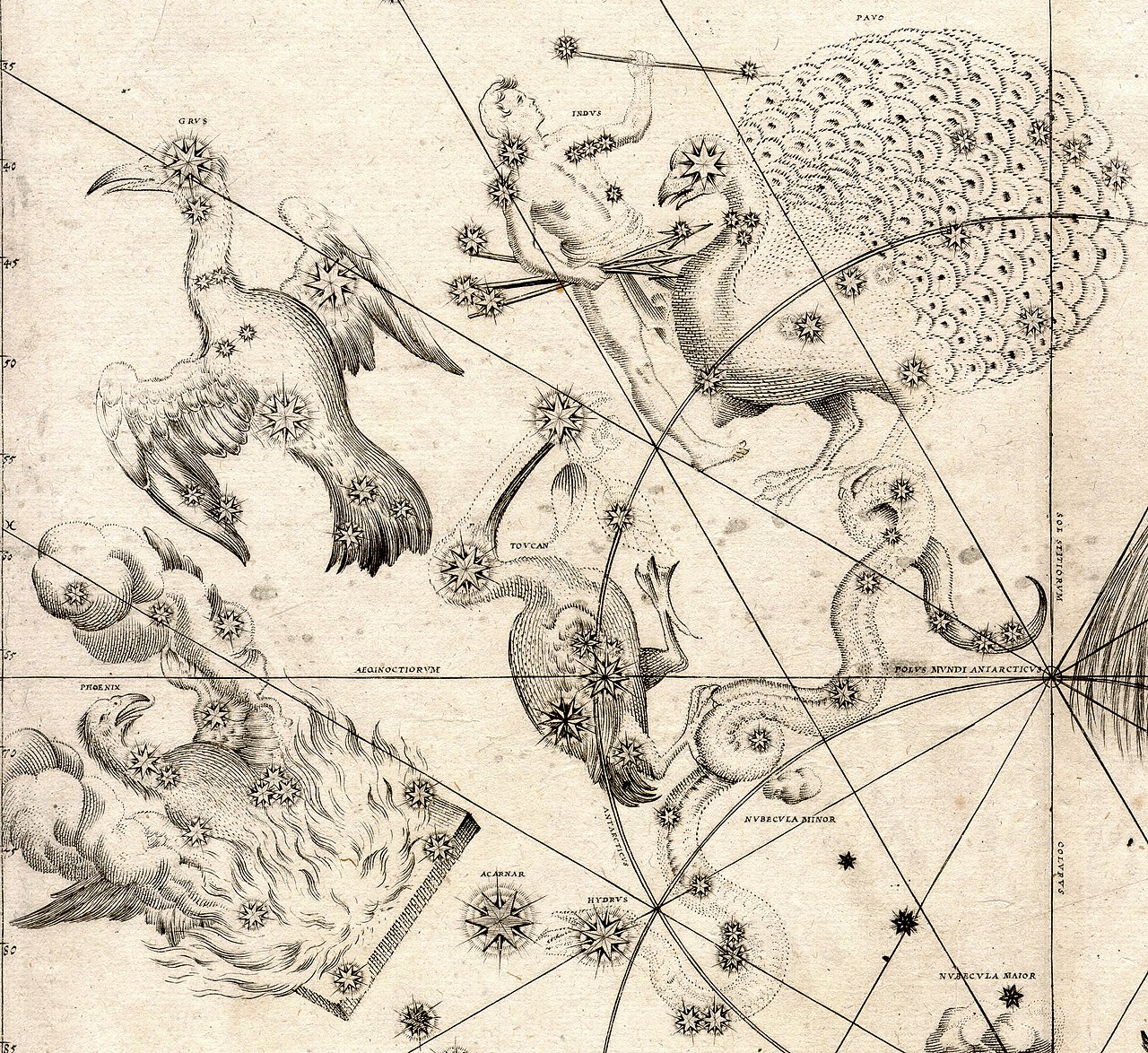
Phoenix is a modest constellation located in the southern celestial hemisphere. It is relatively faint compared with many classical constellations and is most prominent from southern latitudes. The figure represents the legendary bird of rebirth, the phoenix, and is commonly pictured among a group of southern 'bird' constellations.
Image gallery
5 Images



Characteristics and notable stars
The constellation covers a compact patch of sky and contains a handful of stars of interest rather than many bright ones. Its brightest star is Alpha Phoenicis, traditionally called Ankaa, which is an orange-hued giant. Other designated stars include Beta and Gamma Phoenicis. Because most of its stars are of modest brightness, Phoenix does not form an especially striking pattern to casual stargazers.
History and origin
Phoenix is not part of the ancient Greek list of constellations recorded by Ptolemy. It was established in the late 16th century by European cartographers who incorporated observations from southern-hemisphere voyages. Its introduction into celestial atlases and globes reflected the period's expanding geographic and astronomical knowledge rather than classical mythography.
Observing and location
Best viewed from the Southern Hemisphere, Phoenix rises above the southern horizon for mid-latitude observers in favorable seasons. It lies among several other southern constellations and can be located by consulting a star chart for the south sky rather than by striking naked-eye patterns. Light pollution and low altitude toward the horizon often make its fainter stars difficult to see.
Deep-sky objects and scientific interest
Although Phoenix has few bright deep-sky showpieces, it is home to nearby extragalactic objects, including the Phoenix Dwarf, a small galaxy of interest to astronomers studying the local group and galaxy evolution. Amateur telescopes can also reveal more distant galaxies and faint star fields within its borders.
Context and distinctions
Unlike many constellations whose names and imagery date to antiquity, Phoenix reflects the expansion of celestial mapping during the Age of Discovery. It is often described as one of a "nest" of bird-themed constellations in the far south, a reminder that some constellations are relatively modern additions motivated by explorers' reports and the needs of mapmakers.
- Brightest star: Alpha Phoenicis (Ankaa).
- Type: Modern southern constellation.
- Notable deep-sky object: Phoenix Dwarf Galaxy.
Related articles
Author
AlegsaOnline.com Phoenix (constellation) Leandro Alegsa
URL: https://en.alegsaonline.com/art/76538