
Periodic table: metals, nonmetals and metalloids
Overview of how elements are classified on the periodic table into metals, nonmetals and metalloids, their typical properties, locations, historical origin and key uses.
The periodic table arranges chemical elements by increasing atomic number and recurring chemical behavior. One of its fundamental divisions is between metals and nonmetals, with a narrow band of elements called metalloids (or semimetals) bridging them. These classifications reflect broad differences in physical appearance, bonding, and reactivity that influence how elements are used in technology, industry and biology.
Image gallery
3 Images

Typical properties
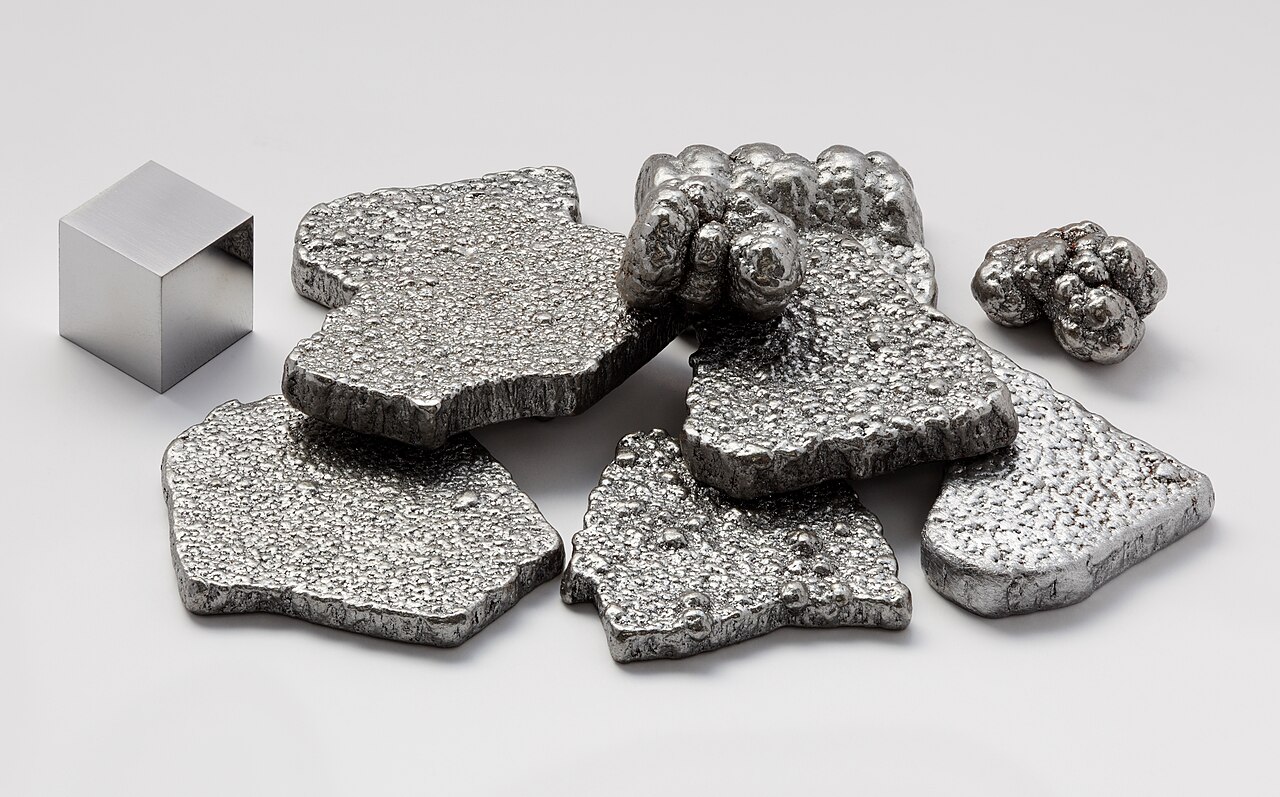
Metals generally have metallic luster, conduct heat and electricity, and are malleable and ductile. They tend to form cations by losing electrons. Nonmetals usually lack metallic shine, are poorer conductors, and form anions or covalent bonds. Metalloids show mixed properties and often behave as semiconductors.
Location and examples
- Metals: occupy the left and center of the table — alkali metals (e.g., sodium), alkaline earths (e.g., magnesium), transition metals (e.g., iron, copper) and post-transition metals (e.g., aluminum).
- Nonmetals: found on the upper right — hydrogen, carbon, nitrogen, oxygen, the halogens (e.g., chlorine) and noble gases (e.g., neon).
- Metalloids: lie along the zigzag boundary — boron, silicon, germanium, arsenic, antimony, tellurium (polonium is sometimes included).
History and scientific basis
The modern periodic table grew from Dmitri Mendeleev’s 19th-century arrangement by atomic weight and chemical similarity; later work replacing weight with atomic number clarified periodic trends. The classification into metals and nonmetals predates the table and is based on observable properties and electronic structure (valence electrons and band structure explain conductivity differences).
Uses and importance
Metals are essential in construction, electrical wiring, and catalysis; alloys tailor mechanical properties. Nonmetals are crucial for life (carbon, oxygen), for fuels and chemicals (hydrogen, nitrogen, halogens), and for inert gas applications. Metalloids, notably silicon and germanium, underpin the electronics and semiconductor industries.
Notable trends and distinctions
Metallic character increases down a group and decreases across a period from left to right. Some elements show variable behavior depending on conditions or oxidation state; for example, carbon forms both metallic-like carbides and covalent networks. Understanding these categories helps predict bonding, reactivity and technological role.
Related articles
Author
AlegsaOnline.com Periodic table: metals, nonmetals and metalloids Leandro Alegsa
URL: https://en.alegsaonline.com/art/75832