
Pelican eel (Eurypharynx pelecanoides) — deep‑sea gulper
A deep‑sea eel known for its enormous expandable mouth and bioluminescent tail tip. Found worldwide in tropical and subtropical waters, it is the sole species of its family and rarely seen by humans.
The pelican eel (Eurypharynx pelecanoides) is a distinctive deep‑sea fish noted for an enormous, pouch‑like lower jaw and a slender, whip‑like body. It inhabits the mesopelagic to abyssal zones of tropical and subtropical oceans worldwide and is seldom observed in situ by humans. Specimens are occasionally retrieved by deep‑water trawls or reported by fisheries. Because of its unusual appearance and feeding adaptations, the pelican eel is often highlighted in discussions of deep‑sea specialization and camouflage.
Image gallery
6 Images
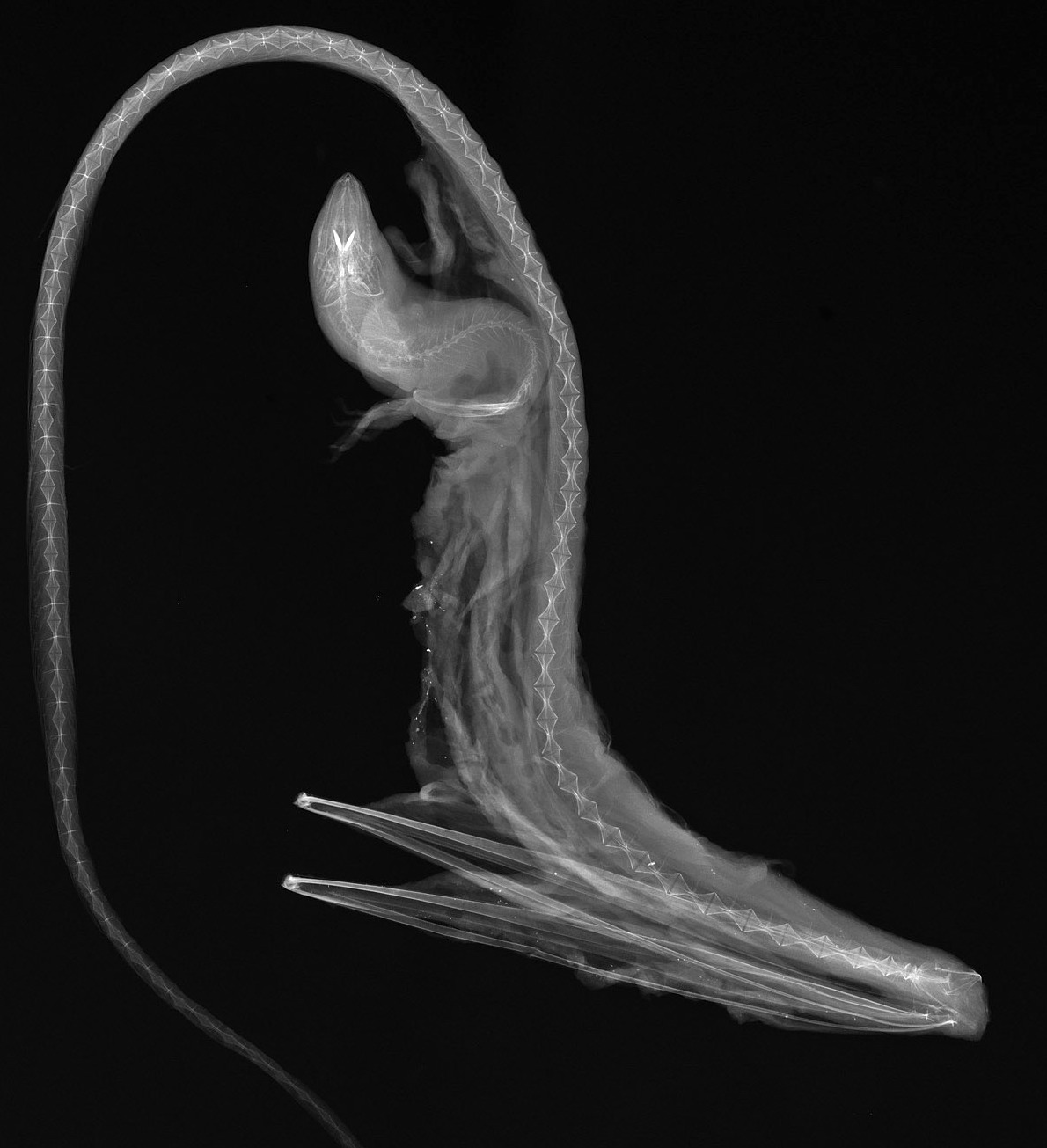


Physical characteristics
Its most striking feature is a disproportionately large mouth that can be opened wide and stretched to engulf prey much larger than the eel's own head. The lower jaw forms a flexible pouch that inspired the common name by resemblance to a pelican's bill. The body is elongated and eel‑like, typically reported at roughly 0.6 to 1.0 m in length, with a very narrow profile behind the head. Eyes are relatively small, and fins are reduced or absent in appearance, reflecting adaptations to a low‑energy environment.
- Mouth and stomach: The mouth and distensible stomach allow ingestion and temporary storage of large prey items.
- Tail and lure: The tip of the tail often bears a light‑producing organ (a photophore) and is used as a lure to attract prey in darkness.
- Sensory and locomotion: Movement is achieved by undulating the body and tail; vision is limited and other senses are important in prey detection.
Diet and feeding
Pelican eels are opportunistic predators and scavengers. Their diet includes small fishes, crustaceans such as shrimp, and zooplankton such as plankton. The combination of an extendable mouth and elastic stomach means a single large capture can supply energy for an extended period — an advantage in food‑poor deep waters. The bioluminescent tail tip is thought to function as a lure, drawing curious organisms within reach of the gape.
Classification and natural history
Taxonomically, the pelican eel is the sole recognized species in the genus Eurypharynx and the family Eurypharyngidae. It belongs to the order Saccopharyngiformes, a group closely related to the true eels (Anguilliformes) but distinguished by several skeletal and soft‑tissue specializations for deep‑sea life. Much about its life cycle, reproduction and larval development remains poorly documented because of the depths it occupies and the difficulty of observing living animals in their natural habitat.
Distribution, significance and notable facts
Reported from tropical and subtropical oceans around the globe, pelican eels have been caught at depths ranging from the mesopelagic zone down to abyssal depths. They are a striking example of extreme morphological adaptation to the deep sea and are often cited in popular accounts of deep‑ocean biodiversity and adaptations. Because they are uncommon in surface catches and are rarely filmed alive, many aspects of their behaviour are inferred from preserved specimens and comparison with related deep‑sea taxa.
For accessible overview information on deep‑sea species and related research, consult general resources about deep sea fish. Continued deep‑ocean exploration and improved imaging technologies are expected to reveal more about pelican eel behaviour, reproduction and ecological roles in the future.
Related articles
Author
AlegsaOnline.com Pelican eel (Eurypharynx pelecanoides) — deep‑sea gulper Leandro Alegsa
URL: https://en.alegsaonline.com/art/75489