
Parliament of Victoria: structure, history and functions
The Parliament of Victoria is the elected legislature of the Australian state of Victoria. This article explains its two houses, powers, procedures, constitutional role and the parliamentary precinct in Melbourne.
Overview
The Parliament of Victoria is the state legislature responsible for making laws in Victoria, Australia. It is a bicameral legislature composed of two elected chambers—the Legislative Assembly (lower house) and the Legislative Council (upper house)—together with the Crown, which is represented in the state by the Governor of Victoria. The leader of the party or coalition with a majority in the lower house becomes the Premier of Victoria, who heads the executive government. For example, the Australian Labor Party (Labor) won the 2014 state election and its leader, Daniel Andrews, subsequently served as Premier; more recent premiers have continued the convention that the lower house majority forms government.
Image gallery
9 Images




Composition and electoral systems
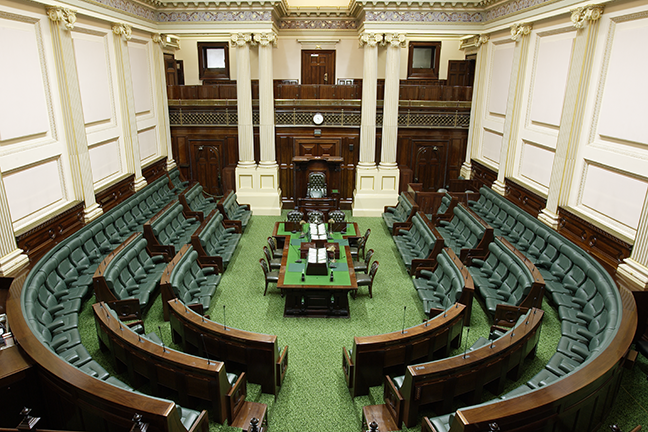
The Legislative Assembly contains 88 members representing single-member electoral districts and generally uses preferential voting to elect one member per district. The Legislative Council is made up of 40 members elected from multi-member regions using a form of proportional representation that allows multiple parties to gain representation. Together the two houses review, amend and pass legislation, though supply and money bills traditionally originate in the lower house.
Roles and parliamentary processes
Parliamentary business includes introducing and debating bills, scrutinising the executive, approving budgets, and holding inquiries through a system of committees. Typical features of sitting weeks include question time, committee hearings, and debates on legislation. When both houses have agreed on a bill it is presented to the Governor for royal assent on behalf of the Crown, after which it becomes law.
History and the parliamentary precinct
Victoria gained a separate colonial parliament in the 19th century and was an early adopter of representative institutions in Australia. The seat of the state parliament is Parliament House on Spring Street in central Melbourne, an imposing building that has hosted many important events in Victorian and national history. Notably, this building also served temporarily as the meeting place for the federal Parliament of Australia in the early 20th century. Past governors such as David de Kretser have represented the Crown in the state; the office of Governor continues to perform constitutional, ceremonial and community roles.
Committees, accountability and civic importance
Committees are a persistent and influential feature of the Victorian Parliament, allowing detailed examination of public policy, legislation and administration. They provide a mechanism for non-government members to investigate issues, call witnesses and make recommendations. Through these processes the parliament acts as a forum for public accountability, transparency and representation of Victoria’s communities.
Distinctive features and public access
- Two-house system balancing local representation and proportional review.
- Public sittings, committee reports and Hansard records that document debates and decisions.
- Parliament House and the surrounding precinct host civic ceremonies and educational visits.
The Parliament of Victoria remains central to the state's constitutional framework and civic life, combining historical traditions with modern procedures for lawmaking and oversight.
Related articles
Author
AlegsaOnline.com Parliament of Victoria: structure, history and functions Leandro Alegsa
URL: https://en.alegsaonline.com/art/74760
Sources
- parliament.vic.gov.au : "Parliament of Victoria - About Parliament"
- parliament.vic.gov.au : "Parliament of Victoria - Governor"