
Ozymandias — Shelley's sonnet on impermanence and power
An overview of Percy Bysshe Shelley's sonnet 'Ozymandias': its form, themes of ruin and hubris, historical sources tying the name to Ramesses II, and the poem's lasting literary influence.
Ozymandias is a short sonnet by Percy Bysshe Shelley that distills a meditation on time, power, and ruin. Rather than presenting the scene directly, the poem frames its account through a traveller’s story about a ruined statue in a desert and an inscription that exposes the vanity of human pride. Its compressed narrative, striking diction, and a single memorable ironic declaration have made it one of Shelley’s most frequently discussed poems.
Image gallery
5 Images
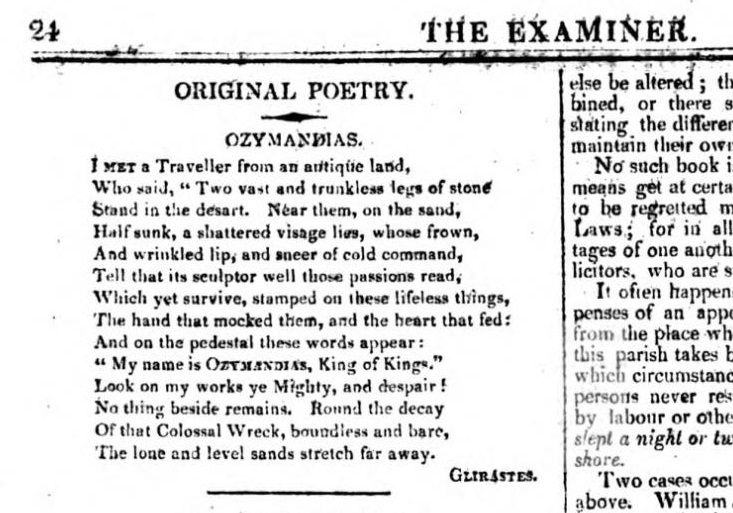


Background and publication
Written during a period of intense European interest in antiquity and Egyptology, Shelley’s poem was first printed in the 11 January 1818 issue of The Examiner. He chose the compact sonnet form to deliver a short story, sustained description, and moral reflection within a few lines. The choice of a reported speech—‘I met a traveller from an antique land’—creates narrative distance and invites readers to judge the scene for themselves.
Structure, imagery and devices
The poem opens with a traveller’s visual report: “two vast and trunkless legs of stone,” a “shattered visage,” and “lone and level sands.” These concrete images emphasize contrast between the sculptor’s skill and the ruin that time enforces. The ruler’s name, Ozymandias, is retained in the poem as a Greek transliteration from Greek renderings of an Egyptian throne name, and the famous line—“Look on my works, ye Mighty, and despair!”—is presented with bitter irony: the boast stands above nothing.
- Central themes: impermanence, ambition, the fall of empires.
- Poetic techniques: visual detail, contrast, irony, concentrated diction.
- Form and voice: narrative sonnet; framed report that shifts authority from narrator to traveller to inscription.
Historical connections
Shelley drew on classical sources and contemporary archaeological interest when he made Ozymandias the emblem of a vanished majestic ruler. The name has long been associated with Ramesses II. Early nineteenth-century visitors discussed a colossal head known as the Younger Memnon, originating from Thebes and later acquired by the British Museum. Ancient authors, especially Diodorus Siculus, had recorded royal inscriptions; Shelley’s sonnet paraphrases the boast carved into a base or inscription on the base that declared the ruler a king of kings.
Reception and continuing relevance
Readers and critics have praised Ozymandias for its economy and power. The poem is widely anthologised as an example of Romantic irony and of how a brief lyric can express broad historical truths. It has entered cultural conversation as a cautionary emblem against the belief that monuments secure immortality; artists, essayists, and teachers still draw on it to discuss leadership, memory, and the limits of material legacy.
Because it pairs a vivid physical image with a universal moral, Ozymandias endures: a compact poem that converts a single ruined statue into a meditation on time, legacy, and the human condition.
Related articles
Author
AlegsaOnline.com Ozymandias — Shelley's sonnet on impermanence and power Leandro Alegsa
URL: https://en.alegsaonline.com/art/73864
Sources
- books.google.com : Rosalind and Helen, a modern eclogue, with other poems
- worldcat.org : 1940490
- sparknotes.com : "SparkNotes: Shelley's Poetry: "Ozymandias""
- cliffsnotes.com : MacEachen, Dougald B. CliffsNotes on Shelley's Poems. 18 July 2011.
- perseus.tufts.edu : Diodorus Siculus, Bibliotheca Historica, 1.47.4
- perseus.tufts.edu : Perseus Project
- rpo.library.utoronto.ca : "Percy Bysshe Shelley : Ozymandias"