
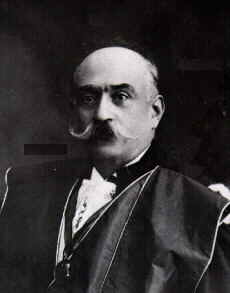
Augusto Righi
Italian physicist (1850–1920) known for experimental work in electromagnetism, early studies of electromagnetic waves and contributions to physics education and instrumentation.
Overview
Augusto Righi (27 August 1850 – 8 June 1920) was an Italian experimental physicist whose work helped extend classical studies of electricity and magnetism into the late 19th and early 20th centuries. Born and died in Bologna, Righi combined careful laboratory technique with an interest in practical apparatus. His investigations ranged from electrostatics and thermoelectric phenomena to optical analogies for electromagnetic waves and early research on X-rays and magneto-optical effects. For a concise biographical outline see biographical sources.
Image gallery
3 Images

Research and main contributions
Righi followed the program of translating theoretical predictions into reproducible experiments. Early in his career he worked on electrostatic phenomena and measurements of electrical conduction and heat transfer in unusual metals such as bismuth. Later studies included experiments on the photoelectric effect and on the interaction between magnetic fields and spectral lines, which related to what is now called the Zeeman effect. He also examined the then-new Roentgen rays (X-rays) as they became accessible to laboratory study. Further reading on his scientific topics is available via electromagnetism resources.
Electromagnetic waves and apparatus
One of Righi's best-known areas was experimental work on electromagnetic waves following Heinrich Hertz's discoveries. Righi constructed oscillators and resonators and demonstrated reflection, refraction, polarization and interference of radio waves using apparatus that often drew analogies with optical components. These demonstrations helped show the practical continuity between visible light and longer-wavelength electromagnetic radiation and informed later developments in wireless telegraphy and microwave techniques.
Academic career and timeline
Righi held several university chairs in Italy. He became a professor at the University of Palermo in 1880, where he studied thermoelectric and transport phenomena. He taught at the University of Padua during the mid-1880s and carried out work on photoelectric effects. In 1889 he returned to Bologna as a professor, a position he kept for the remainder of his life. Institutional and archival material related to his appointments can be consulted at the University of Bologna collections.
Legacy, influence and distinctions
Righi is remembered for his role as an experimenter and teacher: his lectures and laboratory demonstrations influenced a generation of students and researchers and helped bridge laboratory physics and emerging applied fields. His microwave and Hertzian-wave experiments were part of the experimental heritage that informed early radio and wireless invention. Modern histories of applied electromagnetism and instrumentation often note Righi's laboratory techniques and apparatus. Several modern summaries and catalogs of his papers and instruments are indexed online; see archival catalogs and historical overviews at technical history sites.
- Born and died in Bologna (1850–1920)
- Professor at Palermo, Padua, and Bologna
- Worked on electrostatics, thermoelectricity, photoelectric effect, X-rays, Zeeman effect, and electromagnetic waves
- Contributed to early microwave experimentation and physics education
Related articles
Author
AlegsaOnline.com Augusto Righi Leandro Alegsa
URL: https://en.alegsaonline.com/art/7351