
Electromagnetism
Electromagnetism studies electric and magnetic forces, fields, and their unification into electromagnetic theory; it explains light, electric currents, and many technologies from motors to wireless communication.
Overview
Electromagnetism is the branch of physics that describes how electric charges and currents produce forces and fields, and how those fields interact with matter. It is one of the basic frameworks scientists use to explain everyday phenomena such as static electricity, magnets, electric currents and light. The theory connects the behavior of individual charged particles to macroscopic effects and underpins technologies from power transmission to radio. See broader context on fundamental forces and basic concepts of electric charge.
Image gallery
3 Images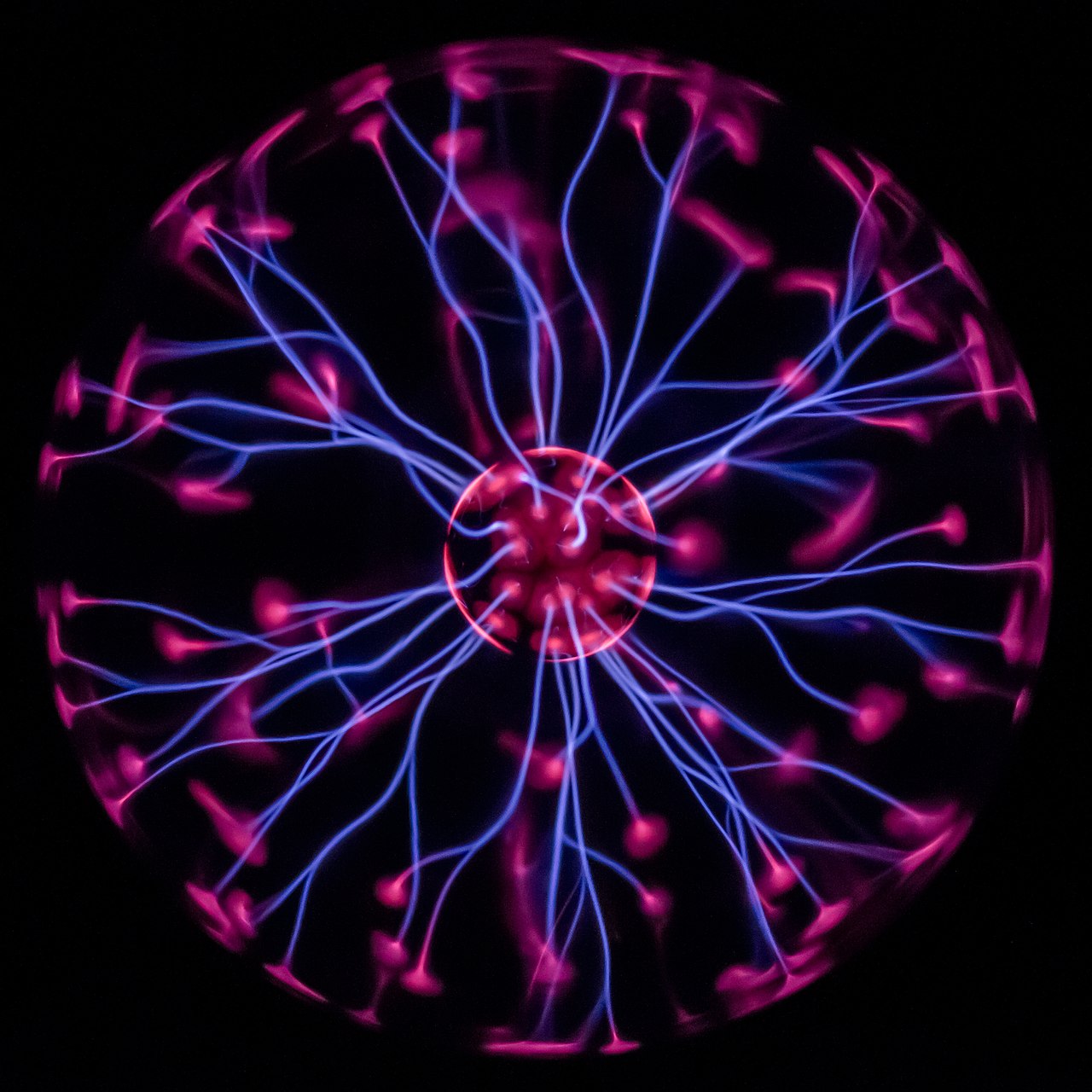

Key principles and components
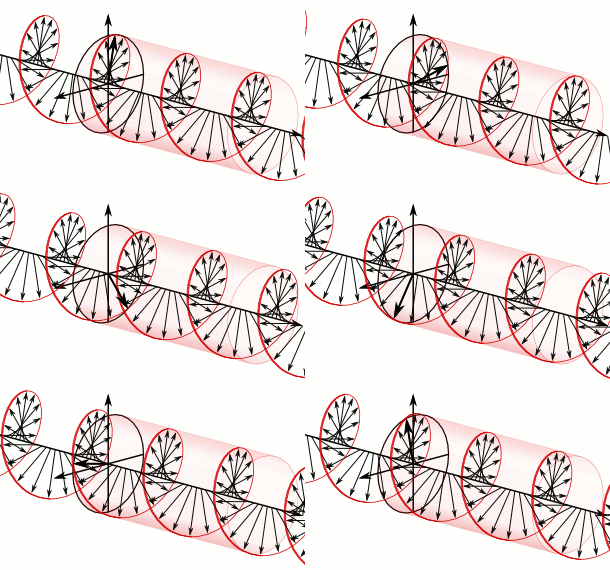
At its core are a few widely used ideas and equations: Coulomb's law governs the force between stationary charges; the magnetic force acts on moving charges; and the Lorentz force law combines both effects to give the total force on a charged particle. Electric and magnetic fields are vector fields that exist in space and mediate interactions. Maxwell's equations unify these elements into a consistent set of relations that also predict electromagnetic waves — oscillating fields that travel through space and include visible light.
History and development
Understanding of electricity and magnetism developed over centuries, from experiments with static charge and compasses to the 19th-century synthesis by scientists such as Ørsted, Ampère, Faraday and Maxwell. Ørsted first noticed that electric currents affect magnets; Faraday discovered electromagnetic induction; Maxwell combined experimental laws into a unified mathematical framework; later experiments by Hertz confirmed the existence of propagating electromagnetic waves. In the 20th century, classical electromagnetism was extended by quantum electrodynamics, a quantum field theory describing electromagnetic interaction at small scales.
Applications and examples
Practical uses of electromagnetism are ubiquitous: electric motors and generators convert between electrical and mechanical energy; antennas transmit and receive radio, television and cellular signals; transformers and power lines distribute electricity; magnetic resonance imaging (MRI) uses magnetic fields and radio waves for medical imaging; and everyday devices such as sensors, coils and capacitors rely directly on electromagnetic principles. Lightning and auroras are natural manifestations of electromagnetic processes in the atmosphere.
Distinctions and notable facts
Electrostatics studies stationary charges, while electrodynamics treats time-varying fields and currents. Magnetic effects arise only from moving charges or changing electric fields. Light and other electromagnetic radiation form a continuous spectrum from radio waves to gamma rays. On the microscopic scale, the quantum theory of electromagnetism describes how particles such as electrons and protons interact by exchanging photons, the force carriers of the electromagnetic field.
- Core equations: Maxwell's equations and the Lorentz force law.
- Classical vs quantum: classical theory works for many macroscopic applications; quantum electrodynamics is needed for microscopic precision.
- Everyday impact: power, communications, medical imaging, and electric machines.
Questions and answers
Q: What is electromagnetism?
A: Electromagnetism is the study of the electromagnetic force, one of the four fundamental forces of nature.
Q: What does the electromagnetic force push or pull?
A: The electromagnetic force pushes or pulls anything that has an electric charge, like electrons and protons.
Q: What does the electric force do?
A: The electric force pushes all charged particles.
Q: What does the magnetic force do?
A: The magnetic force only pushes moving charges.
Q: How many types of electric charge are there?
A: There are two types of electric charge: positive and negative.
Q: What happens when opposite charges are near each other?
A: The electric force pulls opposite charges (positive and negative) towards each other.
Q: What happens when similar charges are near each other?
A: The electric force pushes similar charges (both positive, or both negative) away from each other.
Related articles
Author
AlegsaOnline.com Electromagnetism Leandro Alegsa
URL: https://en.alegsaonline.com/art/30728