
Onon River (Mongolia and Russia)
Transboundary river rising in the Khentii Mountains; about 818 km long, joins the Ingoda to form the Shilka and is the headwater of the Amur river system. Important for ecology, history and local livelihoods.
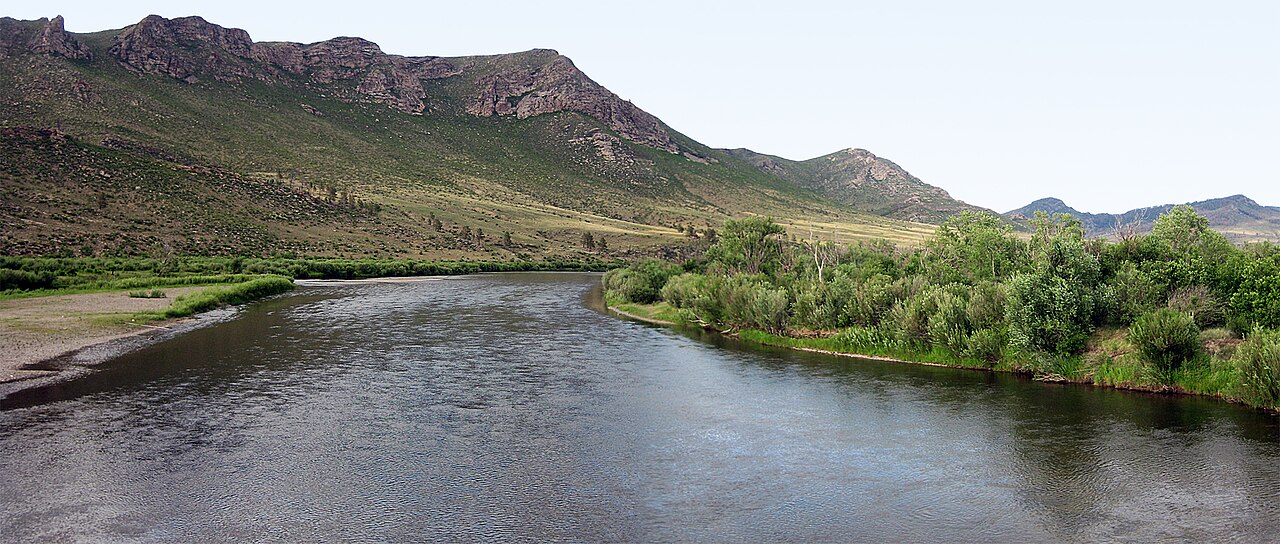
The Onon River flows from the eastern slopes of the Khentii Mountains and crosses international borders between Mongolia and Russia. Its total length is approximately 818 km, with a drainage basin of roughly 94,010 km². The river's upper reaches and much of its cultural history lie within Mongolia; about 298 km of the river runs inside Mongolian territory before it continues northeast into Russia.
Image gallery
3 Images

Course and hydrology
The Onon begins as a network of mountain streams in the Khentii range and flows generally northeastward across a transition zone from Mongolian steppe to Siberian taiga. In eastern Russia it receives major tributaries and eventually meets the Ingoda River; the junction of the Onon and Ingoda forms the Shilka River. Seasonal variations are pronounced: spring thaw increases discharge substantially, while winter brings extensive ice cover in many stretches.
Ecology and landscape
The river supports riparian woodlands, floodplain meadows and wetland pockets that provide habitat for fish, waterfowl and other wildlife. The upper basin retains large areas of relatively intact vegetation, and parts of the watershed lie inside protected territories such as regional conservation zones in Mongolia. Aquatic communities and bank vegetation reflect the climatic gradient from continental steppe to boreal forests.
History and cultural importance
The Onon valley figures prominently in local traditions and history. Mongolian oral history and some historical sources associate the upper Onon region with the early life of Genghis Khan, making it a place of national significance. For centuries, nomadic herders and riverine communities have used the river for drinking water, livestock, small-scale irrigation and seasonal fishing.
Uses, management and challenges
- Local economies rely on the river for fisheries, livestock watering and limited irrigation; commercial navigation is generally minimal because of shallow, fast-flowing sections.
- Cross-border management is important because the Onon contributes to the larger Shilka–Amur system; upstream activities can affect water quality and flows downstream.
- Environmental pressures include localized overfishing, grazing impacts on riparian zones, and potential contamination from settlements. Conservation efforts target habitat protection and sustainable use.
Notable facts
The Onon is the headwater of one of the world's longest contiguous river systems. The sequence Onon–Shilka–Amur is often cited for its combined length, with component lengths commonly given in the order: Onon (~818 km), Shilka (~560 km) and Amur (~2,874 km). This linkage makes the Onon an important hydrological and cultural source for a major East Asian river corridor.
Related articles
Author
AlegsaOnline.com Onon River (Mongolia and Russia) Leandro Alegsa
URL: https://en.alegsaonline.com/art/72659