
Orakzai District
Orakzai District, formerly Orakzai Agency in Pakistan's tribal belt, is a mountainous Pashtun-inhabited district with several tehsils, notable tribal history, and administrative changes since the FATA merger.
Orakzai District occupies a rugged, largely mountainous area in northwestern Pakistan. Formerly known as Orakzai Agency within the Federally Administered Tribal Areas, it lies in a zone of steep valleys and ridges and has long been inhabited mainly by Pashtun tribes, principally the Orakzai people. Population estimates commonly cited for the former agency are on the order of 450,000 residents; the territory covers roughly 700 square miles (about 1,800 km²).
Image gallery
4 Images

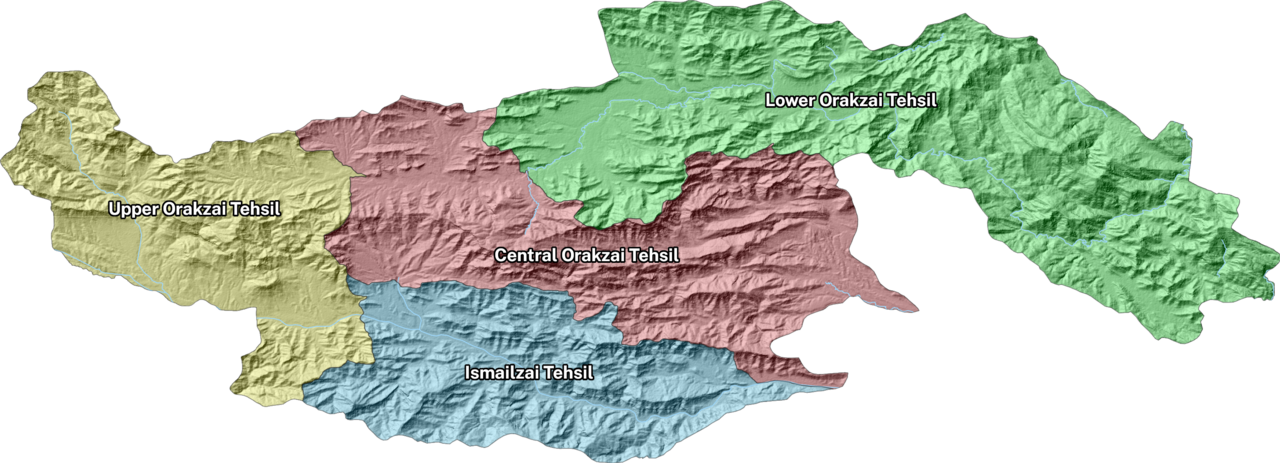

Geography and settlements
The district is characterized by narrow river valleys, terraced agriculture on lower slopes, and higher pastures. Kalaya (often written Kalaya) serves as the principal town and administrative center. Settlements tend to cluster along accessible valleys and the few motorable roads; many villages remain connected by footpaths and seasonal tracks.
Administrative divisions
- Central Orakzai Tehsil
- Ismailzai Tehsil
- Lower Orakzai Tehsil
- Upper Orakzai Tehsil
These subdivisions are used for local administration and delivery of services. The pattern of small tehsils reflects the region's topography and tribal landholdings.
History and governance
Orakzai long formed part of the semi-autonomous tribal agencies that bordered settled districts of Pakistan. For much of the 20th century it was administered under a distinct legal regime as part of the Federally Administered Tribal Areas. In 2018 the federal government integrated the tribal agencies into the province of Khyber Pakhtunkhwa, bringing Orakzai under provincial law and administration within the state of Pakistan. That change aimed to extend formal governance, judicial systems, and development programs into the area.
During the early 21st century the district experienced security challenges associated with broader conflicts in the region; military operations and displacement affected local communities, followed by gradual returns and reconstruction efforts in subsequent years.
Economy, culture and notable facts
Economic life is dominated by small-scale agriculture, livestock rearing, forestry and local trade. Social organization remains clan- and tribe-oriented; customary leadership and jirga practices continue to play an important role alongside formal institutions. Orakzai is often noted for its strategic position between neighboring districts, its distinct tribal identity, and the transition from agency to district administration that has shaped recent development and governance efforts.
Related articles
Author
AlegsaOnline.com Orakzai District Leandro Alegsa
URL: https://en.alegsaonline.com/art/72916