
Oleum (fuming sulfuric acid)
Oleum is a solution of sulfur trioxide in sulfuric acid—called fuming sulfuric acid—used industrially to make concentrated sulfuric acid and as a strong sulfonating agent; it is highly corrosive and hazardous.
Overview
Oleum, often called fuming sulfuric acid, is a commercial name for solutions of sulfur trioxide dissolved in sulfuric acid. It is not a single pure chemical species but a mixture of sulfuric acid with dissolved or complexed SO3 and related condensed oxides. The term is used both in industry and chemistry to describe liquids whose properties differ from ordinary concentrated sulfuric acid.
Image gallery
1 Image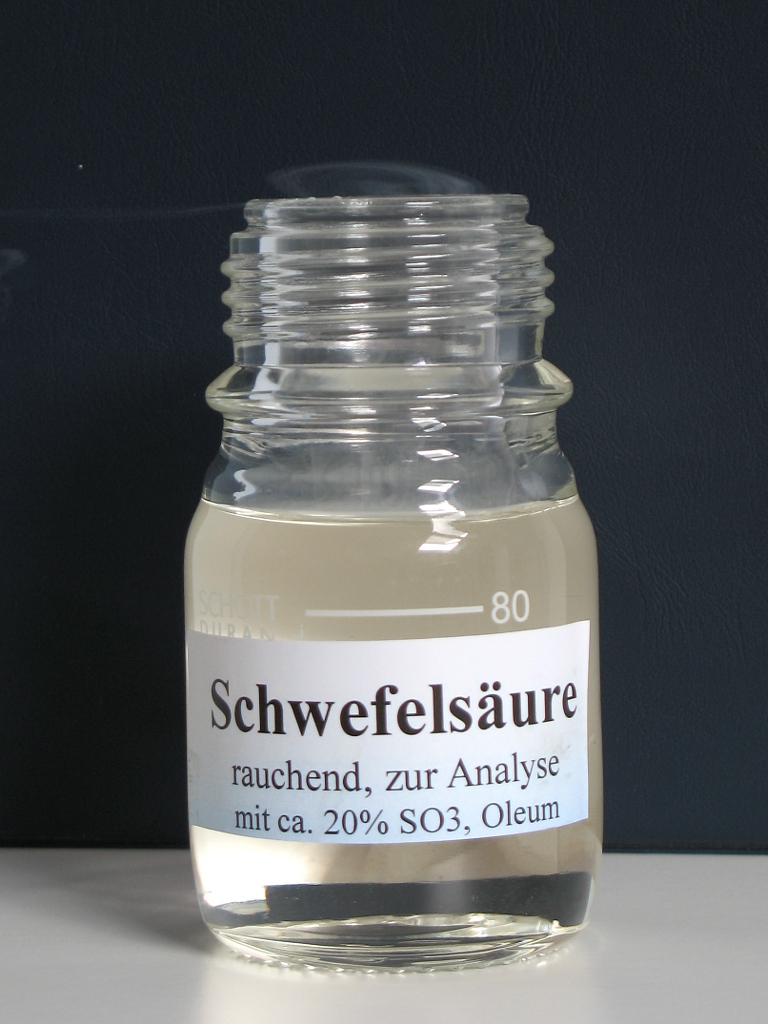
Composition and chemical character
Oleum consists of sulfuric acid (H2SO4) containing additional sulfur trioxide (SO3). Because it is a solution rather than a discrete compound, it lacks a single molecular formula and is commonly specified by the free SO3 content or by an equivalent formula such as H2S2O7 (pyrosulfuric acid) for certain compositions. The dissolved SO3 may exist as molecular SO3, coordinated complexes, or polymeric oxides, depending on concentration and temperature.
Production and role in industry
Most industrial oleum is produced during the contact process for sulfuric acid: SO2 is oxidized to SO3, which is then absorbed into existing sulfuric acid to form oleum. This intermediate allows manufacturers to produce very concentrated sulfuric acid by carefully adding water to oleum or by diluting it to meet product specifications. See processes described as a contact process and the chemistry of sulfur trioxide for background.
Properties, uses, and applications
Oleum is a dense, oily, and fuming liquid that releases sulfur trioxide vapors on exposure to air. It is a potent sulfonating and dehydrating agent widely used in organic synthesis (sulfonation of aromatics), manufacture of explosives, dyes, pharmaceuticals, and in petroleum refining for alkylation. Because it can be neutralized or diluted to provide concentrated sulfuric acid, oleum is an important intermediate in acid production. For a general distinction between mixtures and pure compounds see mixture versus compound.
Hazards and handling
Oleum is highly corrosive and reacts exothermically with water, releasing heat and toxic fumes. Contact with skin or eyes can cause severe burns, and inhalation of vapors can damage the respiratory tract. Industrial handling requires specialized equipment, corrosion-resistant materials, fume control, and strict safety procedures to prevent accidental dilution or exposure.
Notable distinctions
- Oleum is a prepared solution of SO3 in H2SO4 rather than a single chemical compound.
- It should be handled differently than ordinary concentrated sulfuric acid because of the presence of free SO3 and its stronger fuming and sulfonating behavior.
- Its concentration is usually expressed by the percent free SO3 or by an equivalent composition such as H2S2O7 for specific formulations.
Further reading on related topics is available via introductory resources on sulfur trioxide, the contact process, and general chemical safety references (mixture, compound).
Related articles
Author
AlegsaOnline.com Oleum (fuming sulfuric acid) Leandro Alegsa
URL: https://en.alegsaonline.com/art/72361